
How Do You Earn Replies With B2B Cold Email Best Practices?
TLDR: B2B cold email still works when it is relevant, respectful, and results-focused. Lead with real buyer pain, prove credibility fast, and make the next step easy.
B2B cold email is not dead. It is just less forgiving. Buyers are overloaded, inbox filters are smarter, and generic templates get ignored. The teams that still win are the ones that treat cold email as a micro-conversation, not a broadcast. The best practice is simple: earn the right to continue by being useful in the first 10 seconds.
What defines B2B cold email best practices today?
B2B cold email best practices in 2025 are about precision, proof, and permission. Precision means targeting the right persona at the right moment. Proof means you show a credible reason to listen. Permission means you invite a low-friction next step instead of forcing a sale. That triad is the foundation.
A modern cold email is less about clever subject lines and more about relevance. It answers one question immediately: why you, why now, and why should I care?
How do you make relevance obvious in the first 3 lines?
Relevance is earned by specificity. Use three anchors: role, pain, and trigger.
- Role: Call out the exact function or responsibility.
- Pain: Name the problem they are paid to solve.
- Trigger: A credible reason you reached out now.
Snippet-ready answer: The fastest way to improve reply rates is to show you understand the buyer’s job before you talk about your product.
Example framing: “Noticed your team is scaling outbound in a hiring market that is tightening. Many RevOps leaders are seeing lead response times slip, which hurts pipeline coverage.”
What should the email structure look like?
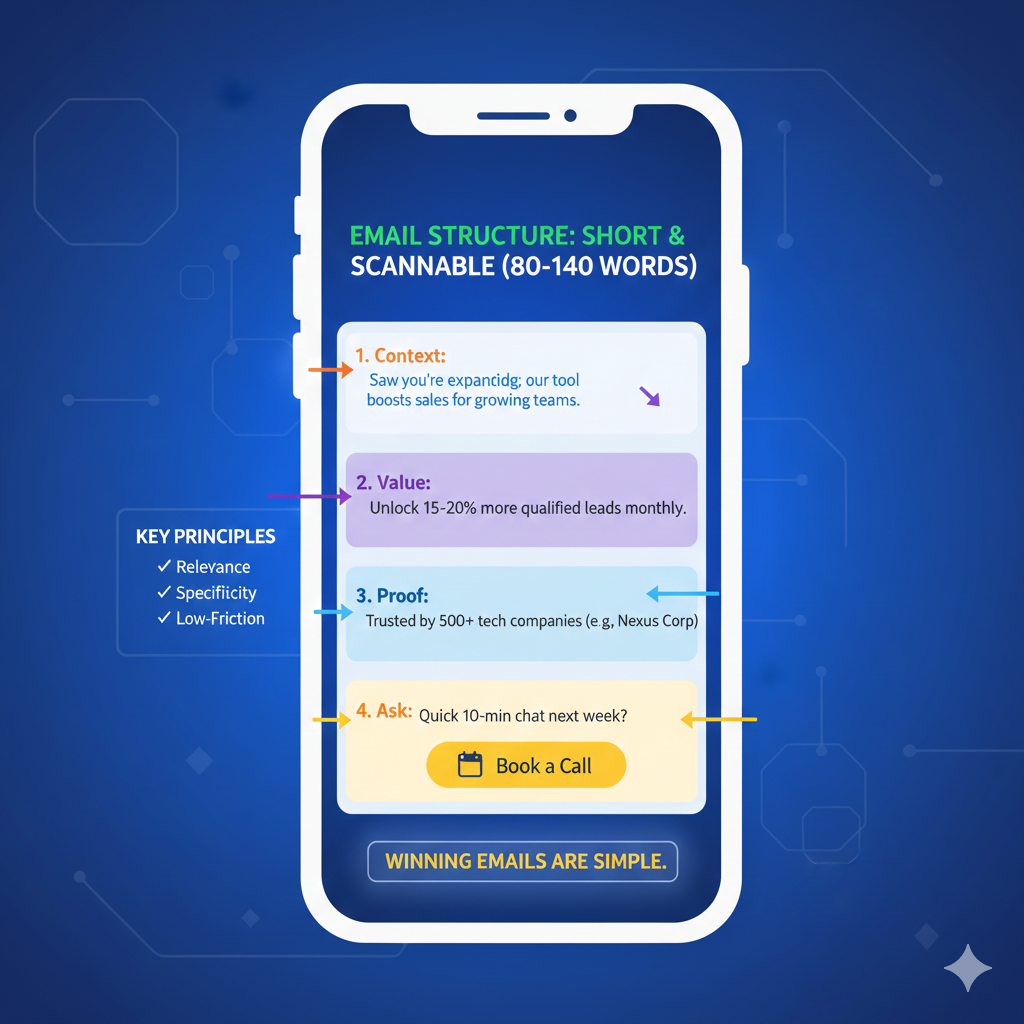
Keep it short and scannable. Most winning emails are 80 to 140 words. A simple structure works across industries:
- Context: one sentence that proves relevance.
- Value: a specific outcome you help with.
- Proof: one data point or customer reference.
- Ask: a low-friction next step.
This structure supports B2B cold email best practices because it respects time and makes the decision easy.
How do you balance personalization and scale?
Personalization does not mean writing novels. It means adding the smallest detail that changes the buyer’s sense of relevance. That can be a recent hire, a tool in their stack, or a growth initiative.
Create a short personalization menu for reps:
- Company event: funding, launch, expansion.
- Role cue: KPI changes, new leader, headcount growth.
- Industry signal: regulatory shift, market downturn, new competitor.
The goal is not to prove you know everything, but to show you did the work that most senders skip.
What proof actually builds trust?
Trust comes from concrete outcomes. Use one proof point that is believable and similar.
Good proof examples:
- “Helped a 200-person SaaS team reduce lead response time by 37%.”
- “Worked with a fintech company to cut onboarding drop-off by 22%.”
Avoid name-dropping without context. If you cannot share a logo, share the metric. If you cannot share a metric, share the approach.
How do you write the CTA to maximize replies?
The best CTAs are small and optional. Avoid pushing for a full demo in the first email. Instead, propose a short call, a quick audit, or a yes/no question.
Examples:
- “Open to a 12-minute chat next week to compare notes?”
- “Worth sharing a 3-point teardown of your current flow?”
- “Should I send a brief outline on how teams like yours are fixing this?”
This style gives the buyer control and keeps the barrier low.
How should you handle follow-ups without burning trust?
Follow-ups should add new value, not pressure. A healthy sequence is 4 to 6 touches across 2 to 3 weeks. Each follow-up should introduce a new insight, case data, or a reframed problem.
Suggested cadence:
- Day 1: initial email.
- Day 3: add a relevant insight or example.
- Day 7: share a short asset or framework.
- Day 12: ask a smaller yes/no question.
- Day 18: close the loop politely.
When you close the loop, be gracious. People remember that tone.
What are the biggest mistakes to avoid?
- Overwriting with too much context.
- Leading with your company instead of their problem.
- Using vague promises like “increase revenue” without proof.
- Asking for a demo too early.
- Sending sequences that feel identical.
These mistakes are common because they are easy. The best teams choose the harder path: research, clarity, and restraint.
How do you measure success beyond open rates?
Open rates are noisy and less reliable. Focus on:
- Reply rate by persona and industry.
- Positive reply rate and conversion to next step.
- Time to first response.
- Sequence contribution to pipeline.
This gives you feedback that actually improves your system.
B2B cold email best practices
Is cold email still effective for B2B? Yes, when targeting is tight and the message is relevant. Broad lists and generic copy are what fail.
How long should a cold email be? Aim for 80 to 140 words. Long emails can work if they are highly relevant, but most are not.
How many follow-ups are too many? Five total touches is often a healthy ceiling. Stop sooner if replies trend negative.
Should I include links in the first email? Use links sparingly. They can reduce deliverability and distract from the ask.
The bottom line
Cold email is a trust exercise. The best B2B cold email practices are not hacks, they are habits: research, specificity, proof, and respect. If you commit to those habits, you will earn more replies and build a stronger brand in the process.