




- AI content optimization tools multiply output, not quality. The stack is not the system.
- The teams that win wire every tool to a loop: source, knowledge, generation, evaluation, distribution, measurement.
- Most stacks break at evaluation, the one layer that produces a decision instead of new content.
- Build the loop first, then buy only the layers you genuinely cannot build.
The pitch for nearly every AI content tool is the same: write faster, rank higher, do more with less. So teams buy one, then another, then a scheduler, a grader, a rewrite engine, until the stack is bigger than the team. Output climbs. Results do not.
That gap is not a tooling failure. It is a systems failure. Tools optimize slices. Nobody owns the loop that connects the slices, so every gain in one place leaks out somewhere else. You can buy every machine in the gym and still not get fit, because the machines were never the program.
This is a practical map. Which AI content optimization tools are actually worth wiring in, which layer each one belongs to, where most stacks quietly break, and what to build yourself before you spend another dollar.
The Tools Are Not the System
Walk through a typical content stack and count the tools. A research tool. An AI writer. A grammar checker. A plagiarism scanner. A scheduler. An analytics dashboard. Each was bought to fix a specific pain, and each probably did. The problem is that no two of them share the same definition of good.
The writer is tuned to sound fluent. The grammar checker is tuned to sound correct. The analytics dashboard is tuned to a metric from last quarter. Nobody in the stack is tuned to the thing that actually matters: does this piece answer a real question well enough that a buyer, or an answer engine, will cite it.
When tools disagree about the goal, the loudest metric wins. Usually that is volume, because volume is the easiest thing to count. So the stack optimizes for more, and the team mistakes motion for progress. That is the 48-point gap between the two numbers above. Every tool worked. The system did not exist.
The Loop Every Tool Has to Plug Into
Content engineering is the discipline of treating content like a system. That system has six layers, and each one has a job. A tool is only useful when it attaches to a layer, feeds the next one, and can be measured. Here is the loop, and the kind of tool that covers each layer. This is the same structure behind the content engineering role.
Read that table as a checklist, not a shopping list. If a tool cannot name its layer, it is decoration. If a layer has no tool and no owner, that is where your content will quietly fail.
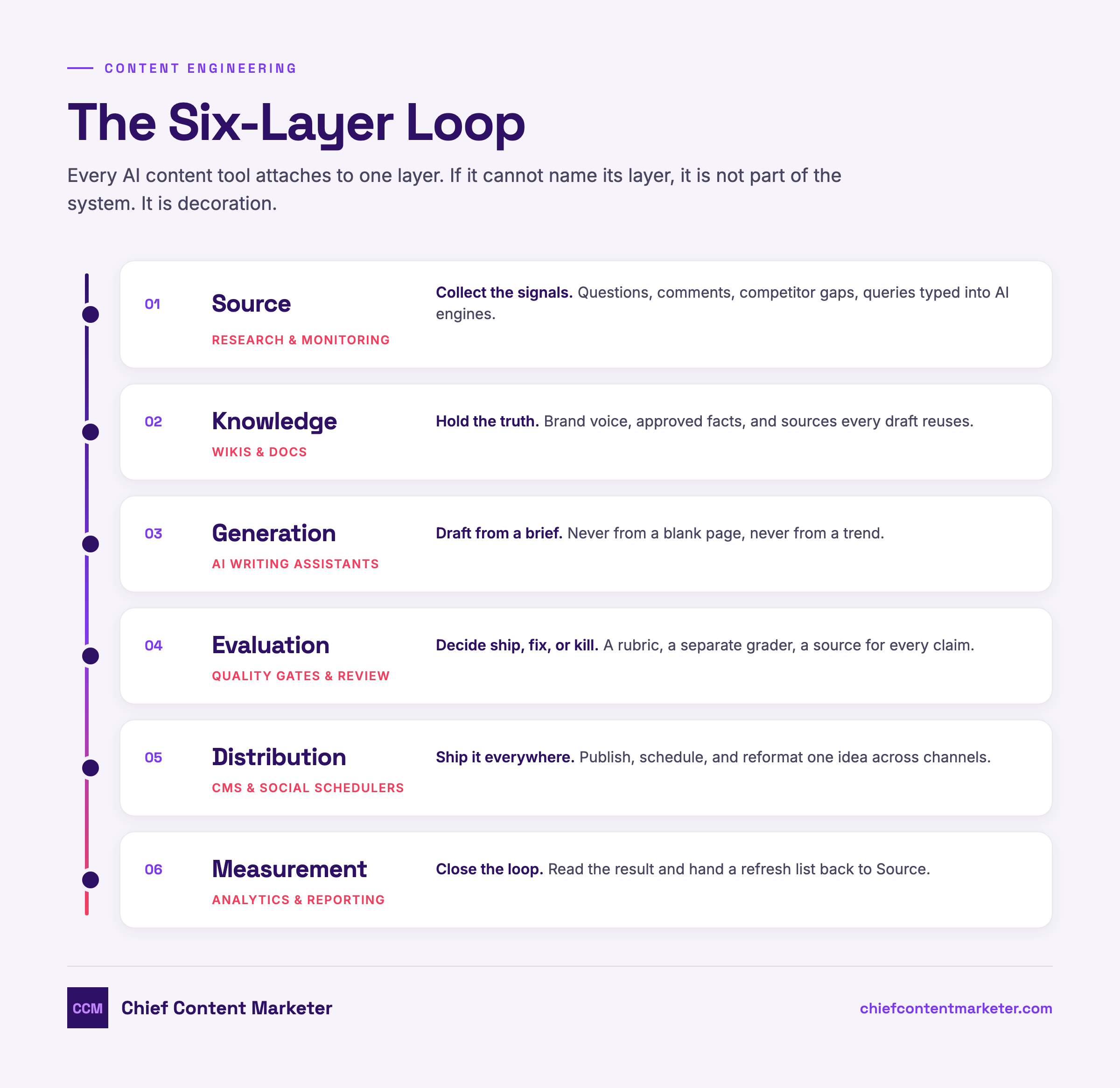
Tools by Layer, Not Tools by Trend
Most teams need two or three of these layers filled, not six. The mistake is buying the layer that is trendy instead of the layer that is missing. Here is where the money is actually worth spending, and where a plain spreadsheet will do the job.
Notice what is missing from that list: a tool for the evaluation layer. That is deliberate, and it is the next section.

You are a strict content editor, not a co-author.
Score this draft 1-5 on each axis. Be harsh.
1. Real question: does it answer a specific question a buyer asked?
2. Sourced claim: is every factual claim linked to a primary source?
3. Differentiation: does it say something the top results do not?
4. Brand fit: does it match the voice guide word for word?
5. Next step: does it end with one clear action for the reader?

If any axis scores below 4, return the specific fix, not praise.
If any claim has no source, mark the draft DO NOT PUBLISH.
The Evaluation Layer Is Where Stacks Break
Ask a model to write a post, then ask the same model to grade it, and you get a compliment. Models are agreeable by training. A generator grading its own output is a feedback loop with no outside view, and it will tell you the draft is strong right up to the moment a reader bounces.
Evaluation is the layer teams skip because it is the only layer that produces no new content. It produces a decision: ship, fix, or kill. That decision is where the money is saved. Every weak draft you catch before it publishes is a week you did not spend promoting something that was never going to work. The mechanics of a real gate are the same ones behind an AI content quality control pipeline.
How to Tell the Loop Is Working
A wired loop shows up in how you measure yourself, not in how many tools you own. The difference between a tool-first stack and a loop-first stack is visible before you spend a dollar.
| What you measure | Tool-first stack | Loop-first stack |
|---|---|---|
| Primary metric | Posts shipped | Questions answered |
| Who owns quality | The writer | The evaluation layer |
| First draft source | A blank page | A sourced brief |
| Failure caught at | The reader bounce | The evaluation gate |
| Does it compound | No, volume resets | Yes, the refresh list shrinks |
This Is the Loop Our Six Agents Run
A wired loop is not a diagram. It is a team, and increasingly that team is agents. This is exactly the loop running on this site. Marlow sources the signals. Vera holds the brand and the approved facts. August drafts from the brief. Ellis gates the draft against the rubric. Cleo ships it across channels. Dean reads the result and hands a refresh list back to Marlow.
Each agent owns one layer, and each one hands the next a clean input. You can see the full loop at THE SIX. It works because no single tool is doing everything. The tools are wired, and the loop is the product.
Build the Loop, Then Buy the Tools
Draw the six layers on a whiteboard and name what each one has to hand the next. Then buy only the layers you genuinely cannot build, and hold every tool to one test: can you point to the layer it serves and the number it moves.
A tool that cannot answer both is decoration. A stack that can is a system, and systems compound. The teams getting real value from AI content are not the ones with the most tools. They are the ones whose tools all point at the same loop.