
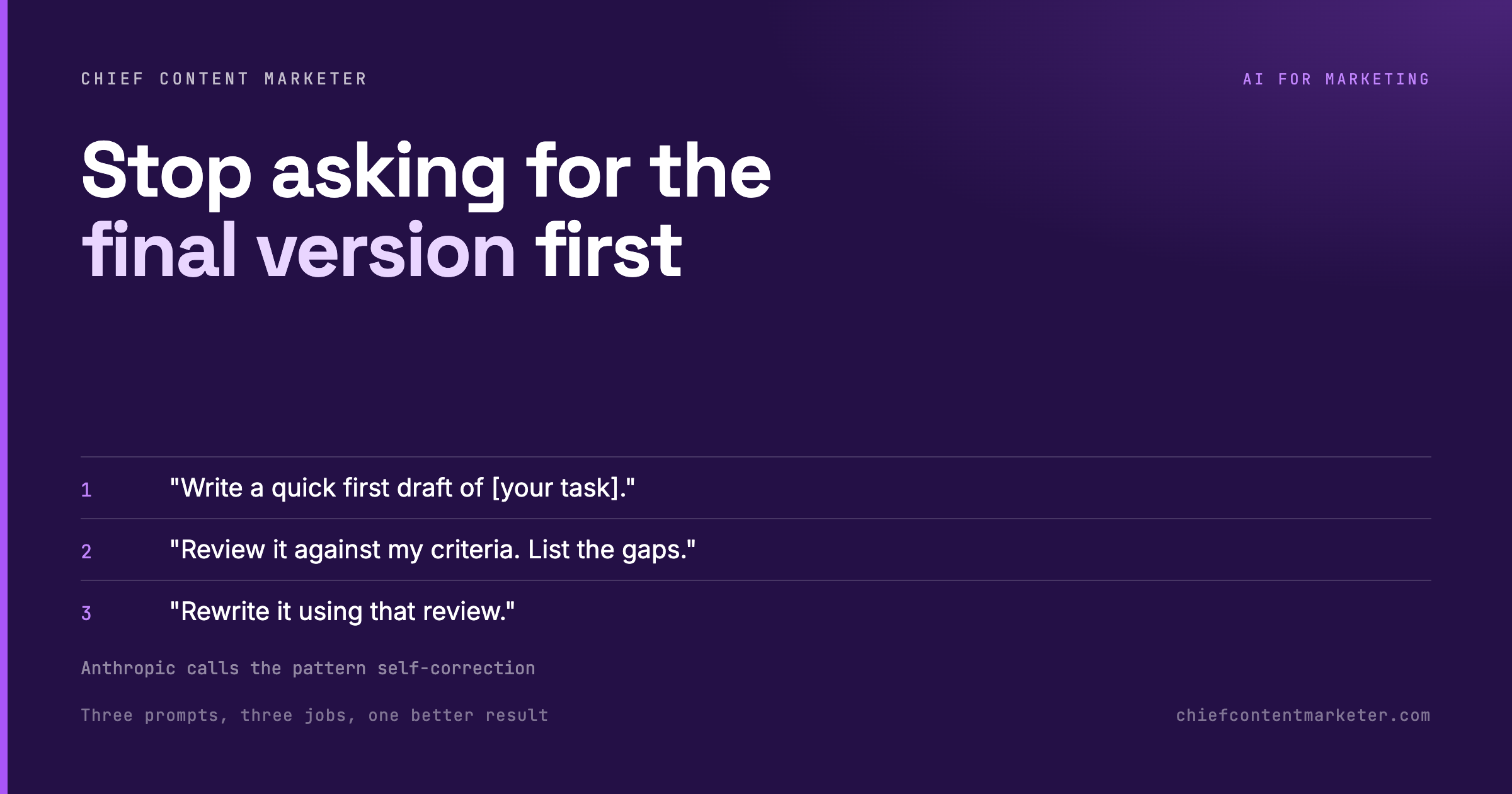




There is a small prompting shift that produces noticeably better writing from Claude, and it has been making the rounds on TikTok, credit to Jeremy Wallace at @jeremywallace.pro. It takes no special settings and works in any normal chat. You stop asking for the final version first, and split the job into three prompts: a draft, a review, then a rewrite.
Why Asking for the Final Version First Fails
Most people open Claude and ask for the finished thing in one shot. Write a blog post about X. Draft a cover letter. Write an email to my landlord about the broken heater. Then they paste the result, and something is always a little off. The email has no date. It runs long. The actual ask is buried three paragraphs down. You end up editing more than the AI wrote.
The reason is structural. When you ask for the final version first, you are asking Claude to do three jobs at once: generate good content, guess your standards, and nail every detail on the first pass. It cannot read your mind about “under 120 words” or “one clear ask plus a date,” so it defaults to generic. You did not get a bad writer. You got a writer with no brief.
Notice the pattern. One prompt is doing three jobs at once, and the job you care about most, matching your standards, is the one Claude is worst at when it is left implicit. Stating criteria up front helps, but a single pass still has no checkpoint where you can catch a miss before it ships.
Draft, Review, Rewrite: The Three-Prompt Sequence
The fix is three prompts instead of one. Each prompt gives Claude a single job, with your standards stated explicitly instead of left for it to guess.
Visibility Is the Point
The real payoff is not a marginally better sentence. It is that you can see every step. With a one-shot ask, Claude does all its reasoning internally and hands you a verdict; if it is wrong, you start over. With the three-step flow, you can interrupt anywhere. The draft says the heater broke on Tuesday, and you know it was Monday, so you say: “Actually, it broke on Monday. Put that in.” You are steering, not requesting.
The video quotes a second line from Anthropic’s prompting guide: Claude handles most multistep reasoning internally. That is true for simple tasks, which is exactly why you should not over-engineer a quick lookup. But for writing that matters, dragging the reasoning out into the open, one visible step at a time, is what lets you steer it.
Three Prompts, Three Jobs, One Better Result
Next time you sit down to write something important, resist the urge to ask for the final version. Ask for a draft, then a review, then a rewrite. It works in any normal Claude chat, needs no settings, and turns the tool from a one-shot generator into a collaborator you can actually steer.