
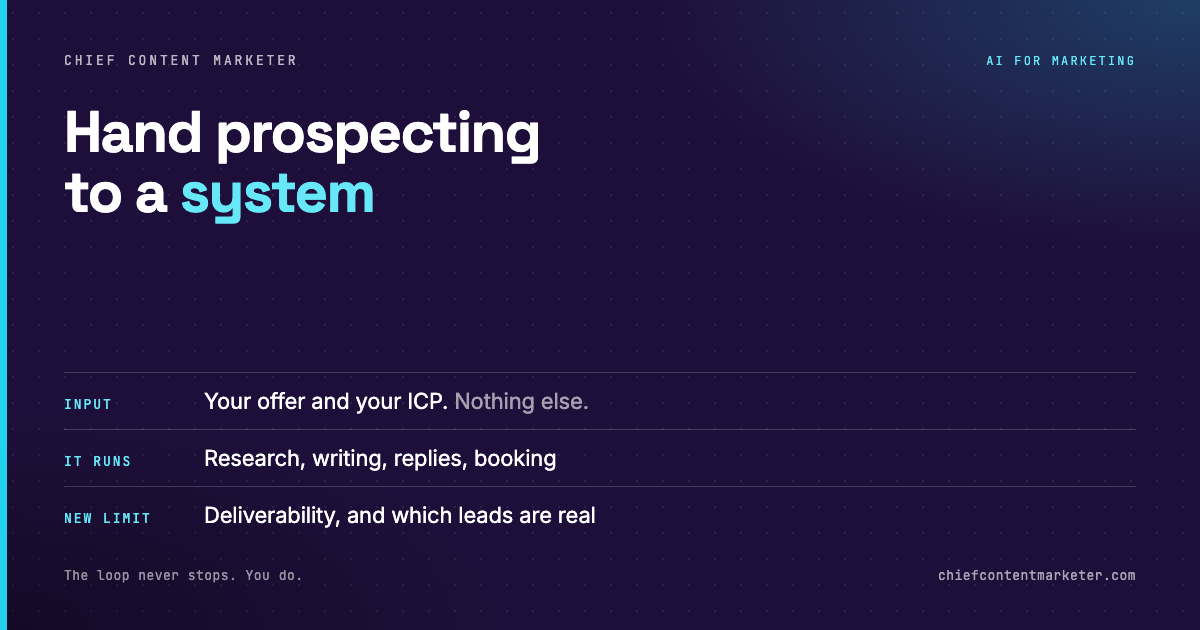




Every outbound motion has the same shape. You pick a market, you find companies in it, you figure out which ones are worth contacting, you write to them, and then you follow up when they reply. The work is not hard. There is just an enormous amount of it, and it all competes with the rest of your job.
That is exactly the profile of work that should not be manual anymore. Not because a model writes better emails than you, but because the loop never stops and you do.
Here is what actually changes when you hand the loop to a system, and equally important, what does not.
Two sentences in, a pipeline out
The entire configuration is your offer and your ideal customer profile. That sounds too simple until you realize how much it forces you to decide up front.
An offer that is vague produces outreach that is vague, and the agent will happily generate a thousand vague emails. The system does not rescue a fuzzy positioning problem. It amplifies whatever clarity you bring to it, in both directions.
This is the first real benefit and the one nobody talks about: writing the offer and ICP down precisely enough for an agent to act on is itself the strategic work most teams skip. You cannot hand over a definition you have never written.
Research first, contact second
The valuable part of automated prospecting is not the sending. It is the filtering that happens before anything is sent.
A system that researches each lead can tell you which ones are worth your time before you spend a minute on them. That ranking is the difference between a list of a thousand and a shortlist of forty that are actually in-market.
This is also where the personalization gets real. An email that references something specific about a business is not a mail merge with a first name in it. It requires having looked, and looking is the expensive part when a human does it at scale.
The job does not end when the email is sent
Most outreach tools stop at delivery. The email goes out, the reply comes back, and everything after that is back on your calendar. That handoff is where most outbound dies, because replies arrive at inconvenient times and sit untouched for two days.

A full loop handles the back half: reading replies, sorting the interested from the polite no, following up with the ones that went quiet, and moving people toward a booked call. That work is unglamorous, constant, and the single highest-leverage thing you can remove from a human’s day.
A live dashboard matters less for the numbers and more for the trust. You need to see what the system is doing well enough to know when it has gone wrong, and you need that visibility without opening six tabs.
Find companies that match the profile. This is a volume job, and volume is cheap.
Score each one. This is the step that decides whether the whole system helps or hurts you.
Write each email around something specific and true. Specific beats clever every time.
Sort responses and follow up. Speed here is worth more than polish in the first email.
Convert interest into a slot. Every manual step between yes and calendar loses people.
Automated outreach has a failure mode that is worse than doing nothing: it can damage your domain reputation faster than you can react. Before you point an agent at a prospect list, you need sending limits, a warmed domain that is separate from your main one, suppression lists, and a human reviewing output before volume scales. Deliverability and compliance are not features the agent handles for you. They are the controls you put around it. Run it at low volume with review on for two weeks before you let it go unattended.
Your time moves from execution to judgment
When the loop runs itself, your job is no longer sending emails. It is deciding which leads the ranking got wrong, which messages sound like you, and whether the pipeline the system reports matches the pipeline that is real.
That is a better job. It is also a job that requires you to look at the output, which is exactly what most teams skip once automation is on.
Start with one market and one offer. Run the loop beside your manual process for a month, not instead of it. Compare the meetings booked. If the system wins, expand it. If it does not, you will know in thirty days instead of after you have burned a domain.