




If you’ve sat through a budget review in the last eighteen months, you know the sequence. The CFO scans the content line item and asks what the company gets for it. You talk engagement, brand lift, and pipeline influence. They nod, write something down, and cut the number anyway.
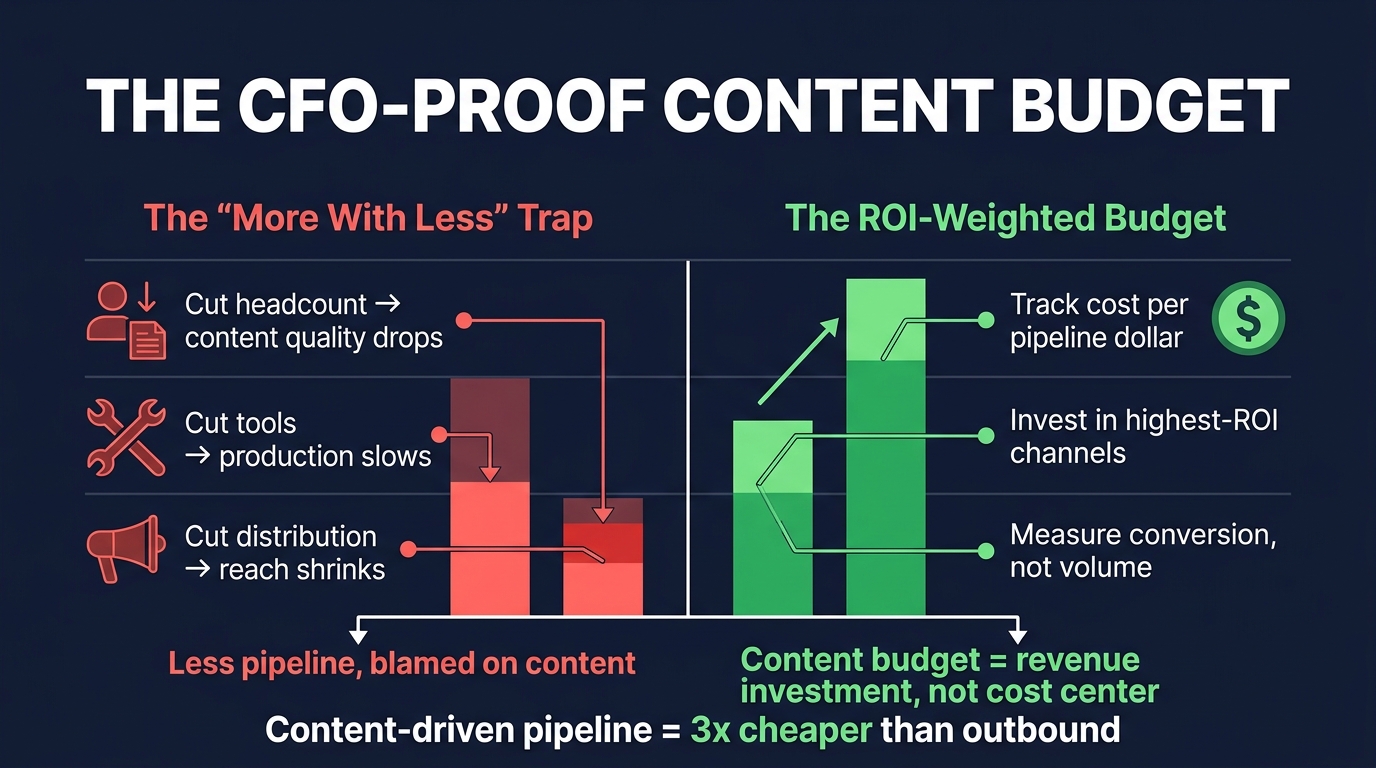
The “more with less” mantra that swept through boardrooms was never a productivity challenge. It was a narrative failure. Marketing leaders reported marketing metrics while finance leaders asked finance questions.
That’s the gap where content budgets die. Here’s the model a CFO will evaluate, plus the math behind each number.
What a CFO-Ready Content Budget Is
A CFO-ready content budget is a spending plan that states the return, the payback period, and the downside risk for each group of content assets. It replaces activity counts with the three tests finance applies to any capital request. Spend breaks out by asset, not by channel, and every asset carries a projected return and a maintenance cost.
Most content leaders walk in with the wrong unit of analysis. They defend a department while the CFO evaluates a portfolio. A department’s a cost. A portfolio is an investment with positions, returns, and rebalancing decisions. Change the unit and the meeting changes. You’ll stop asking for money to make content and start asking for capital to expand what already returns more than it costs.
The Budget Reality: Flat Spend, Higher Scrutiny
Start with the numbers that frame every content budget conversation right now.
Sources: Gartner 2025 CMO Spend Survey; Gartner 2024 CMO Spend Survey; Content Marketing Institute statistics.
Marketing budgets have flatlined at 7.7% of company revenue, according to Gartner. That’s the same share as 2024 and well below the 9.1% reported in 2023. Growth isn’t coming from a bigger pie.
Meanwhile 89% of marketers now use generative AI tools, per CMI. Production capacity is no longer the constraint. Judgment, distribution, and proof of return are. And 74% say content still helps them generate demand and leads.
The asset works. The return stays invisible to whoever holds the checkbook.

Why “More With Less” Loses the Budget Meeting
The problem with “do more with less” isn’t that it’s wrong. It accepts a losing premise. Agreeing to produce more with fewer resources is agreeing that content is a cost to be minimized.
CFOs evaluate in three dimensions: revenue impact, risk, and capital efficiency. A content leader who answers with page views and engagement gets measured on a different scale. That’s not rejection, it’s a units problem. The fix is different data, framed in the units finance already uses.
The Three Metrics CFOs Actually Ask For
Stop reporting marketing KPIs and start reporting business outcomes. These three metrics change the conversation, because each one answers a question a CFO already asks about every investment.
1. Pipeline dollars influenced per content dollar spent. Add every open opportunity where a content asset touched the buyer, multiply by average deal size, and divide by total content cost. A conservative estimate beats no estimate.
2. Content payback period. A paid ad stops delivering when you stop paying. Strategic content keeps working. Payback is the month where cumulative pipeline contribution passes production cost. Track it per asset, then report the median.
3. Content portfolio decay rate. Pages lose position as competitors publish and search behavior shifts. Track the share of assets that dropped more than five positions in a quarter, then multiply by rebuild cost. Finance already understands liabilities.
Bring all four numbers to the meeting, plus the assumption sheet behind them. Volunteering the assumptions is what makes the rest credible.
| Number to Bring | Formula | Data Source | What Good Looks Like |
|---|---|---|---|
| Pipeline per content dollar | Influenced pipeline / total content cost | CRM opportunities with content touch | Above your paid channel multiple |
| Payback period | Months until cumulative influenced pipeline exceeds cost | Content calendar plus CRM close dates | Under 12 months for mid-market |
| Portfolio decay rate | Assets down 5+ positions / total assets | Search Console 90-day comparison | Under 15% per quarter |
| Maintenance ratio | Refresh spend / new production spend | Content ops budget lines | 20% to 30% |
Those ranges are planning defaults, not survey results. Set yours from your first two quarters, then hold them steady so the trend means something.
How to Build the Model in Five Steps
The model takes about two weeks to build for a mid-size content program. Work in this order.
-
1Inventory the assets you already fundList every live asset with its production cost, publish date, and traffic trend. Most teams discover 20% of assets carry most of the demand. That list is your portfolio.
-
2Attach CRM opportunities to assetsPull every closed and open opportunity from the last four quarters. Tag which assets touched each one, using campaign association plus rep confirmation. Directional beats precise.
-
3Calculate return per assetMultiply influenced opportunities by average deal size, then divide by the asset’s loaded cost. Sort the list. The top five are your proof, and the bottom third is your reallocation pool.
-
4Model the payback curvePlot cumulative influenced pipeline against cumulative cost for each top asset. Mark the crossover month. That’s the number that replaces a slide of engagement metrics.
-
5Build the ask as an allocationRequest capital in three buckets: expand proven assets, maintain the mid-tier, and retire the bottom. Every new dollar names the asset it funds.
If your attribution data’s thin, fix that first. No narrative survives a CFO who asks where the numbers came from and gets a shrug. Our guide to what to measure instead of last-touch attribution covers the defensible middle ground.
The 90-Day Narrative: From Marketing Metrics to Finance Language
You don’t need a full portfolio model to start. You need one asset with a defensible story, presented in a finance review rather than a marketing standup.
-
1Month 1: Instrument one assetChoose an asset with measurable pipeline association, such as a pillar page or research report. Add UTMs, CRM campaign association, and rep-level touch tracking. Record every dollar of production and distribution cost.
-
2Month 2: Build the attribution bridgeInterview three reps whose deals touched the asset. Document the deal, the stage where content appeared, and the value. Cross-check against CRM data. Build one sheet with cost, deals influenced, influenced pipeline, and payback.
-
3Month 3: Present in a finance reviewAsk for fifteen minutes on the finance agenda, not the marketing one. One slide, three numbers: cost, influenced pipeline, payback month. Close with the replication math across your next twelve assets.
That’s the move most teams skip. One asset proves the method. The projection across twelve turns a budget defense into a capital allocation request.
If it earns citations in AI answers, say so. Rented search real estate is a risk finance understands. Our breakdown of content that gets cited by AI answer engines shows what that defensibility looks like.
What to Say When the CFO Says Cut the Budget
Most content budgets are cut in one exchange. The CFO proposes a number, the content leader defends a principle, and the meeting ends there. Prepare for these five objections.
| What They Say | What They Are Really Asking | What You Say |
|---|---|---|
| “We need to cut 20% across marketing.” | Which spending is optional? | “Here are the six assets carrying most of the influenced pipeline. Cutting them removes $X of projected pipeline. Cutting the bottom third saves the same amount with no projected loss.” |
| “I can’t see what content produces.” | Show me the mechanism. | “Nine opportunities touched this asset last year. Three closed. Average deal size is $45K. The asset cost $15K and paid back in month seven.” |
| “Our competitors publish more than we do.” | Are we behind on volume? | “Volume isn’t the constraint. 89% of marketers use AI tools, so output is cheap. Position and citations compound, and those come from depth on pages we already own.” |
| “Why is this maintenance line growing?” | Is this a permanent cost? | “Every asset decays. Refreshing the top tier costs about a quarter of rebuilding it and protects pipeline already attributed to those pages.” |
| “Let’s revisit next quarter.” | I need a smaller test first. | “Agreed. Fund one asset this cycle and I’ll bring the payback curve to the next review. If the number doesn’t hold, I’ll recommend reallocating it myself.” |
Notice what these answers share. Each one trades a claim for a number, and each offers the CFO a way to cut spend without cutting return.
The Content Balance Sheet: Treating Content as a Capital Asset
Content is a capital asset. It produces returns and decays without maintenance. Nobody’s saying “do more with less code.” Teams invest in infrastructure, fund maintenance, and measure technical debt. A pillar page that generates pipeline for three years works the same way. Both compound and decay. The only real difference is how it’s reported on a P&L.
That convention is worth attacking directly. Present content as a portfolio of revenue-generating digital assets with a projected twelve-month return. Same dollars, different conversation.
One more prerequisite: the assets have to be good enough to compound. Our breakdown of scaling content quality without headcount covers the system that keeps output from degrading.
A Worked Example: The Payback Math on One Pillar Page
Numbers make the argument concrete. It’s an illustrative model, not a benchmark. Swap in your own deal size, win rate, and production cost.
| Line Item | Value |
|---|---|
| Production cost (research, writing, design) | $12,000 |
| Distribution cost (promotion, email, paid support) | $3,000 |
| Fully loaded cost | $15,000 |
| Opportunities influenced in 18 months | 9 |
| Average deal size | $45,000 |
| Pipeline influenced | $405,000 |
| Pipeline per content dollar | 27:1 |
| Closed deals at a 33% win rate | 3 |
| Closed revenue | $135,000 |
| Payback month | Month 7 |
| Annual refresh cost after year two | $3,600 |
Show pipeline influence and closed revenue side by side. Pipeline is bigger and easier to challenge. Closed revenue is smaller and harder to argue with. Label which is which.
Content Budget FAQ
How do you calculate content marketing ROI?
Multiply influenced opportunities by win rate and average deal size, then subtract total content cost and divide by that cost. Separately report pipeline influenced per dollar, because it doesn’t depend on deal timing.
What percentage of revenue should a content budget be?
There’s no defensible fixed ratio. Gartner puts total marketing spend at 7.7% of revenue, and content is a slice of that. Set your allocation from payback performance, not someone else’s percentage.
How do you prove content ROI when attribution is imperfect?
Use three reinforcing methods: rep interviews on specific deals, CRM campaign association, and holdout groups where you can run them. Report the range instead of a false point estimate. A CFO will accept “between $300K and $450K of influenced pipeline” and will reject a precise number nobody can reproduce.
What’s a good content payback period?
For mid-market B2B, under twelve months is strong and under eighteen is workable. Enterprise deals with long cycles should be modeled per asset, since one closed deal can cover several years of cost.
What do you do when the content budget is cut anyway?
Protect the assets that carry the pipeline and retire the rest on your own terms. Come back with a smaller plan tied to specific assets and a date, not a general argument for content. A funded proof beats an unfunded principle.
What to Do in the Next 30 Days
Pick the first move that matches your state, then work down the list.
- No asset-level cost data: inventory every live asset with production cost, publish date, and traffic trend.
- Cost data, no pipeline data: tag four quarters of opportunities against assets, starting with your top twenty deals.
- Both: calculate payback month for your five best assets and put those five rows on one slide.
- Budget already cut: build the retirement list first. Choosing what to stop rebuilds credibility fastest.
Build the loop into how the team operates, or the number won’t survive the next review. That’s the argument in Content Engineering: Build the Feedback Loop.
The “more with less” era continues. The content leaders who thrive in it won’t be the ones who learn to operate on thinner margins. They’ll be the ones who change the unit of the conversation, from a department asking for money to a portfolio manager reporting return.
That shift is the discipline finance applies to every other investment, pointed at the asset class you already own. Our content ROI measurement framework maps the full metric hierarchy from asset to portfolio.