




Your content team shipped three whitepapers, twelve blog posts, and a webinar series last quarter. Traffic is up. Downloads look healthy. But when you sit down with the sales VP, the question is always the same: “Where are the deals?”
That gap, between content that performs and content that converts, is where most demand generation strategies break down. The fix is not more content. It is smarter content delivery, triggered by real buying signals.
Gartner found that B2B buyers spend about 75% of their purchase journey on independent research before they ever engage a sales rep. If your content doesn’t meet them at the right stage with the right message, you never even enter the conversation. You spend months creating assets for people who already decided, without you.
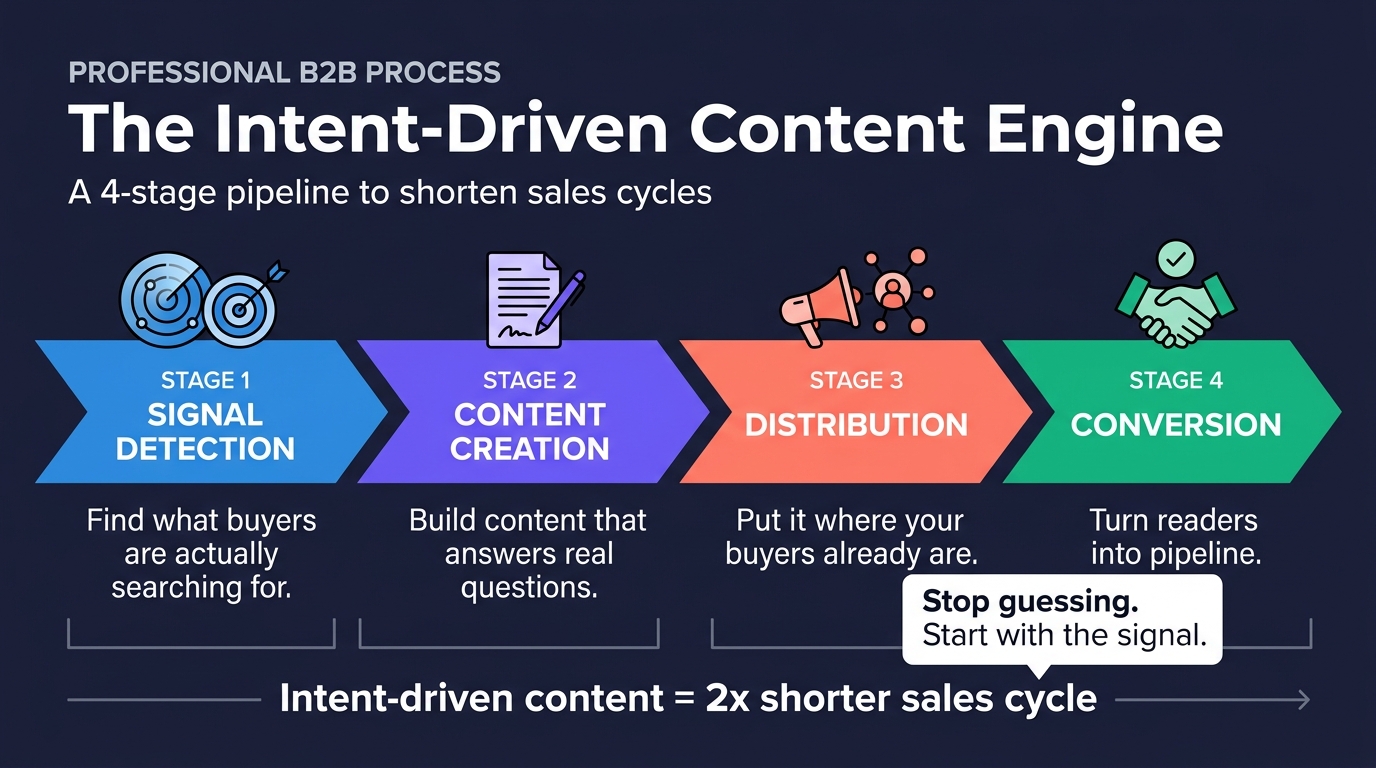
An intent-driven content engine changes the math. Instead of publishing into the void and hoping someone who matters finds it, you build a system. It detects buying signals, matches content to the buyer’s stage, and delivers it automatically. The result: shorter sales cycles, higher conversion rates, and a demand gen program that sales actually trusts.
Here’s exactly how to build one.
What Is an Intent-Driven Content Engine?
An intent-driven content engine is a closed-loop system with three components. A signal detection layer identifies accounts showing buying behavior. A content mapping layer matches signals to stage-appropriate assets. An automation layer delivers the right content at the right time without manual intervention.
It flips the standard content operating model on its head. Traditional content marketing is broadcast: publish, promote, and hope someone with budget stumbles across it. The intent-driven model is signal-response: detect, match, and deliver content to accounts that are already raising their hands, often without realizing it.
The LinkedIn B2B Institute’s “95-5 Rule” explains why this matters: 95% of B2B buyers aren’t in-market at any given time. Broadcasting to the 95% wastes budget. Delivering to the 5% who are active wins deals.
This isn’t a theory piece. By the end, you’ll have a complete blueprint. That covers the signal stack, the content-to-stage map, the trigger automation model, and the 90-day plan.
Why Intent Beats Volume
Every buyer does most of the buying before a salesperson hears from them. That single fact is the entire case for an intent-driven engine. Whoever shapes the buyer’s shortlist during that private research window usually wins. The numbers aren’t close.

Sources: Gartner, B2B Buying Journey, and 6sense, 2025 B2B Buyer Experience Report.
Read that middle number again: the buyer usually picks the winner before you get a meeting. An intent-driven engine exists to shape the shortlist while the buyer is still deciding, not to argue against a choice already made.
Build Your Intent Signal Stack
Most demand gen teams collect signals. Few have a signal stack. A signal stack is an organized, tiered taxonomy of buying signals. It tells you how active an account is, why, and what content it needs next.
Here’s the three-tier signal stack that works across B2B:
Where to get these signals:
Tier 1 and Tier 2 signals come from your own properties: website analytics (GA4 event tracking), product analytics (Heap, Amplitude, or Pendo), and your CRM. Tier 3 contextual signals come from third-party intent data providers like Bombora, 6sense, or Demandbase. You can also collect them from public sources like LinkedIn, Crunchbase, and job boards using tools such as Apollo or Clay.
Map Content to Buying Stages
Once you have signals, you need content that matches where the buyer actually is, not where you wish they were. The mistake most teams make is sending a case study to someone who doesn’t even know they have a problem yet.
Here’s the content-to-stage mapping that aligns to your signal tiers:
| Buying Stage | Signal Tier | Content Type | Example Asset |
|---|---|---|---|
| Problem Awareness | Tier 3 (Contextual) | Thought leader pieces, trend analysis | “The Cost of Not Automating Your Demand Gen” |
| Solution Exploration | Tier 2 (Behavioral) | Frameworks, playbooks, how-to guides | “The Signal-Driven GTM Playbook” |
| Vendor Evaluation | Tier 2 (Behavioral) | Comparison guides, ROI calculators, case studies | “How [Similar Company] Cut Sales Cycle by 40%” |
| Decision | Tier 1 (Explicit) | Demos, trials, pricing, analyst reports | “Executive Buyer’s Guide + Demo” |
Each signal tier maps to a specific content delivery path. When an account moves from Tier 3 to Tier 2, the content should shift from problem-awareness to solution-exploration. The system detects progression, not just presence.
Build the Trigger and Delivery System
Signals without triggers are just noise. The engine needs automation that detects a signal, selects the right content, and delivers it, without a human in the loop for every event. Here’s the architecture:
-
1Connect Your Signal SourcesPipe Tier 1 and Tier 2 signals from your analytics and CRM into a central enrichment tool. Clay, Apollo, and Make are the most common choices. Tier 3 signals from third-party providers feed into the same enrichment layer. The goal is one unified view of account activity across all sources.
-
2Score and Tier Every AccountApply a simple scoring model: Tier 1 = 100 points, Tier 2 = 50 points, Tier 3 = 15 points. Accounts above 100 points in a 30-day window get immediate routing to the appropriate content path. Below 50 points stays in long-term nurture. This prevents the common problem of every signal triggering a sales alert.
-
3Build Content Delivery Paths Per TierCreate three distinct content paths. Tier 1 path: direct sales handoff with a custom content package within 24 hours. Tier 2 path: a mid-funnel nurture sequence featuring framework, comparison, and case study content over 7 to 10 days. Tier 3 path: newsletter subscription and periodic thought-leader content until a stronger signal appears.
-
4Automate the RoutingUse your CRM (HubSpot workflows, Salesforce flows) or an automation platform (Make, Zapier) to route scored accounts into the correct content path. The key rule: never let a high-intent account sit in a nurture sequence designed for low-intent browsers. Build escalation logic that promotes accounts from Tier 3 to Tier 2 to Tier 1 as signals accumulate. If you’re building this from scratch, start with a team AI playbook documenting every routing rule. See our guide on what content attribution actually measures to make sure your intent data aligns with real pipeline outcomes.
Measure What Actually Matters
Most content measurement frameworks are vanity metrics with a dashboard. For an intent-driven engine, you need to measure the signal itself, alongside what happens after you publish. Track these four numbers:
Signal-to-Content Match Rate measures whether the right content reaches the right account at the right stage. If an account triggers Tier 2 signals but keeps getting Tier 1 content (demos and pricing), your match rate is broken and you’re burning trust. Attribution models lie about where deals actually come from, so a match rate metric tells you what is actually working.
Stage Progression Velocity tracks how fast accounts move from Tier 3 to Tier 2 to Tier 1 after receiving content. This is your leading indicator. It tells you the system is working weeks before pipeline numbers show it.
Content-to-Opportunity Rate is the conversion metric: what percentage of accounts in your intent-driven content paths convert to sales-qualified opportunities. Compare this against your generic outbound conversion rate.
Pipeline Velocity measures time from first signal to closed-won. Intent-driven programs should compress this window quarter over quarter. If velocity isn’t improving, your content delivery or signal routing has a gap. For a deeper dive on measuring what matters, see how to build a content ROI playbook that actually connects to revenue. If your team is scaling output at the same time, scaling content quality without more headcount covers the system that keeps quality steady.
The 90-Day Activation Plan
You don’t need a six-month RFP and a $100K intent data contract to start. Here’s the plan that gets an intent-driven engine running in 90 days. It maps to the same phased build we use for a 90-day demand generation engine.
-
1Days 1-30: Audit Your Existing SignalsSet up Tier 1 signal tracking in GA4 and your CRM. Most teams already have demo requests and pricing page visits tracked but are not routing them to content. Build a simple dashboard that shows which accounts triggered which signals in the last 30 days. Audit your existing content library against the four buying stages. Close the obvious gaps first.
-
2Days 31-60: Build Basic RoutingSet up CRM workflows that route Tier 1 signals to sales with a content package attached. Build a simple 3-email nurture sequence for Tier 2 signals using existing mid-funnel assets. Don’t create new content yet. You almost certainly have enough. The gap is delivery, not volume. A tight AI content brief framework keeps any new asset you do build on-message.
-
3Days 61-90: Layer in Measurement and IterateTrack the four intent metrics above. Identify where the signal-to-content match rate is lowest and fix those handoffs first. Add Tier 3 contextual signals from one source (Bombora, 6sense, or LinkedIn Sales Navigator alerts). Don’t add multiple third-party sources until the basic routing is proven. More data without working delivery just creates more noise.
Intent-Driven Content Engines: FAQ
What is an intent-driven content engine?
It’s a closed-loop system that detects buying signals from a target account, matches content to the stage that account is in, and delivers it automatically. The engine, not the editorial calendar, decides what an account sees next.
How is it different from a normal content calendar?
A calendar publishes to everyone on a schedule. An intent-driven engine delivers to specific accounts based on what they just did. The calendar still exists, but signals override it.
What signals should I start with?
Start with Tier 1 explicit signals in your own funnel: demo requests, pricing page visits, trial signups, and form submissions. They are free, high-intent, and usually already tracked. Add behavioral and third-party contextual signals only after the explicit ones are routed and working.
Do I need third-party intent data to start?
No. Most teams get their first wins from their own website and CRM signals alone. Third-party providers like Bombora and 6sense add reach later, once internal routing is proven.
How long before an intent-driven engine shows results?
Expect early routing wins in 30 to 60 days, when existing explicit signals start reaching the right accounts with the right content. Compounding pipeline impact typically shows up over two to three quarters as scoring and content mapping improve.
This is not a one-time build. It is a system that gets smarter every quarter. Each signal that converts teaches the engine what works. Each signal that fizzles teaches it what to deprioritize. Over 6 to 12 months, the engine moves from guesswork to certainty. You stop thinking an account might be interested and start knowing the stage it is at.
At that point, your sales VP stops asking “where are the deals?” and starts asking “how fast can we scale this?”