




Why the Best Content Ideas Are Already in Your CRM
There is a fundamental asymmetry in B2B content creation. The people who write the content — marketing teams — are rarely in the room with the people who consume it. They guess at what buyers care about. They produce content based on internal assumptions, keyword research, and competitor analysis. And then they wonder why it doesn’t resonate.
Meanwhile, your sales team has dozens of conversations per week with actual buyers. Your support team handles hundreds of tickets describing real problems. Your customer success team runs onboarding calls where new customers articulate exactly why they bought and what they were struggling with before. Every one of these interactions is a content brief waiting to be written.
The gap is systematic. Sales, support, and success teams generate insight. Marketing teams need content. But there is no pipeline connecting the two. Building that pipeline — a system for capturing customer conversations and structuring them into content — is the highest-impact investment most content teams can make. And it costs almost nothing except process discipline.
As we covered in why content isn’t driving pipeline, the disconnect between content and sales is the single biggest gap in B2B marketing. Customer-driven content bridges it directly.
Three Channels, One Process
A scalable customer conversation engine needs exactly three input channels. You don’t need more. You just need to make these three work reliably.
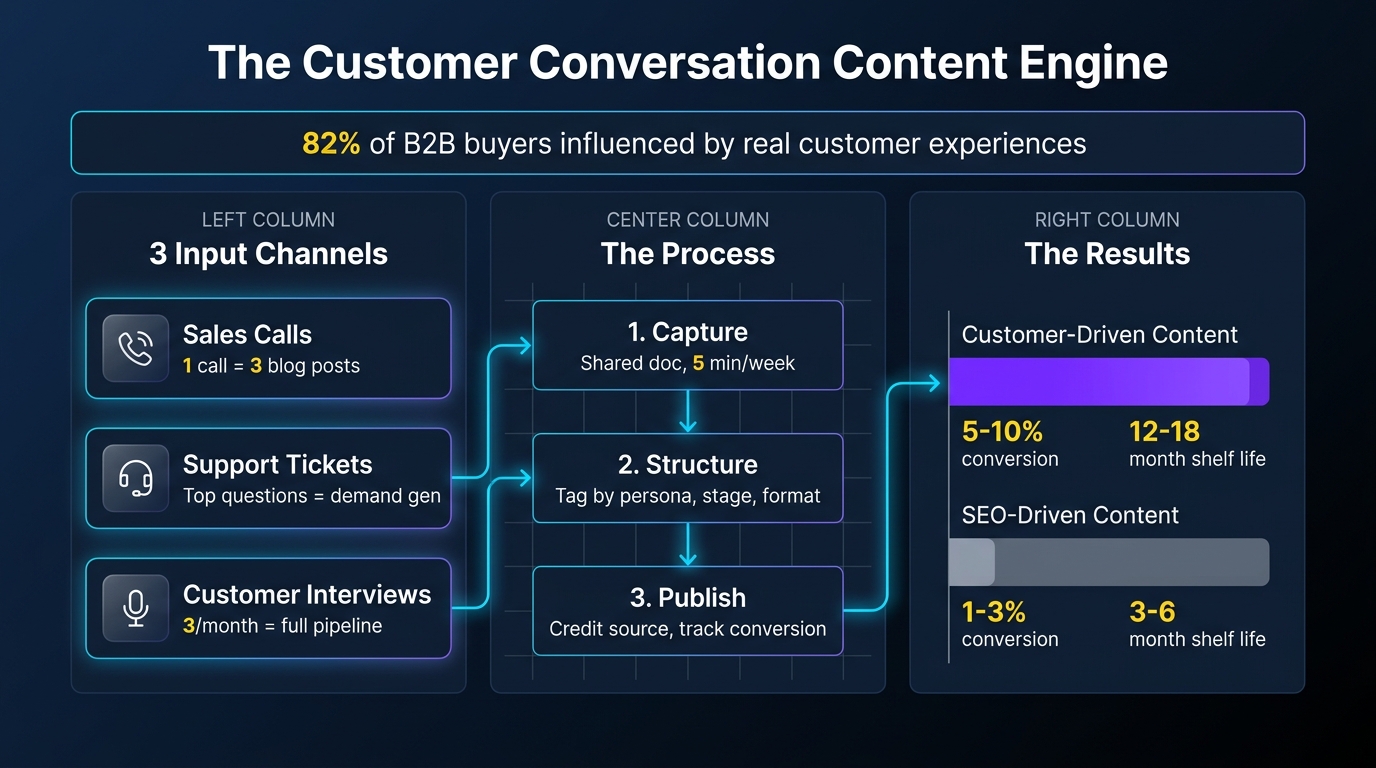
Sales calls. The highest-signal content source in any B2B company. A prospect asks a question that surprises the sales rep. The rep shares a framework that closes a deal. A competitor comes up and the rep explains how the differentiation actually works. Every one of these moments is content. The system: record calls (with consent), have a process for flagging good moments, and assign someone to extract them weekly. One 30-minute sales call can yield three blog posts, a LinkedIn post, and a sales enablement one-pager.
Support tickets. Your support team knows what your buyers struggle with after purchase. That struggle is the content gap your prospects are feeling right now — they just haven’t bought yet. The most-asked support questions, rephrased as pre-purchase content, are free demand generation. The system: tag tickets by theme, review the top 10 most-asked questions monthly, and write one piece of content per question per month.
Customer interviews. Nothing replaces a structured conversation with a customer who will tell you the truth. Schedule three 30-minute customer interviews per month. Ask three questions: what were you trying to solve before you found us, why did you pick us, and what surprised you. Transcribe every call. Extract one insight, one story, and one data point per interview. That is your content pipeline for the month.
The Brief-to-Post Workflow
Raw customer insight is not content. It’s raw material. The gap between “the customer said X” and a published piece that generates pipeline is a specific workflow that most teams skip because it feels slow. But skipping it creates content that has the ring of authenticity without the substance.
The workflow has three stages. First, validate the insight. Is this a one-off comment or a pattern? If only one customer said it, it’s an anecdote, not content. Wait for the pattern to confirm. Second, generalize the lesson. The customer described their specific situation. Your content needs to frame it so other buyers in similar situations recognize themselves. Third, add your data. The customer story is the hook. Your data — your benchmarks, your survey results, your internal analysis — is what makes the piece authoritative.

How to Know the Engine Is Working
Customer conversation-driven content performs differently from SEO-driven content, and you need to measure it differently. The primary metric isn’t traffic — it’s conversion. Content that comes from real customer problems naturally speaks to people who have that problem. They don’t just read it. They act on it.
Track three metrics. Conversion rate from content to demo request or trial start — this should be 2-3x higher for customer-driven content than for keyword-optimized content. Sales feedback score — ask your sales team to rate whether a piece of content helped them in a conversation. This is the only content metric that actually predicts pipeline impact. And source velocity — how long it takes to go from customer conversation to published piece. Target: one week. If it takes longer, the process is too heavy.
The signal-driven GTM model we’ve discussed before works because it connects engagement to revenue. Customer-driven content is the perfect input for that model — it creates the kind of engagement that actually signals buying intent, not just curiosity.
The One-Week Implementation Plan
You don’t need a new tool or a bigger team to start building a customer conversation engine. Here is the one-week plan. Day one: set up a shared document with three sections — sales insights, support patterns, customer stories. Share it with your teams and ask for one entry each by Friday. Day two: pick your three best customers and schedule 30-minute interviews for next week. Day three: ask your sales team for their top three objections and turn each into a headline. Day four: write one piece from the support ticket backlog. Day five: review what you captured, pick the best insight, and publish it.
One week. One piece of content that is guaranteed to resonate because it came from a real customer problem. Do this every week for a quarter and let me know how your pipeline looks.