





Most B2B content calendars are a spreadsheet of publish dates. They answer one question well: what goes out this week. They answer the harder question badly: what does this calendar do for revenue. That gap is why a team can publish every week for a year, hit every deadline, and still watch pipeline stay flat.
A better scheduling tool won’t fix this. What fixes it is a calendar built around buyer stages, sales outcomes, and what the revenue team says, not channel slots and word counts. The four statistics above come from Content Marketing Institute, CoSchedule, Semrush, and HubSpot. The numbers are real. They also hide the part that matters, which is what the calendar is for.
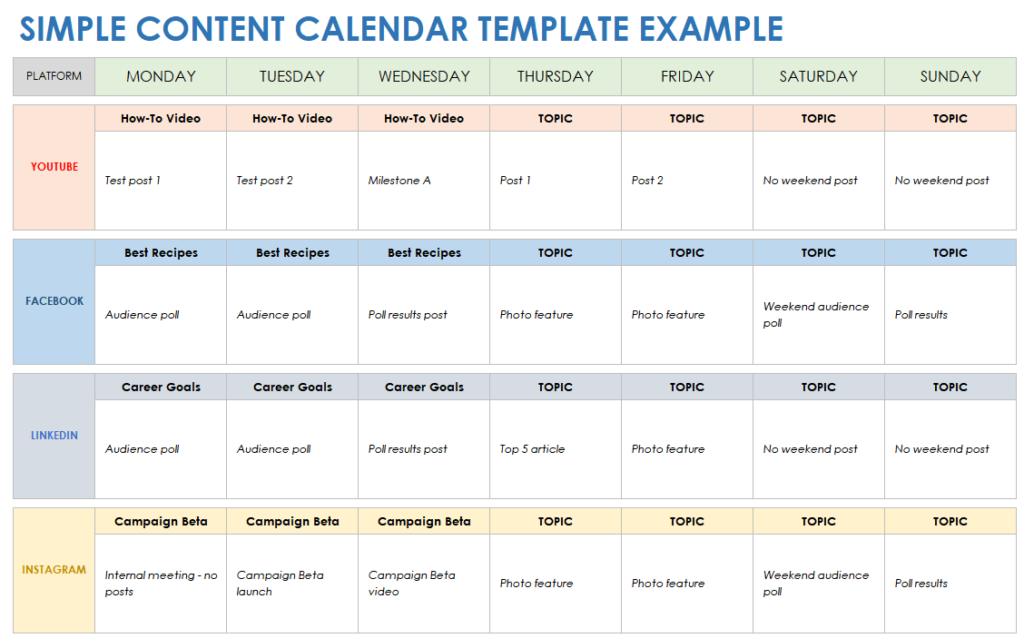
What a B2B Content Calendar Does
That’s the short definition. Hold onto it. The rest of this guide is how to build one.
Two teams can run the same tool and get opposite results. The calendar isn’t the variable. What it’s organized around is. Here’s the line between the two.
| Scheduling calendar | Pipeline calendar | |
|---|---|---|
| Organized around | Publish dates and channels | Buyer stages and sales conversations |
| Success metric | On-time publishing | Content-influenced pipeline |
| Who owns it | The content team | Content and sales, jointly |
| Failure mode | A busy calendar, a flat pipeline | A slower cadence, better-fit demand |
| First question each week | What are we publishing? | What does sales need this week? |
Everything below pushes your calendar toward the right column. Start with steps 2 and 7, the two that do the most work.
The 7 Steps to a Content Calendar That Drives Pipeline
These are the steps that move a calendar from a publishing tool to a demand engine. Run them in order the first time. After that, revisit steps 1, 2, and 7 every quarter.
-
1Define the outcome, not the cadenceStart from the revenue goal, then work backward to content. “Generate 40 qualified conversations this quarter” beats “publish 8 posts a month.” The cadence follows the goal. It isn’t the goal.
-
2Map every piece to a buyer stageTag each item with the stage it serves and the job it does. Not “awareness,” but “answers the pricing objection” or “shortens the security review.” A calendar where every row has a stage and a job is a calendar you can defend.
-
3Do keyword and query research that matches intentFind the queries your buyers type, and split them by intent. Informational queries feed the top. Comparison and objection queries feed the middle and bottom, and they convert far better. Map each target query to the stage it belongs to.
-
4Schedule production, not just publicationGive every piece a draft date, an edit date, and a publish date with a named owner. Most missed calendars fail at the draft, not the publish. Production milestones are what keep the schedule honest.
-
5Build a repurposing lane into every rowOne asset should feed many channels. Plan the derivative clips, posts, and emails at the same time you plan the original, so distribution doesn’t become an afterthought. The repurposing system is what makes a small team look large.
-
6Review it with sales every weekPut the calendar in the revenue meeting. Ask what deals are stuck and what content would unstick them. A calendar that never hears from sales is guessing at what buyers need next.
-
7Measure pipeline, then rewrite the planTrack what moved, not just what published. Kill the formats that produced nothing and double the ones that entered deals. The next quarter’s calendar should look different from this one, or you aren’t reading the data.
Why step 2 does most of the work
If you only fix one thing, fix stage mapping. A calendar tagged by stage lets you see the gaps instantly. A team with 20 awareness posts and 1 comparison page doesn’t have a content problem. It has a calendar shaped like a funnel with no bottom, and stage tags expose that in one screen. It’s also the difference between a content plan and a demand plan, which is the whole premise of the 2026 content marketing playbook.
Why step 7 is the one teams skip
Most calendars are built once and then maintained by habit. The value comes from the rewrite: reading the measurement and changing the plan on purpose. Content measurement is a philosophy problem before it’s a data problem. That’s why we wrote a whole piece on why your attribution dashboard is lying to you. The calendar is where that honesty becomes a decision.
Four Numbers That Tell You If the Calendar Works
Output metrics feel productive and prove nothing. Track these four instead, and review them monthly:
- Stage coverage: the share of buyer stages with at least 2 live assets. A healthy calendar covers the whole funnel.
- Content-influenced pipeline: opportunities where at least one asset appears in the activity timeline. Flag it, don’t over-credit it.
- Sales usage: how often reps send or reference your content. Unused content is a cost, not an asset.
- Rewrite rate: how much of next quarter’s plan changed based on results. A zero here means the data’s decorative.
If you want the sequencing template that connects these numbers to a working demand engine, the 90-day demand generation plan picks up where the calendar ends.

Content Calendar FAQ
What is a B2B content calendar?
A B2B content calendar is a forward plan that maps each piece of content to a buyer stage, an owner, and a revenue outcome, and schedules production and distribution around sales cycles. It’s a demand plan with dates, not a list of publish slots.
How far ahead should I plan?
One quarter for the themes, four weeks for the specific pieces. Quarter-level planning sets the intent, week-level planning keeps it accurate. Plan further out than that and you’re guessing at topics before you have the data to choose them.
What tool should I use?
Any tool that supports a stage tag, an owner, and a why column. A spreadsheet does the job. The tool’s rarely the bottleneck. The structure and the weekly sales review are what make a calendar work.
How many posts should I publish a week?
As many as you can produce at a quality that earns pipeline, and not one more. Cadence is an output of capability and demand, not a target. Teams that fix the number first usually get volume and no demand.
[…] step: Grab the 7-step content calendar framework and integrate your distribution map directly into your planning process. If distribution […]
[…] worth amplifying and enough budget to test it without panic. If content is one of your three, a B2B content calendar keeps the publish cadence honest before you spend a dollar on […]
[…] engineer role. See our breakdown of the 2026 content marketing playbook and our walkthrough of building a B2B content calendar that drives pipeline. If you are restructuring the function, start with the content roles you actually need in […]