




When Everyone Has the Same Superpower, Nobody Has a Superpower
In 2024, using AI to write marketing content was a competitive advantage. You could produce 3x the content at half the cost of your competitors. By 2025, it was table stakes — if you weren’t using AI, you were falling behind. In 2026, we’ve hit something qualitatively different: AI-generated content has become so ubiquitous that it’s creating a uniformity problem that actively undermines the goals content marketing was supposed to achieve.
Every B2B blog sounds the same. Every LinkedIn post follows the same structural template. Every email nurture sequence uses the same five transition phrases. The internet is drowning in content that is competent, correct, and completely forgettable.
This isn’t speculation. It’s observable. Run the same prompt through any major LLM. You’ll get structurally identical output — the same “In today’s rapidly evolving landscape” openers, the same three-point frameworks, the same “the key takeaway is” closers. The tools are converging, and the output is converging with them.
Why AI Content Triggers the Uncanny Valley of Marketing
Buyers have developed a sixth sense for machine-generated writing. It’s not that the content is wrong — it’s that it’s too smooth, too structured, too absent of the friction that signals a human mind at work. Real human writing has texture: a surprising analogy, an unpopular opinion, a specific anecdote from a real project, a moment of vulnerability. AI writing has polish without perspective.
The deeper problem is what this does to trust. Content marketing’s entire value proposition is built on trust — the idea that if you teach someone something valuable, they’ll eventually buy from you. But trust requires authenticity. When a reader suspects the content they’re consuming was generated by a machine, the implicit contract of content marketing breaks. “We’re teaching you something real” becomes “We’re generating SEO filler.”
The brands that will win in 2027 aren’t the ones with the best AI prompts. They’re the ones whose content sounds like it was written by a specific person with a specific point of view — because it was.
The Data Is Starting to Confirm What Instinct Tells Us
The early data on human-authored versus AI-generated content is telling. A 2025 analysis by Orbit Media found a stark pattern: blog posts with named human authors who include personal anecdotes generate 2.1x more time on page and 1.7x more social shares than anonymous or AI-attributed content. The topics were identical. Newsletters written by individual practitioners — Lenny’s Newsletter, Molly Graham’s essays, Adam Grant’s output — continue to grow. AI-generated newsletter templates struggle to maintain open rates above 12%.
Search engines are adapting too. Google’s Helpful Content updates increasingly reward content that demonstrates first-hand experience — EEAT signals that AI content by definition cannot satisfy. Content that references real projects, real data, real mistakes, and real outcomes is outperforming generic “ultimate guides” that could have been written by anyone, or anything. We explored how to structure this kind of high-signal content in our guide to building content that AI answer engines cite.
Human-Authored Content Is a Strategic Moat — Treat It Like One
If the thesis holds — and every signal points in this direction — then human-authored content isn’t just nice to have. It’s a defensible competitive advantage in a market where everyone else’s content is converging toward the same AI-generated mean. Building this moat requires three deliberate investments.
Invest in named authors, not branded content. The most trusted content on the internet has a face and a name attached to it. Stop publishing under your company logo. Build individual practitioner brands within your organization — your head of product, your solutions architect, your customer success lead — and give them the platform and editing support to publish under their own names. This is uncomfortable for many organizations. It’s also the single most effective content investment you can make in 2026.

Publish what AI can’t fake. Original research. Case studies with named clients and real numbers. Frameworks developed from actual project experience. Opinions that take a side. Content that cites specific conversations with specific customers on specific dates. These are the content formats where AI cannot simulate authenticity because the value is in the provenance, not the prose.
Build distribution around humans, not channels. Your most valuable distribution asset isn’t your email list or your SEO rankings — it’s the individual practitioners on your team who have built audiences on LinkedIn, Twitter, podcasts, and industry communities. When they share your content, it carries the credibility of their personal brand. Invest in helping them build those audiences. It compounds.
Yes, AI Still Has a Role. But It’s Not the Role You Think.
This isn’t an anti-AI argument. AI is genuinely useful for content marketing — just not where most teams are using it. The right role for AI is in the production layer, not the creation layer.
AI should handle: transcription, summarization, first-pass research aggregation, SEO metadata generation, content audit analysis, distribution scheduling, performance reporting. These are high-volume operational tasks where speed matters more than originality.
AI should not handle: thesis development, argument structure, voice and tone, personal anecdotes and examples, contrarian positions, frameworks derived from practitioner experience. These are the elements that make content worth reading — and they require a human mind to execute well.
The teams that get this right treat AI as a research assistant and production accelerator, not as a content author. The human owns the thinking. The AI handles the logistics.
The Three Waves of Content Differentiation (2024-2028)
Here’s how I see this playing out. We’re currently in the middle of Wave 2, and most companies haven’t realized it yet.
Wave 1 (2024-2025): The AI Productivity Wave. Early adopters used AI to produce more content faster. This was a legitimate advantage — for about 18 months. Now every competitor has the same tools, and the advantage has evaporated.
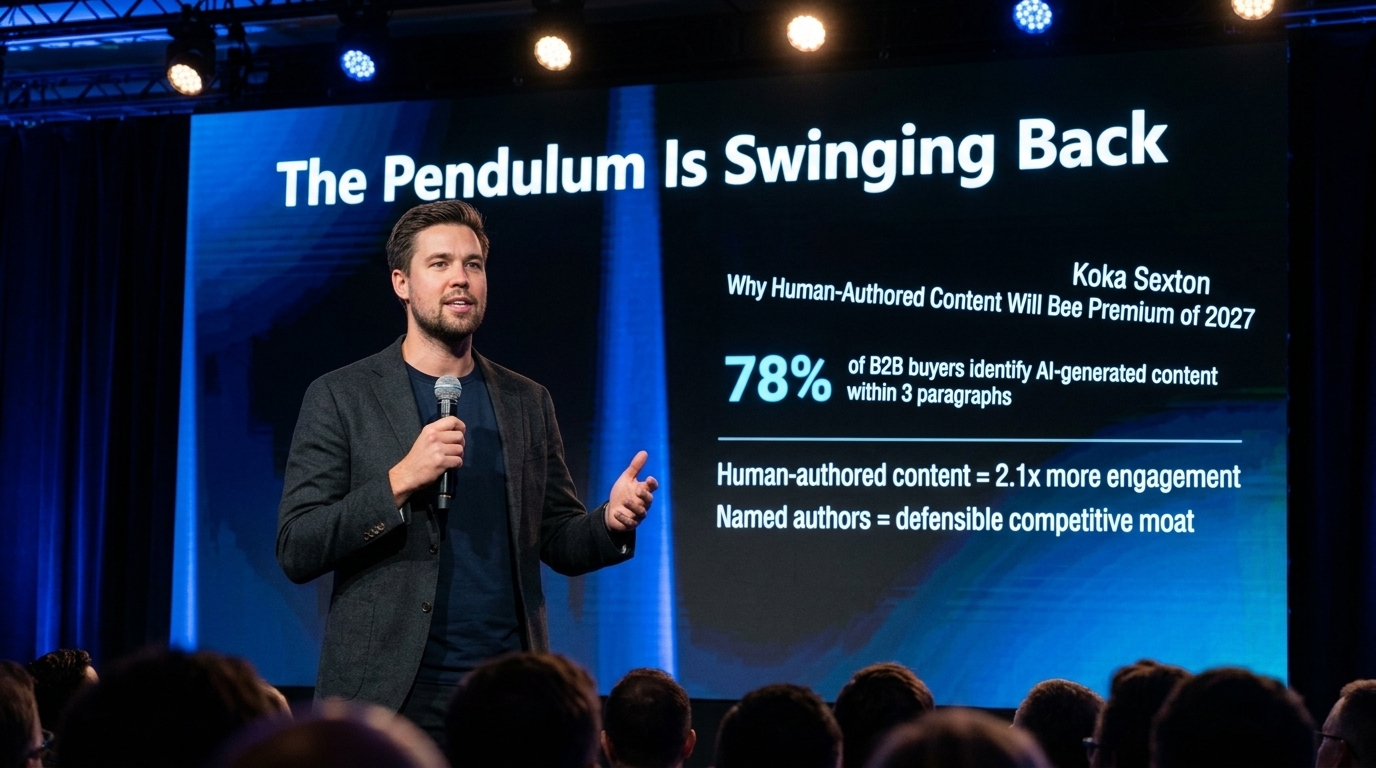
Wave 2 (2026-2027): The Authenticity Correction. Buyers develop AI fatigue. Trust in generic content plummets. Named authors, original research, personal anecdotes, and practitioner frameworks become the new moat. Companies still investing in AI-only content production find their engagement rates declining while their volume increases — the worst possible combination.
Wave 3 (2028+): The Synthesis. The market stabilizes. AI handles production and distribution; humans own strategy, thesis, and voice. The winners are the companies that built their human-author infrastructure during Wave 2, while their competitors were still optimizing AI prompts.
What to Do on Monday
If I were running a content marketing function right now, here’s what I’d change this week:
Audit your existing content for authenticity signals. For every piece of content you published in the last 90 days, ask: does this have a named author? Does it cite a real experience? Does it take a position that could be wrong? Content that answers no to all three is anonymous filler — and it’s doing more harm than good.
Redirect 30% of your content production budget from volume to depth. Instead of publishing three AI-assisted posts per week, publish one deeply researched, human-authored article that references real data, names real customers, and takes a real position. The math on engagement and conversion will justify the shift within 90 days. And if you need to build the business case, our content ROI measurement framework gives you the numbers.
Identify 2-3 practitioners in your organization and build their publishing muscle. Give them editing support, a content calendar, and distribution amplification. Their network reach plus content credibility is a combination no AI workflow can replicate.
The brands that win on content in 2027 won’t be the ones with the best AI stack. They’ll be the ones whose content sounds like it came from a person with an opinion, not a machine with a prompt.