




What Content Attribution Is
It doesn’t answer the harder question: which piece of content moved the buyer? That gap is the entire problem. Attribution is bookkeeping. Influence is behavior change. They’re related. They aren’t the same thing. Confusing them has cost more content teams their credibility with the CFO than any single bad campaign.
So before we tear the dashboard down, it helps to be precise about what we’re measuring. Content attribution usually refers to four different jobs. Blur them, and nobody trusts your number:
- Touchpoint attribution : crediting content by where it appeared in the path to conversion (first, last, or somewhere in the middle).
- Channel attribution : crediting a whole channel (organic search, LinkedIn, email) rather than a specific asset.
- Campaign attribution : crediting a coordinated set of assets and channels aimed at one objective.
- Influence attribution : crediting content for changing a buyer’s behavior, which is the number you want and the one most tools can’t produce.
Most dashboards quietly do the first two, label them the fourth, and let the third take the blame when the board asks why pipeline did not grow.
Your Attribution Dashboard Is a Fiction You Paid For
The dirty secret of B2B content attribution is that most tools measure proximity and call it influence. A buyer downloads a whitepaper, gets a nurture email three weeks later, and eventually fills out a demo request after reading a competitor comparison page. The attribution model credits the whitepaper. Or the nurture email. Or the comparison page. Or all three, depending on which model you toggle in the dashboard.
And here is what nobody says out loud: you can change the attribution model and change the story. Last-touch makes your bottom-funnel content look brilliant. First-touch makes your brand awareness team look like heroes. W-shaped makes everyone feel good and nobody accountable. The tool works fine and the data is real. The interpretation, though, is a Rorschach test for CMOs who need to justify headcount.
We Built Attribution for a Linear World That Does Not Exist
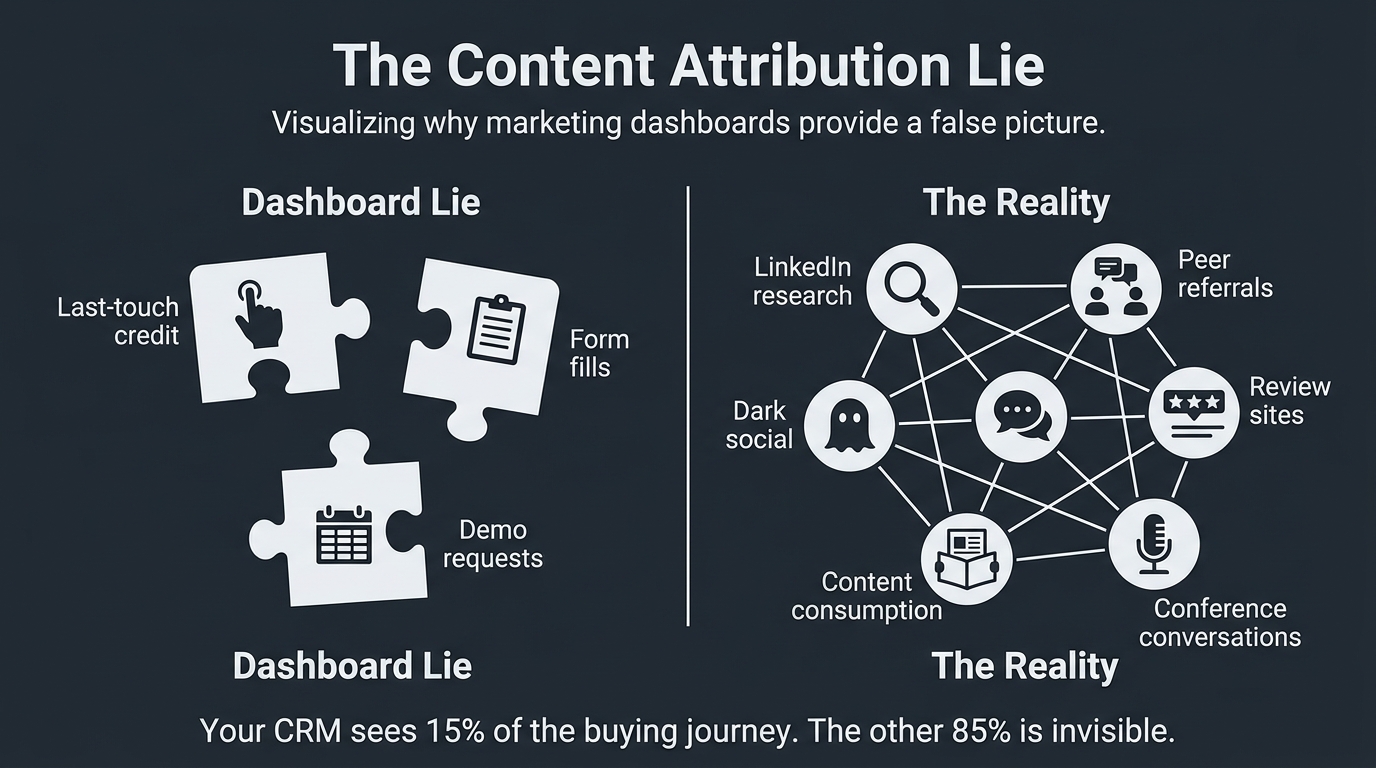
Content attribution models were built in an era when a buyer’s journey looked like a funnel. Top. Middle. Bottom. Touchpoint, touchpoint, touchpoint, purchase. That world is gone. The modern B2B buyer reads a LinkedIn post on their phone during a meeting they aren’t paying attention to. They forward a newsletter to a colleague on Slack. They Google a term they half-remember, click a result, skim for 12 seconds, and close the tab. They do this 27 times before they ever talk to sales. Your attribution tool captured maybe four of those interactions.
The Content Marketing Institute found that 45% of B2B marketers lack a scalable model for content creation in the first place. If you can’t scale how you produce content, scaling how you measure it is a fantasy. But attribution vendors sell the fantasy because the fantasy is profitable. Which model is “right” is a debate nobody wins. What you’re measuring, and what decision it drives, is the only thing that pays.
The Five Content Attribution Models, and What Each One Lies About
Every attribution tool ships with the same menu of models. Here is what each one does, and the blind spot that makes it dangerous when it’s the only lens you use.
| Model | Gives credit to | What it lies about |
|---|---|---|
| First-touch | The first content a buyer touched | Over-values awareness and ignores everything that closed the deal |
| Last-touch | The final asset before conversion | Over-values bottom-funnel content that often just happened to be last |
| Linear | Every touchpoint, equally | Treats a 5-second skim the same as a 9-minute read |
| Position-based (U-shaped) | First and last touch, most heavily | Assumes discovery and closing are the only moments that matter |
| W-shaped | First, lead-creation, and opportunity-creation touches | Still measures proximity, just with more decimal points of false precision |
Notice the pattern: every model is a different way of deciding who to thank. None of them measure whether the content changed what the buyer believed or did. A buyer can convert with zero content influence and still light up every model in the dashboard. That’s why a strong pipeline quarter can be followed by a weak one with the same content strategy in place.
The 3 Metrics That Outperform Attribution Models
If attribution models are broken, what should content marketers measure instead? Three signals that correlate with revenue without pretending to cause it.

1. Content engagement depth, not breadth. Stop counting pageviews. Measure whether people consumed the content. Scroll depth. Time on page for articles over 1,000 words. Repeat visitors to your content library. One reader who spends 8 minutes on a strategy framework and forwards it to their boss is worth more than 400 skimmers who bounced at paragraph two. Depth is the closest proxy we have for influence.
2. Sales conversation lift. Here is the metric your dashboard will never show you: how often does your content enter the sales conversation? Track which assets sales uses in deal cycles. Track which articles prospects reference on discovery calls. Content that never enters a sales conversation cannot be influencing revenue. And the model will not tell you that it’s missing.
3. Signal velocity. Before someone becomes a lead, they emit signals. They visit your pricing page. They read three blog posts in one week. They open every newsletter for two months straight. Measure the velocity of those signals, not the attribution of a single touchpoint. The buyer who binges five articles in two days is worth more pipeline attention than the buyer who downloaded one gated asset and ghosted.
How to Do Content Attribution That Survives a CFO Review
You still need numbers for the board. The fix is a content-attribution practice a CFO will trust. Honest about what it can prove, and what it can’t.
-
1Pick two models and freeze themChoose a position-based model for the funnel view and a self-reported model (“how did you hear about us?”) for ground truth. Write down why. Report the same two every quarter, so the trend means something.
-
2Add a self-reported attribution line to every formOne field: “What convinced you to reach out?” It’s the cheapest, most honest signal you will ever collect, and it routinely surfaces influence the touchpoint data missed entirely.
-
3Track content in the sales conversationHave AEs tag the assets that came up in deals. This is your influence proxy, and it costs nothing but a CRM field and the discipline to use it.
-
4Report a range, not a single number“Content was present in 34-41% of closed-won opportunities this quarter” beats “content generated $2.4M.” A range is defensible. A precise number built on proximity isn’t.
-
5Use it to make decisions, not to claim creditIf the data doesn’t change what you publish next quarter, it was never measurement. It was marketing for the marketing team.
Replace Attribution With Content-to-Revenue Alignment
The smartest content teams stopped asking which piece generated the pipeline. They ask something better: is our content aligned to revenue, or to a content calendar?
Content-to-revenue alignment means three things. First, every content asset maps to a specific revenue stage. Not “awareness.” Not “consideration.” Real stages: “enables an AE to overcome the pricing objection.” “Shortens the security review by answering the 7 questions every CISO asks.” Second, content performance is reviewed in revenue meetings, not just marketing meetings. Third, content strategy changes when revenue strategy changes, not when the editorial calendar says it’s time for another trend piece.
The Content Marketing Institute data tells us that only 29% of B2B content strategies are highly effective. The difference between that 29% and everyone else is strategic alignment, and it shows up long before any software does. The top performers know their content is working because the business is working. Pipeline grows, win rates improve, sales cycles shorten. They don’t need a dashboard to tell them their content mattered. They can see it in the numbers that matter.
Content Attribution FAQ
What is content attribution in B2B marketing?
Content attribution is the practice of assigning credit for a conversion or revenue outcome to the content assets a buyer engaged with before converting. In B2B, it’s complicated by long, non-linear buying cycles where the CRM typically captures only a fraction of the real touchpoints.
Which content attribution model is best?
There is no single best model. Position-based (U-shaped) is a good default for a funnel view, and self-reported attribution is the best ground truth. The mistake is using one model as the only lens. Pick two, freeze them, and report the same ones every quarter.
Why is content attribution so hard in B2B?
Because the buying journey isn’t linear and most of it happens off your infrastructure, in dark social, forwarded newsletters, and private Slack threads. Your tools capture a minority of real touchpoints, so any precise number is built on incomplete data.
What should I measure instead of attribution?
Measure content engagement depth, sales-conversation lift, and signal velocity. Together they approximate influence without pretending to assign causation, and they’re far more useful for deciding what to publish next.
Content Measurement When AI Floods the Channel
The attribution problem is about to get worse. As AI-generated content floods every channel, distinguishing signal from noise becomes exponentially harder. The Content Marketing Institute found that 62% of marketers already use AI for brainstorming, 53% for summarizing content, and 44% for writing drafts. Content volume is about to explode. Attribution tools will drown in data points.
This is why the shift from attribution to alignment matters now. When everyone publishes 3x the content at 10x the speed, one thing separates you: does it map to revenue? Does it help someone buy? Measure that. Everything else is a dashboard telling you a story you paid to hear.
For more on building content strategy that drives pipeline, read our breakdown of why content volume will kill your brand, our guide to scaling content quality without scaling headcount, and our framework for structuring B2B content that gets cited by AI answer engines.