




More Content Is Making You Less Trustworthy
Let me be direct about something most content strategists are dancing around: AI-generated content, at volume, is destroying brand trust faster than SEO-optimized content ever did. And the numbers prove it.
A 2026 study by Edelman’s Trust Barometer found that 67% of B2B buyers say they can now identify AI-generated content reliably — and 73% say they trust it less once they do. Not 50%. Not “some.” Nearly three-quarters of your buyers are actively penalizing you for content that reads like it was written by a machine, even if they can’t prove it.
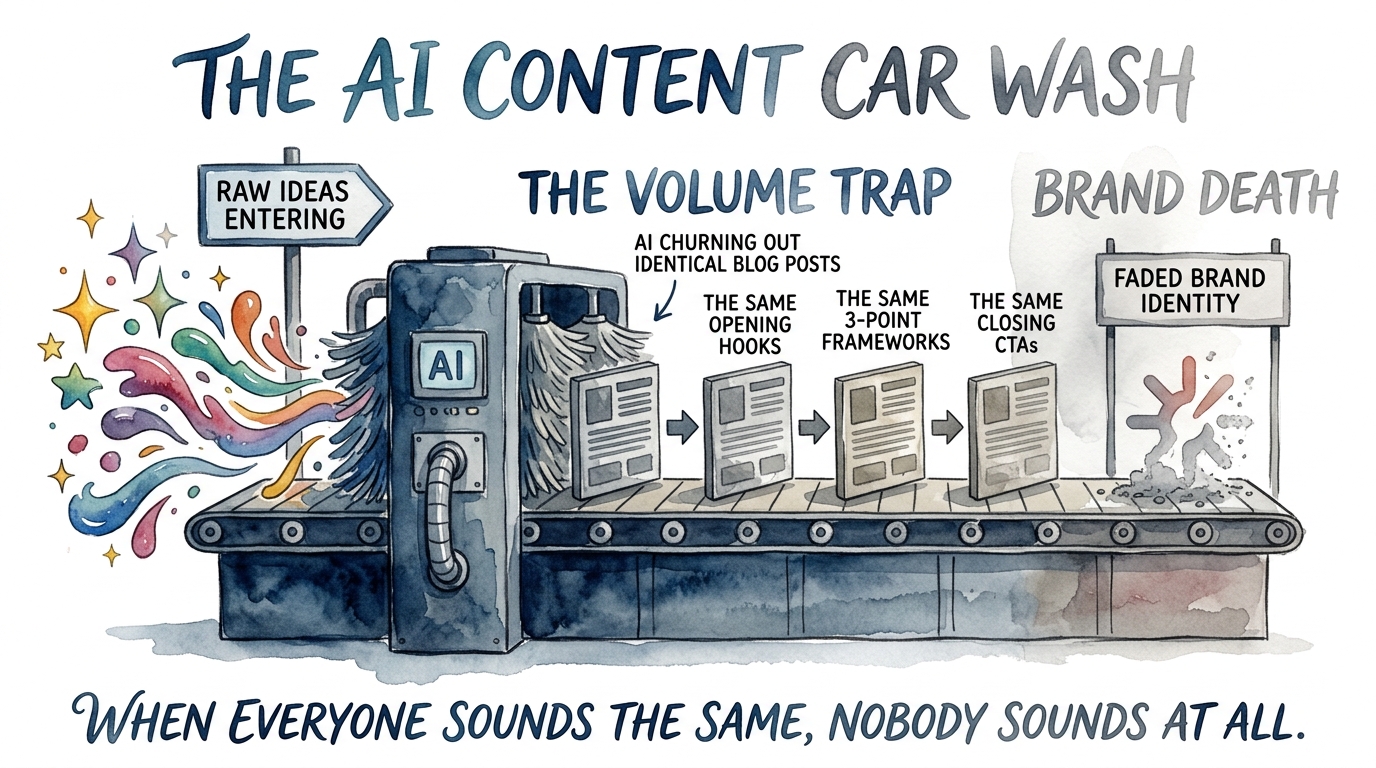
The mechanism is predictable. AI content converges toward the median — the most probable next token, the safest example, the least offensive framing. Publish enough of it and your brand voice flattens into a grey smear that looks exactly like every other brand running the same tools on the same data. The content sameness crisis isn’t coming. It’s here. And it’s self-inflicted.
I have watched teams go from publishing two thoughtful pieces per month to publishing twenty AI-assisted pieces per week. Their traffic metrics sometimes look better for the first 60 days. But their brand perception — measured by referral traffic quality, direct traffic growth, and survey-based brand tracking — starts to slide. The new content isn’t bad. It’s just not distinctive. And indistinct content is the fastest way to become invisible.
AI Search Has a New Filter and It Is Brutal
Here is what changes the math completely. In 2026, answer engines — ChatGPT, Google AI Mode, Perplexity, Claude — don’t just surface content. They synthesize it. And they have gotten alarmingly good at detecting which sources are authoritative vs. which are just AI-generated filler with good SEO.
The synthesis engines use two implicit signals that hit AI-volume brands hardest. First, citation diversity. If your content says the same thing as 20 other sources, you lose the citation lottery. The engine picks one — probably not yours. Second, source uniqueness. If your content has original data, proprietary frameworks, or named methodologies, you get cited. That is why content structured to earn AI answer engine citations outperforms generic SEO filler. If it’s a rephrasing of common knowledge, you don’t.
This means the brands publishing the most content are actually competing with themselves. Every piece of AI-generated filler you publish dilutes the semantic real estate your genuinely good content occupies. The answer engine sees 200 posts from your domain, 190 of which say nothing new, and it adjusts its trust weight for your entire domain downward. Your best content suffers because of the volume around it.
Publish Less. Make Each Piece Count More.
The strategy that protects your brand from the AI content car wash is brutally simple and surprisingly hard to execute: publish less. Not by 10%. By more than feels comfortable.
Instead of 20 pieces per month of “good enough” content, publish 4 pieces per month of genuinely distinctive content. Each piece should meet three criteria before it gets approved: it must contain something your competitors cannot say, it must advance a point of view that could be wrong (and you’re willing to defend), and it must include evidence that the reader can verify.
This approach — what I call “editorial rareness” — protects your brand for three specific reasons. First, each piece has enough signal density to earn citations from answer engines rather than just getting synthesized into a generic response. Second, readers who encounter your content remember it because it doesn’t blend into the grey noise. Third, your editorial team can invest the time they previously spent on volume into depth, accuracy, and genuine craft.

The data backs this up. Brands that reduced content output by 40% or more while increasing per-piece investment saw an average 28% increase in organic referral traffic from answer engines within six months, according to a 2026 analysis from Search Engine Land. The content that drives results in the answer engine era isn’t the content that answers the most queries. It’s the content that answers one query better than anyone else.
The Three Things Every Piece of Content Needs
When you strip away the tools, the formats, the channels, and the trends, every piece of content that builds brand equity does three things. Volume-first strategies forget all of them.
It surprises the reader. The reader learns something they didn’t expect to learn. A counterintuitive data point. A framework they haven’t seen. A connection between two ideas they’d never connected. Surprise is the atomic unit of memorable content, and AI models are optimized for predictability — the opposite of surprise.
It takes a side. The most trusted content tells the reader what to do, not just what to consider. It makes an argument and commits to it. AI-generated content, by design, hedges. It presents options. It summarizes. But it never commits. And readers can feel the difference between content that has a conviction and content that has a word count.
It shows its work. The reader can verify the claims, trace the logic, and see the source. This is the single strongest signal of human-created content in 2026 — not the writing quality, which AI has caught up on, but the willingness to link to sources, cite specific data, name specific companies, and run the risk of being proven wrong.
Volume Is a Decision, Not a Requirement
No one is forcing you to publish 20 AI-generated posts a week. That is a decision your team is making — usually because volume targets are easier to hit than quality targets, and because “we published X pieces this month” is a metric that sounds productive without being one.
The brands that survive the AI content car wash will be the ones that make a different decision. They will publish less. They will invest more in each piece. They will treat brand equity as an asset that is easier to destroy than to build, and they will govern their content accordingly.
The tools are not the problem. The volume is. And the volume is a choice you are making. If your brand is starting to sound like everyone else’s, don’t blame the AI. Look at the decision that put you in the car wash.