




What Is an AI Content Brief?
Your AI Is Not a Bad Writer. Your Brief Is a Bad Manager.
Content Marketing Institute’s 2025 B2B research found that 81% of B2B marketers now use generative AI tools, up from 72% the year before. Only 19% say AI is woven into their daily workflows. Most are still experimenting, with 54% describing an ad hoc approach. The tools are everywhere. The process is nowhere.
Language models are pattern-matching engines. They predict the most statistically likely next word from their training data. Hand one a generic brief and it returns the average of everything ever written on that topic, which is the content your audience already scrolls past. A differentiated draft requires specific constraints, and that is the job of the brief. The rest of this guide shows you how to build one that works.
Define the Insight Before the Topic
Most briefs start with a keyword. “Content marketing strategy.” “Demand generation best practices.” “AI for marketing.” That order is backwards. A keyword tells the model what to write about. An insight tells the model what to say.
An insight is a specific, arguable claim your article proves. “Content marketing strategy” is a keyword. “Most content strategies fail because they optimize for search engines instead of buying committees” is an insight. The keyword marks the territory. The insight delivers the argument.
How to build it: before opening any AI tool, finish this sentence in one line: “After reading this article, the reader will believe that ________.” If your answer already lives on three other blogs, dig deeper. If a competitor could publish the same claim without anyone noticing, you do not have an insight yet. Keep going until the answer is specific enough that only your brand could make it.
Build the “Not This” Section
AI models are trained to be agreeable. They default to safe, consensus views because the training data rewards that. When you leave out explicit exclusions, the model hands you the statistical average of industry opinion, which is indistinguishable from every other AI article in your space.
The “Not This” section is the most valuable part of any AI content brief and the one almost nobody writes. It tells the model which conventional takes to avoid, which angles are played out, and what competitors already say.
NOT THIS - what to avoid:
- Do not open with the "fast-paced landscape" throat-clearing line
- Do not lead with the same three industry stats everyone cites
- Do not close with "content is king" or any version of it
- Avoid these angles (already covered by competitors): [list 2-3]
- Avoid this overused framework: [name it]
- Do not reuse these examples (every model defaults to them): Netflix, Nike, Apple

THIS - what to target:
- Lead with the counterintuitive insight: [your insight]
- Use data from these exact sources: [your research]
- Frame the problem around: [your reader's specific pain point]
- Close with: [one specific action, not a vague summary]
The “Not This” section works because it constrains the model’s pattern matching. Left alone, the model reaches for the most common patterns. Block those and it has to find less common, more specific alternatives, which is where differentiated content lives.
Supply the Source Material
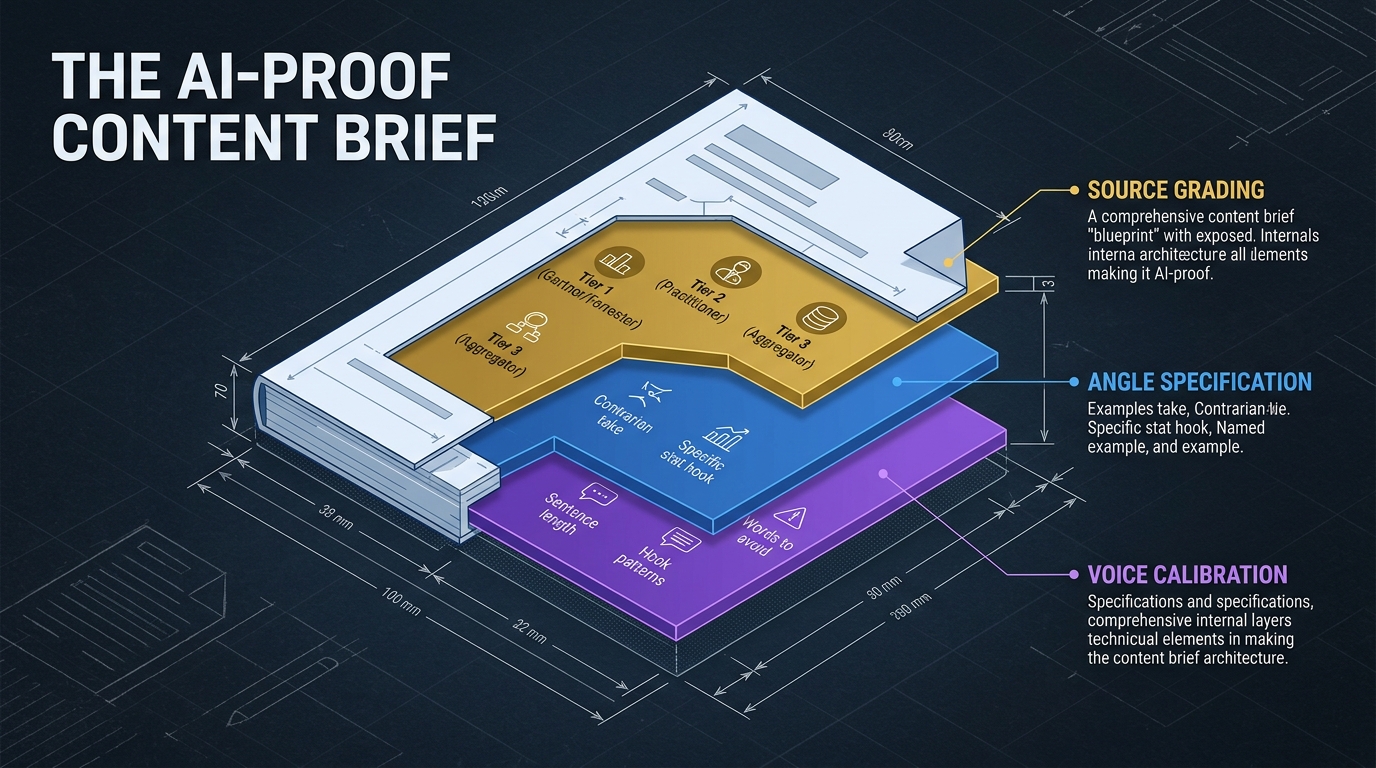
AI produces generic content because it works from generic training data. The fix is direct: give the model specific material to work from. A strong brief includes at least three sources the model would not otherwise have.
1. Internal data. Survey results, customer interview transcripts, sales call recordings, product usage numbers, win/loss notes. Anything only your company owns. A model cannot hallucinate your customer data, but it can synthesize it into compelling content if you hand it over.

2. Subject matter expert quotes. Three to five verbatim quotes from internal experts or outside sources. AI organizes and contextualizes real human insight better than it invents fake authority.
3. Competitor gap analysis. Links to three or four existing articles on the topic, each with a one-line note on what it misses. “Covers the what, not the how.” “Framework with no data behind it.” “All theory, no implementation.” This tells the model exactly which gap your article fills.
Write the Audience Objection Paragraph
Every reader arrives with skepticism. They have been burned by generic advice before, and they scan for proof that this article is different before they commit. A draft that ignores their objections loses them by paragraph three.
The audience objection paragraph is a section in your brief that names what the reader is thinking but not saying:
“We do not have time to build an elaborate brief for every piece.”
“This sounds like it works for enterprise teams with dedicated strategists, not a team of two.”
“If this is so effective, why is not everyone doing it?”
Your brief should instruct the model to answer each objection inside the draft. This is not about defending yourself. It is about meeting the reader where they are. Generic AI content sounds like it was written for nobody because it addresses nobody’s specific doubt. It recites information into a void.
Define the Voice as a Constraint, Not a Description
“Professional but conversational” is not a voice description. It is what everyone types when asked to describe their brand voice, and it gives the model zero usable direction. Voice instructions need to be specific enough that the model can self-correct while it generates.
Voice constraints that work:
| Weak Voice Description | Strong Voice Constraint |
|---|---|
| “Conversational tone” | “Write like you are explaining this to a smart colleague over coffee, not presenting to a boardroom.” |
| “Authoritative” | “Earn authority through specificity. Never make a research claim without naming the study behind it.” |
| “Actionable” | “Every section needs one sentence the reader can act on in 24 hours. No ‘consider exploring.’ Say ‘do this.'” |
| “Data-driven” | “Stats are anchors, not decorations. Follow every number with a sentence on what it means for the reader.” |
| “Witty” | “Humor comes from observation, not joke-telling. No puns, no pop culture references that need a search.” |
The best voice constraints include negative examples. Models follow “do not” instructions better than “do” instructions because “do not” removes options, and fewer options means less generic output.
Include the “But Actually” Test
This is the most effective quality filter I have found for AI drafts. After the model produces a draft, run every claim through the “But Actually” test:
-
1Highlight every declarative claimMark each sentence that asserts something: “Content marketing builds trust.” “AI is transforming marketing.” “Personalization drives conversions.”
-
2Ask “But actually…”For each claim, finish the sentence “But actually…” If the follow-up is sharper than the original, replace the claim with it. Example: “But actually, most content marketing builds familiarity, not trust, and trust needs risk.”
-
3Cut what fails the testIf a claim has no interesting “but actually” behind it, the claim is filler. Delete it. The draft gets shorter and more valuable.
Write this test into the brief. Tell the model: “After you draft, run the ‘But Actually’ test on your own output and revise.” Models self-critique well when you give them a clear framework. The model will not catch everything, so a human still reviews the draft. The test removes the most obvious filler before an editor ever reads it.
AI Content Brief vs. Traditional Content Brief
The two briefs share a skeleton, then diverge on who does the thinking. A traditional brief hands strategy to a human writer who fills gaps with judgment. An AI content brief has to encode that judgment up front, because the model will not supply it.
| Element | Traditional Brief | AI Content Brief |
|---|---|---|
| Primary reader | A human writer with domain context | A model with none |
| Insight | Often implied or left to the writer | Stated as one arguable sentence |
| Exclusions | Rarely written down | Explicit “Not This” list |
| Source material | Pointers the writer expands | Full excerpts pasted in |
| Voice | Style guide reference | Do and do-not constraints |
| Quality control | Editor judgment | Self-critique test, then editor |
The payoff: an AI content brief turns tacit editorial judgment into written instructions. That is harder to produce and far more reusable. Once the six sections exist, the same brief can run through any model without losing the point of view.
Putting It All Together: The Six-Part AI Content Brief
Here is the complete template. Fill it in before you ask any AI tool to generate content. The 15 minutes you spend on the brief saves you 45 minutes of rewriting generic slop on the back end.
Building better briefs is one of the skills that keeps a content marketer valuable as models get cheaper. It is not flashy, and it needs no new tool. It needs the discipline to spend 15 minutes thinking before you spend 15 seconds prompting. That ratio decides whether AI amplifies your point of view or erases it.
AI Content Brief: Frequently Asked Questions
What is an AI content brief?
An AI content brief is a written instruction document that tells a model what to argue, what to avoid, and how to check its own draft. It carries the strategy so the model only has to produce copy that follows it.
How long should an AI content brief be?
One to two pages is enough. The six sections in this framework take about 15 minutes to fill in, and each one earns its space by changing what the model produces.
Can ChatGPT write the brief for me?
No. The brief holds the strategy: the insight, the source material, the objections. A model can draft a brief’s structure, but it cannot supply your proprietary data or your point of view. Do that part yourself.
What is the best AI content brief template?
Any template works if it forces six things: insight, exclusions, source material, objections, voice constraints, and a self-critique step. The values inside those sections matter more than the format.
To go deeper on AI-native content operations, read our guide to the content engineer role, our breakdown of how to build an AI content moat, and our warning about the generalist AI trap. If you are still assembling the team, start with the AI agents every content team needs and our case against volume without quality.