




Walk into most content teams in 2026 and you will find the same setup: everyone has ChatGPT or Claude open in a browser tab. They paste in a brief, copy the output, clean it up, and publish. It feels productive. It looks modern. And it is the single biggest bottleneck holding your content operation back.
The generalist AI trap is seductive because it works well enough. One tool handles everything: research, outlining, drafting, editing, repurposing, even distribution. Why learn a complex system when a single chat window gets you 80% of the way there?
Because that last 20% is where the money lives.
The Content Marketing Institute found that 76% of marketers now use AI for content creation. That is no longer a competitive advantage — it is table stakes. The gap is not between teams that use AI and teams that do not. The gap is between teams that use one AI for everything and teams that have built specialized agent architectures.
Only 31% of marketing teams have integrated AI beyond basic generation into workflow automation, according to CMI’s 2026 benchmarks. Those 31% are not working harder. They built a different machine.
Here’s what happens when you run every content task through a single generalist AI:
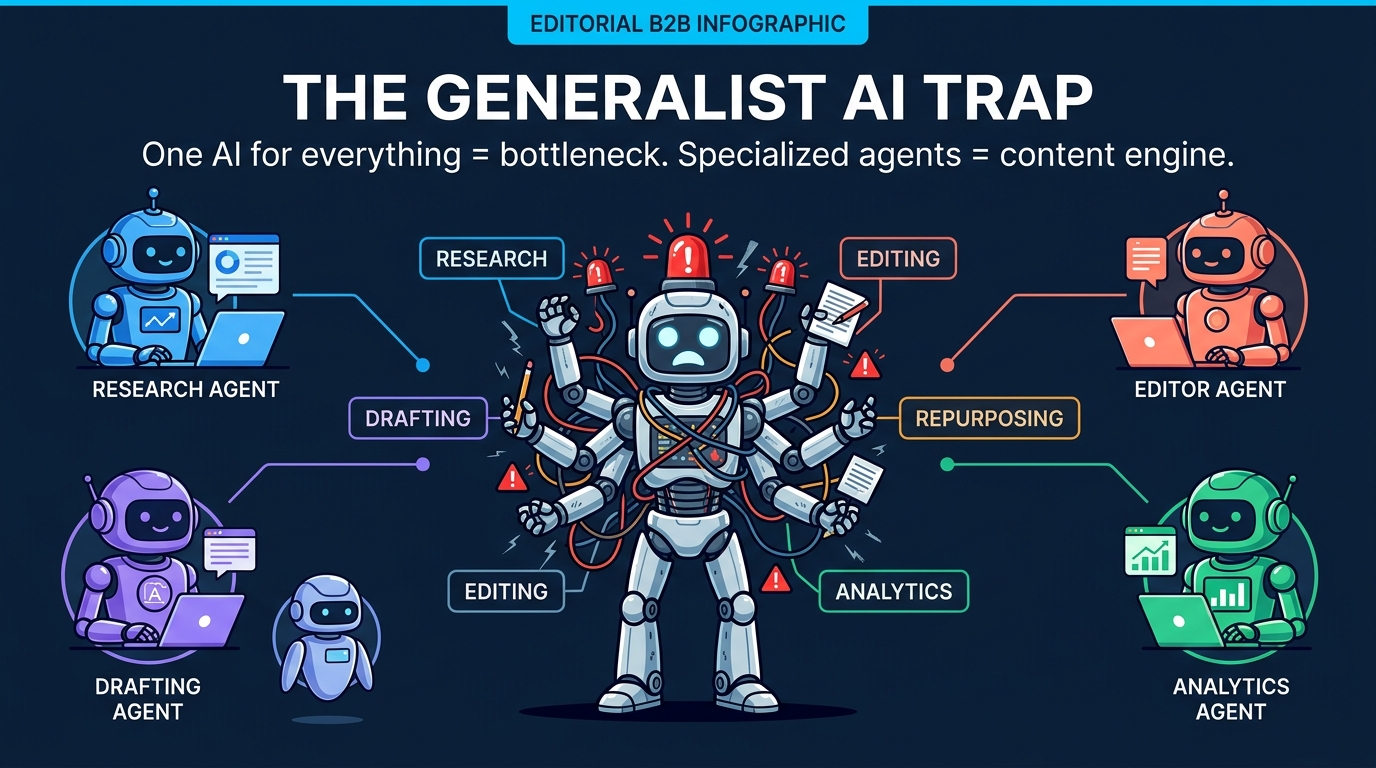
Context collapse. A researcher agent needs access to your competitive landscape, audience data, and SEO history. A first-draft agent needs your brand voice guide, style rules, and editorial standards. An editor agent needs your tone-of-voice matrix, factual databases, and quality rubrics. A distribution agent needs your social calendars, channel performance data, and audience segmentation.
When you cram all of this into one chat window, the AI does not perform any of these functions well. It averages them. The output is generic because the context is generic. No single prompt, no matter how well-written, can hold seven specialized knowledge domains simultaneously.
Quality normalization. Generalist AI optimizes for completion, not impact. It produces content that is factually adequate, structurally sound, and completely forgettable. It does not take risks. It does not develop a point of view. It cannot, because it has no memory of your brand’s intellectual history — the arguments you have made before, the positions you have staked out, the contrarian takes that define your voice.
Output homogeneity. When every piece of content passes through the same filter, every piece starts to sound the same. The blog post reads like the newsletter which reads like the LinkedIn post which reads like the case study. Your audience stops being able to tell your content apart from your competitors’ — because both are running through the same generalist models with slightly different prompts.

The pattern is consistent across every benchmark that tracks this: teams with AI do better than teams without. But teams with specialized AI architectures do dramatically better than teams with a generalist approach. The returns are not linear. They compound.
Think of your content operation as a newsroom. You would never have one person write, edit, fact-check, design layouts, manage distribution, and track analytics. That person would break within a week — and the output would be terrible. Yet that is exactly what most content teams are asking their AI to do.
The alternative: a team of specialized AI agents, each with its own purpose, context window, rules, and success metrics. Here’s the architecture:
| Agent Role | What It Does | Context It Needs | Success Metric |
|---|---|---|---|
| Researcher Agent | Gathers source material, competitive intel, data points, and audience insights | SEO tools, CRM data, competitor content, industry databases | Breadth and accuracy of sources per article |
| First-Draft Agent | Produces structurally sound, brand-aligned drafts from research briefs | Brand voice guide, style rules, editorial standards, content templates | Structural completeness and voice consistency |
| Editor Agent | Reviews for quality, voice, factual accuracy, and strategic alignment | Tone-of-voice matrix, factual databases, quality rubrics, historical content | Error rate and brand voice score |
| Distribution Agent | Adapts content for channels, schedules publishing, optimizes formats | Social calendars, channel performance data, audience segmentation | Channel-specific engagement and reach |
| Measurement Agent | Tracks performance, identifies patterns, recommends optimizations | Analytics dashboards, attribution models, pipeline data | Actionable insights generated per reporting cycle |
This is not science fiction. Teams are building this today using Claude Projects, custom GPTs, and composable agent frameworks. The technology is ready. The bottleneck is organizational — most teams have not yet designed the architecture.
Anthropic, the company behind Claude, published their own research on this in December 2025. The title of their paper: “Building Effective Agents.” The key finding is unambiguous:
This is not a vendor telling you to use more of their product. This is the company that builds the underlying models telling you that using one model for everything is suboptimal. The architecture matters as much as the engine.
McKinsey’s research reinforces the scale of this: marketing and sales capture approximately 75% of generative AI’s total business value — but only when AI is deployed with specialized workflows, not generic implementation. The difference between 75% value capture and 15% is not better prompts. It is a different system design.
The teams pulling ahead are not the ones with the fanciest AI tools. They are the ones that stopped treating AI as a single assistant and started treating it as a team of specialists. Every specialized agent they add does not just improve one workflow — it improves every workflow that sits downstream of it. Read our guide to the 3 specialized AI agents every content team needs to start building your architecture.
You do not need a six-month engineering project. You need to start treating your AI like a team, not a tool. Here’s the 30-day path:
-
1Days 1-7: Audit Your Current AI UsageMap every task your team currently runs through AI. Research, drafting, editing, repurposing, distribution, measurement. For each task, ask: is this getting its own context, rules, and success criteria, or is it competing for attention inside a generalist chat window? Most teams find that 80% of their AI tasks are under-contextualized.
-
2Days 8-14: Build Your First Two Specialized AgentsStart with the highest-impact pair: a researcher agent and an editor agent. The researcher pulls competitive intel, audience data, and source material into structured briefs. The editor reviews drafts against your brand voice, factual accuracy, and strategic alignment. Build these as Claude Projects or custom GPTs with dedicated context windows and rule sets. Document everything in a team AI playbook so the agents scale beyond you.
-
3Days 15-21: Run a Side-by-Side TestProduce one piece of content using the generalist approach and one using the specialized agent chain. Measure: time to publish, editorial rounds required, brand voice consistency, and audience engagement. The specialized chain will win on every dimension — not because the AI is better, but because the architecture is better. Share the results with your team. Data kills resistance.
-
4Days 22-30: Add Distribution and ExpandBuild a distribution agent that adapts content for channels, schedules publishing, and optimizes formats. Then expand: add a measurement agent that tracks performance and surfaces optimization opportunities. Each new agent inherits the output quality of the agents before it. A great draft edited well distributes better. This is how compound returns work in AI operations.
Gartner predicts that by 2028, 60% of marketing operations roles will include AI agent management as a core competency. This is not a distant trend. The job descriptions are being written right now. The career paths are being defined.
The content teams that win over the next two years will not be the ones with the biggest budgets or the most headcount. They will be the ones that treat AI architecture as a strategic capability, not a productivity hack.
Sam Altman said it plainly in his 2025 interview with The Verge: “The most interesting applications of AI are not the ones that replace humans — they are the ones that handle the operational grinding so humans can do the things only humans can do.”
The generalist AI handles the grinding. It produces words. It checks boxes. But the specialized agent architecture handles the thinking — the research depth, the editorial judgment, the distribution intelligence, the measurement rigor. That is where the competitive advantage lives.
One AI for everything is comfortable. It is familiar. It is also your ceiling. Break through it.
[…] playbook for revenue operators shows where agent deployment fits in the full operating model, and why the generalist AI trap is the bottleneck your team will hit next. And if you’re ready to start building, here’s the practitioner’s guide to […]
[…] is the generalist AI trap in its final form. When your entire content operation funnels through one general-purpose model, […]
[…] is it. Five decisions. This ties directly into the bigger argument in our piece on the generalist AI trap: when nobody owns quality, quality does not exist. It is also the counterweight to the sameness […]
[…] the content engineer role, our breakdown of how to build an AI content moat, and our warning about the generalist AI trap. If you are still assembling the team, start with the AI agents every content team needs and our […]