





A $10 Billion Problem Hiding in Plain Sight
Here is a stat that should make every marketing leader sit up. Forrester projects that ungoverned generative AI will cost B2B companies more than $10 billion in 2026, and that number is already priced in. And the biggest contributor is not your engineering team shipping a buggy model. It is your marketing team shipping a thousand pieces of content nobody fact-checked.
Marketing now produces more AI-assisted output than any other function in the company. Blog posts, emails, social, sales collateral, product pages. And almost none of it is governed. There’s no review process, no fact-check layer, no owner for what goes out under the brand name. That’s the gap. Not the technology. The gap between how fast we ship AI content and how little we control it.
This piece makes one argument. I want to convince you of one thing: AI governance is not a compliance tax. It is a competitive moat. The companies that govern AI well will ship faster and safer than the ones that don’t, and the ones that ignore it will be the cautionary tales of 2026.
The Gap Is a Marketing Problem, Not an IT Problem
Most leaders file AI governance under IT, legal, or security. That’s the first mistake. The $10 billion Forrester is projecting doesn’t come from servers getting hacked. It comes from people using AI tools without guardrails, and the heaviest users are in marketing and sales.
The reason marketing is the epicenter is simple math. Your content team generates more AI-assisted words in a week than your engineering team generates AI-assisted code in a month. Every one of those words carries brand risk. A hallucinated statistic. A fabricated customer quote. A product claim that doesn’t exist. A tone that drifts off-brand in a way that goes viral for the wrong reasons.
When engineering ships a bad model, you get a bug. When marketing ships a bad claim, you get a correction, a refund demand, or a headline. The blast radius is different, and it is pointed directly at the brand.
Hallucination Is Now a Brand Event
Here is where it gets worse. The errors are getting more sophisticated at the exact moment the volume is exploding. A hallucination used to be a quality-control problem. You caught it in editing, you fixed it, you moved on. In 2026 it is a brand event. A single fabricated claim in a customer-facing asset can cost you a deal, a compliance fine, or a social media cycle that defines your quarter.
The Stanford numbers are the thing to sit with. Across 26 leading models, hallucination rates range from 22 percent to 94 percent depending on the benchmark, according to the 2026 AI Index Report. Even the best models get it wrong a meaningful fraction of the time. And the incidents are climbing fast, from 233 in 2024 to 362 in 2025. The tools aren’t getting more careful. They’re getting more widely used.
Shadow AI and the Accountability Vacuum
Most of this AI usage is shadow AI. People logging into tools with personal accounts, pasting company context into public models, and shipping output without anyone reviewing it. There’s no owner. There’s no process. There’s only speed.
Governance Is a Moat, Not a Tax
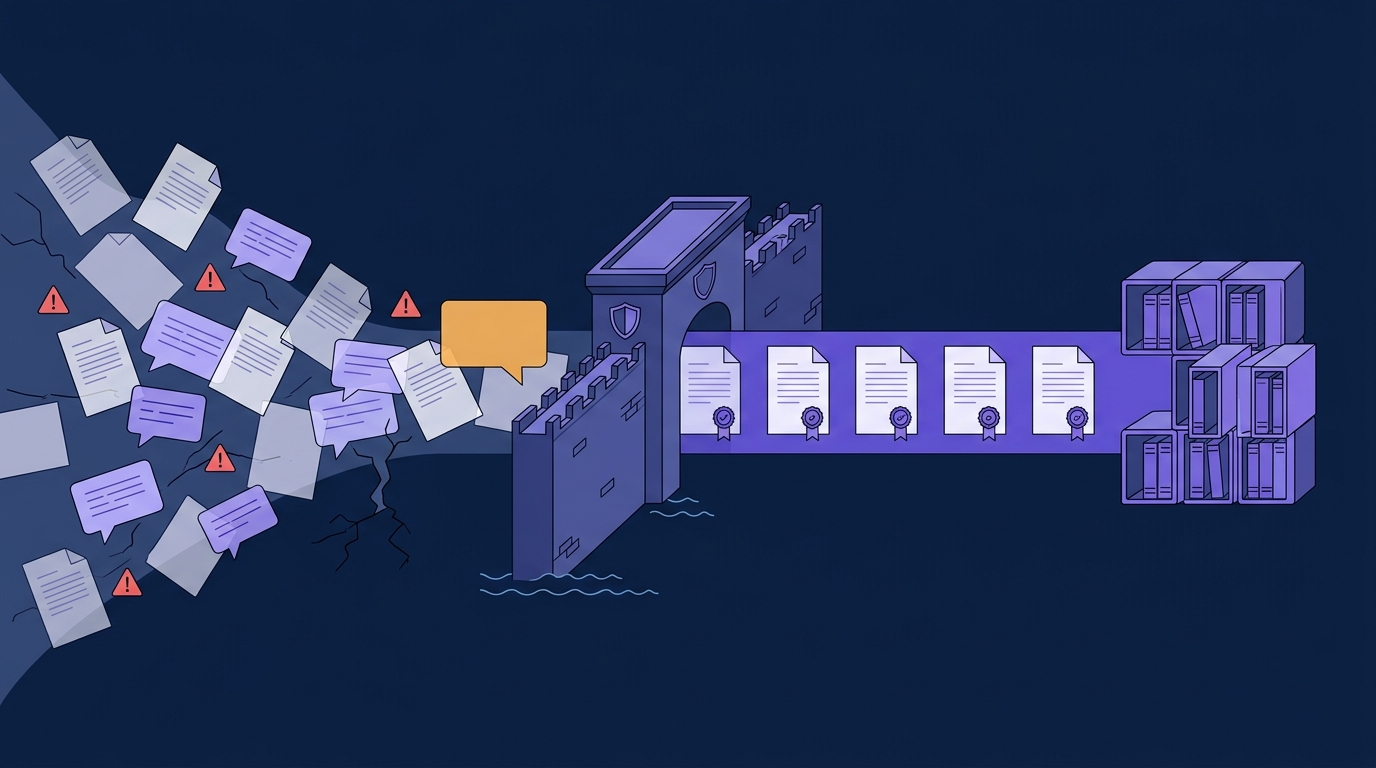
This is where the contrarian argument lives. Most teams treat governance as friction. A tax. Something that slows you down right when you need to move fast. That framing is exactly backwards. The companies that govern AI well ship faster. They have a defined process, so nothing gets stuck in a committee. They have named owners, so decisions happen. They have guardrails, so they don’t have to pull work back out of the wild to fix it.

| Dimension | Ungoverned AI | Governed AI |
|---|---|---|
| Ship speed | Fast at first, then slow with rework and legal review | Steady, with no rework or corrections |
| Brand risk | High and compounding with every asset | Low and managed |
| Trust | Eroding, one correction at a time | Compounding into authority |
| Cost | Cheap to start, expensive to fix | Small, predictable investment |
Governance done right removes friction. It doesn’t add it. The teams that get this will be the ones that survive the $10 billion year while their competitors clean up the mess.
The Minimum Viable Governance Stack
You don’t need a 50-page policy. You need five things, and you can build them this quarter.
-
1Name one ownerOne person owns AI output quality. Not a committee. One name. When an AI-assisted asset goes wrong, this is who answers for it, and this is who fixes the process.
-
2Tier your reviewsRoutine content gets light review. Sensitive content, meaning claims, data, or product promises, gets full review. Review should be proportional to risk, not to how many people are in the thread.
-
3Fact-check every claimEvery number and claim gets a source before it ships. A claim you can’t verify in five minutes is a claim your buyer can fact-check in ten seconds, and they will.
-
4Approve your toolsPeople use the tools you have vetted, not whatever is fastest. The unapproved tools are where company context leaks and unverified output hides.
-
5Close the loopWhen an error ships, log it and feed it back into the process. A feedback loop turns one mistake into a permanently better system instead of a repeating one.
That’s it. Five decisions. This ties directly into the bigger argument in our piece on the generalist AI trap: when nobody owns quality, quality doesn’t exist. It is also the counterweight to the sameness problem in building an AI content moat. Anyone can generate volume. Few teams can prove their output is safe, sourced, and on-brand. That reliability is the part of the moat that doesn’t show up in a word count.
Get Ahead of It or Get Burned by It
Ungoverned AI is not a future risk. It is a present one, and Forrester has already put a number on it: $10 billion in 2026. The good news is the fix is not expensive or complicated. It is five decisions: name an owner, tier your reviews, fact-check every claim, approve your tools, and close the loop when something breaks. The companies that make those five decisions now will enter 2027 faster and safer than their competitors, and they won’t spend the year doing corrections.
The ones that keep treating governance as a tax will keep paying for it, in corrections, in compliance fines, and in the slow leak of trust that no amount of content volume can replace. The choice is not whether to govern AI. It is whether you want to be the company that got ahead of it or the company that got burned by it.