




What Are AI Agents for Content Marketing?
AI agents for content marketing are software systems that each own a defined job in the content lifecycle and run it with minimal hand-holding. A research agent assembles briefs. A drafting agent turns a brief into a structured first draft. An editor agent runs the quality passes. A repurposing agent turns one asset into every derivative. An analytics agent watches performance and feeds the lessons back. Each agent has one job, one typical input, and one typical output. Together they form a content operation instead of a folder full of prompts.
Every content team I talk to right now is having the same conversation. Some version of “we’re using AI” followed by an awkward pause when you ask what that means. Usually it’s someone with a ChatGPT tab open. Sometimes it means they bought a tool nobody uses. Occasionally it means they wired up an API and called it a day.
None of that is an AI content operation. It’s bolting a calculator onto a typewriter and calling yourself a software company.
The next twelve months will separate content teams into two groups. One group treats AI as a tool, something an individual contributor reaches for to unblock themselves. The other treats AI as infrastructure, a set of agents that own discrete functions the way you’ve got people who own editorial, distribution, and analytics. The second group produces more content, at higher quality, with tighter measurement. The gap compounds every quarter.
Agent vs. Assistant vs. Chatbot
People use these three terms as if they’re the same thing. They don’t. The difference decides what you can automate.
| System | What it does | What it cannot do |
|---|---|---|
| Chatbot | Answers one prompt at a time, in the moment | Hold context across a project or own a recurring job |
| Assistant | Helps a person do a task faster, with the person driving | Run a job end to end without a human at the wheel |
| Agent | Owns a recurring job, takes a defined input, and produces a defined output | Replace editorial judgment on anything touching brand or accuracy |
Most teams stop at the assistant row. They get speed on individual tasks and then wonder why total output doesn’t move. The compounding sits in the third row, where the job runs whether or not someone is watching.
The tooling isn’t the bottleneck. 81% of B2B teams already use generative AI, but only 19% have it wired into daily workflows (Content Marketing Institute, 2025). Agents are how you close that gap.
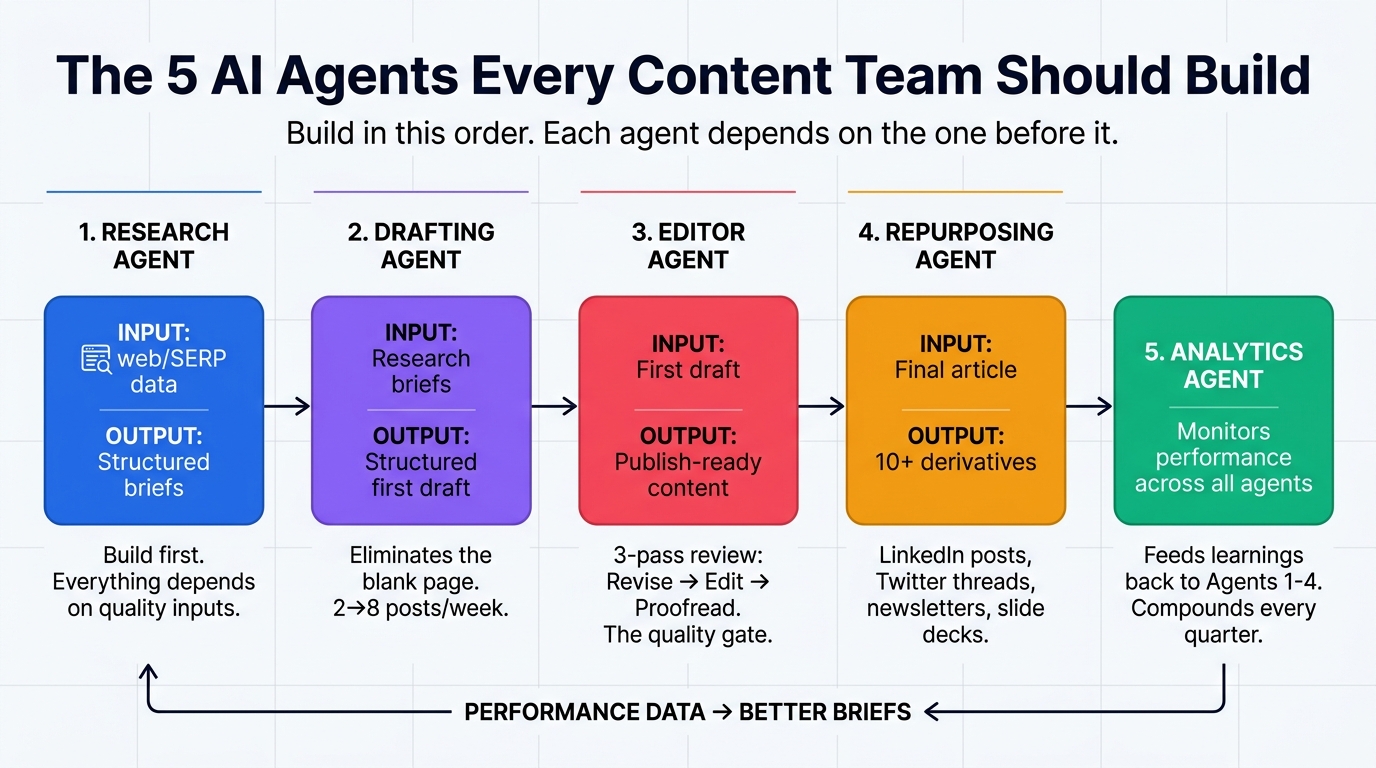
Five agent types cover the full content lifecycle. Build them in the order below and each new agent makes the last one more valuable.
The Research Agent
Before any word gets written, someone has to decide what to say and why. This phase burns the most time and produces the most anxiety. Writers stare at blank pages. Editors send “can you look into this” messages that take two days to answer. Research is where content quality is made or lost, and it stays almost entirely manual in most organizations.
A research agent doesn’t write. It prepares. It pulls competitive SERP data and finds the top-performing content on a topic. It extracts the main arguments and data points, flags gaps nobody covers, and delivers a structured brief. It answers what’s already been said, what’s missing, and where you can add something real.

The best research agents grade their sources. They separate a Gartner report from an influencer’s hot take. They know a percentage pulled from a survey is useless on its own. You need to know who was surveyed, how many people, and who paid for the study.
Build this agent first. Everything downstream depends on its output, so its quality sets the ceiling for the rest.
The Drafting Agent
This is the agent most teams think they already have. They don’t.
Using a chatbot to write a blog post isn’t a drafting agent. A drafting agent understands your brand voice, your content architecture, your SEO target, and your editorial standards. It then produces a structured first draft an editor can work with in minutes instead of hours. It doesn’t replace the writer. It removes the blank page.
A real drafting agent takes a research brief as input and produces a structured first draft. That structure includes a TL;DR, a hook paragraph, data points in place, internal links mapped, and a CTA routed to the right destination. The editor’s job shifts from “write this from scratch” to “verify, sharpen, and ship.”
That’s the single biggest productivity gain in content operations. When your best editor goes from producing two pieces a week to reviewing and sharpening eight, you haven’t cut quality. You’ve multiplied output without adding headcount. Teams that want the input side dialed in should read our 6-part AI content brief framework.
The Editor Agent
Most teams stop at drafting and call it done. That’s the mistake.
A drafting agent produces a first draft. An editor agent reviews it. They’re separate functions for the same reason a newsroom has separate writers and editors. The person who wrote it shouldn’t be the person who catches its flaws.
An editor agent runs structured passes: revise for structure and flow, edit for voice and readability, proofread for grammar and encoding. It checks Flesch reading scores. It scans for AI fingerprint patterns. That includes the balanced “on one hand, on the other” constructions, the placeholder examples, and the hedging that signals nobody wrote this with conviction. It verifies every stat traces back to a named source. Our guide to AI content with a human touch covers why that gap shows up to readers within two posts.
The Repurposing Agent
Content teams spend enormous creative energy on distribution. Someone writes a 2,000-word article. Then four people spend four hours each turning it into LinkedIn posts, a thread, a newsletter section, and a slide deck. Most of that work is formatting. That’s not thinking.
A repurposing agent takes one long-form asset and produces every derivative. That means a LinkedIn post with the right hook and a thread sized for the platform. It also drafts the newsletter section with the right subject line, plus the carousel outline. It’s the same insight, packaged for each platform.
The math is brutal in the best way. A team producing three original articles a week and repurposing manually across three channels can ship nine derivative assets. A team with a repurposing agent ships the same three articles and produces all the derivatives, 12, 15, 20 assets, in roughly the same time. The bottleneck is reformatting, not ideas, and the agent removes the reformatting. Our 10 B2B marketing prompt templates are built to feed this kind of agent.
The Analytics Agent
Few teams build this agent yet, and it compounds the hardest over time.
A content team without an analytics agent is flying blind. You publish, you wait, you maybe open Search Console once a month, and you’ve got a vague sense that some posts do better than others. An analytics agent closes the loop. It’s watching every published asset for performance signals, including traffic trends, CTR changes, engagement patterns, and content decay. When one trends the wrong way, it raises a flag.
More important, it feeds lessons back into the other agents. When the analytics agent finds that a stat-led hook outperforms a question hook on LinkedIn, the drafting and repurposing agents both get smarter. The system learns. This is the structural edge AI gives to content operations, and most teams haven’t built it (see the surprising edge AI gives to content creation).
How to Sequence the Build
You don’t build all five at once. You build them in the order of compounding value.
-
1Research agent firstEverything else depends on quality inputs. Get the brief format right and the drafting agent has something to work with. Without it, you automate the production of generic content.
-
2Drafting agent secondThis is the productivity multiplier. A good research agent feeding a good drafting agent is the difference between two posts a week and eight.
-
3Editor agent thirdOnce volume rises, you need the quality gate. Without it you’re shipping more drafts faster, not better work.
-
4Repurposing agent fourthYou’ve got quality articles flowing. Now multiply their reach without multiplying the work.
-
5Analytics agent fifthThis closes the loop. Every agent gets smarter over time, and the system learns what works.
The trap is starting with agent 2. The drafting agent is the one everyone wants because it produces output. Without research you get generic content. Without editing you get unverified content. Without analytics you get untested content. The order matters because the dependencies are real.
How to Tell If Your Agents Are Working
Agents are easy to build and easy to leave unmeasured. Four numbers tell you whether it’s earning its keep.
| Metric | What it signals | Rough target |
|---|---|---|
| Draft-to-publish time | Whether the drafting and editor agents removed the blank page | Cut in half within 60 days |
| Editor change rate | How much the editor agent still has to fix as upstream quality climbs | Fall month over month |
| Derivatives per asset | Whether the repurposing agent is pulling its weight | 10 or more per long-form piece |
| Refresh hit rate | Whether the analytics agent flags the right pages to refresh | Most flagged pages gain clicks after refresh |
These are internal signals, and they’re the ones you can act on weekly. For the pipeline view, tie the content operation to demand generation, the way our 90-day demand generation build does.
Who Builds and Runs the Agents
You don’t need a large team for this. You do need clear ownership. Two roles cover it: an operator who keeps the agents running and a strategist who sets the targets they work against. On a small team, one person can play both parts at the start.
Write the rules down. Who owns each agent, what its input is, what its output must include, and what a human still approves. That’s what keeps the system consistent when the team changes. It’s the same idea behind our guide to building a team AI playbook from scratch.
AI Agents for Content Marketing: Frequently Asked Questions
How many AI agents does a content team need?
Five cover the core lifecycle: research, drafting, editing, repurposing, and analytics. Small teams can merge drafting and editing into one agent at the start, then split them once volume rises.
Do AI agents replace content writers?
No. They remove the blank page and the manual reformatting. Writers spend their time on judgment, angle, and argument. That’s where the value always sat.
Which agent should you build first?
The research agent. Every other agent depends on the quality of its input. Building drafting first produces fast generic content that the editor agent then has to rescue.
How do you keep AI agents on brand?
Give each agent the brand voice, the content architecture, and the editorial standards as part of its brief, not as an afterthought. The editor agent then checks the output against those standards before a human ever sees it.
How long until the system pays off?
Teams usually see draft-to-publish time fall within the first month and editor change rates fall by the second. The analytics agent compounds more slowly because it needs a few months of performance data to flag decay with confidence.
If you want to see how this fits a larger content function, start with the AI content brief framework and the team AI playbook. Then map the pipeline side with the 90-day demand generation plan.