





The dirty secret of AI in B2B marketing is how little thought goes into the instructions. A marketer copies a prompt from a LinkedIn post, pastes it into a chat window, and gets LinkedIn-post-quality output. Generic. Safe. Forgettable.
The difference between AI that accelerates your content and AI that homogenizes it comes down to prompt design. Most teams haven’t spent a single hour getting good at it. The ten templates below close that gap.
These aren’t theory prompts. Each one follows a repeatable structure, so a teammate can adapt it in minutes. Fill in the bracketed variables and run it.
What Are B2B Marketing AI Prompts?
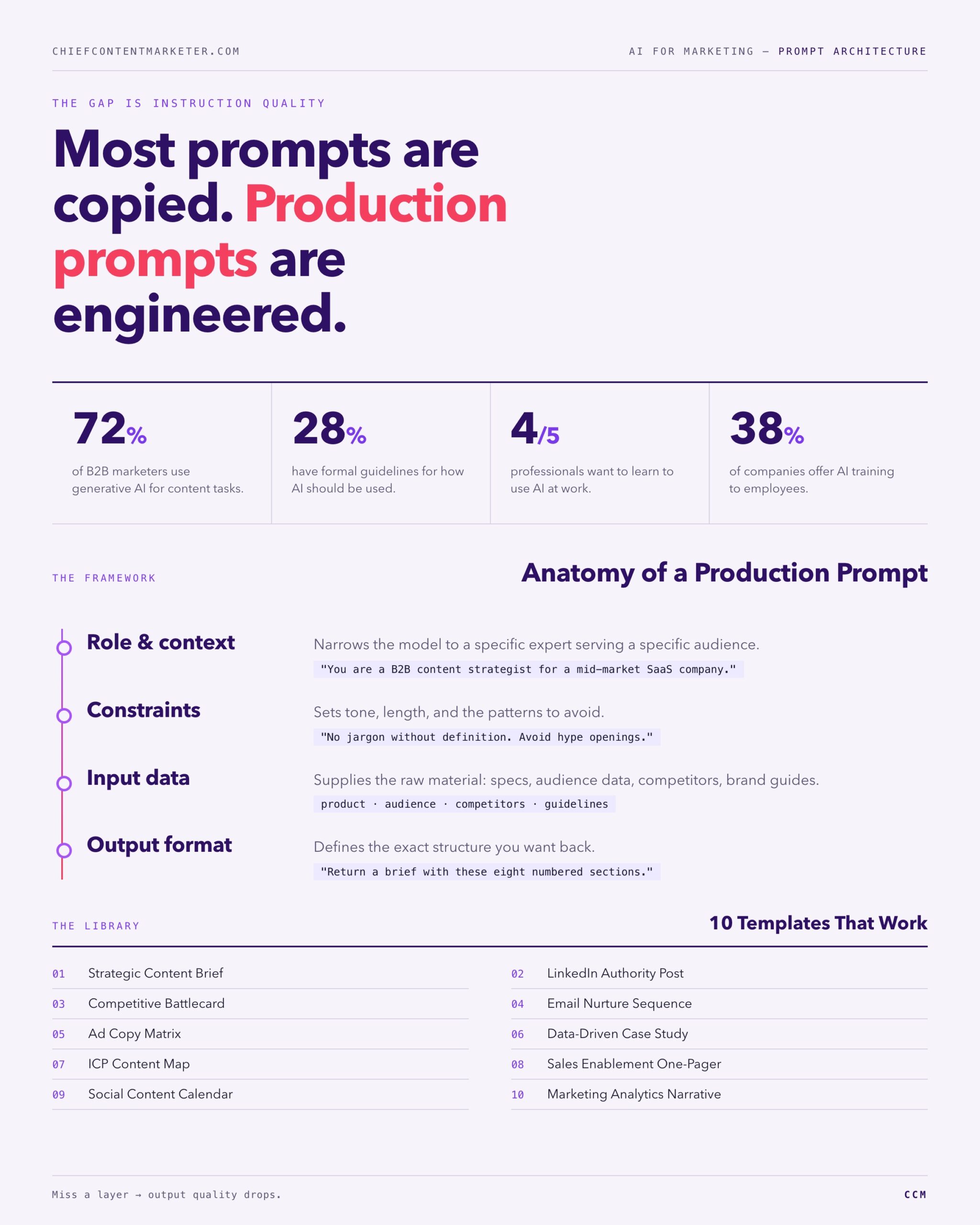
B2B marketing AI prompts are written instructions that tell a language model how to produce a specific marketing asset. A production-grade prompt names a role, gives context about the company and the audience, sets constraints, and specifies the output format. That structure is what turns a one-off guess into a reusable template any teammate can run.
Why Prompt Quality Decides Your Output
Generative AI adoption in B2B marketing has outrun the practices that make it work. Tool access is everywhere. Shared prompt standards aren’t.
Sources: the Content Marketing Institute’s 2026 B2B Content Marketing Benchmarks and the LinkedIn Workplace Learning Report. Adoption isn’t the bottleneck. Instruction quality is. A team can share the same model and still get wildly different results, because the prompt carries the strategy.
The Anatomy of a Production Prompt
Before the templates, learn the structure that makes them work. It’s simpler than it looks. Every production prompt has four layers.
Every template below follows this architecture. The bracketed variables are yours to fill. The surrounding structure is what keeps output consistent across a team.
10 B2B Marketing AI Prompt Templates
Use these as starting points, not finished products. Adapt the variables, then test each template against a real task before adding it to your library.
1. The Strategic Content Brief
Use when: you need a researched brief for a long-form article or white paper.

You are a senior B2B content strategist for [COMPANY], which sells [PRODUCT] to [AUDIENCE]. Create a content brief for an article about [TOPIC]. The strategic goal is [GOAL].

Include: (1) working title with a hook, (2) target keyword and secondary keywords, (3) audience pain points, (4) a unique angle, (5) a 5-section outline with word counts, (6) 3 internal linking opportunities, (7) 3 external sources to cite, (8) suggested visuals.

Constraints: target the reading level of a VP or Director. Define any jargon. Avoid generic scene-setting openings. Output a structured brief with clear headers.
2. The LinkedIn Authority Post
Use when: you need a contrarian, data-backed post that sounds like a person, not a marketer.
You are a B2B executive with 15 years in [INDUSTRY], known for contrarian, data-backed posts.

Write a LinkedIn post about [TOPIC]. Requirements: (1) a first line that creates tension, (2) one specific data point or personal experience, (3) a challenge to a common assumption, (4) a closing question, (5) 1,200 to 1,800 characters, (6) single-line paragraphs for mobile, (7) no hashtags.

Constraints: no "I am excited to share." No humble-bragging. Sound like a smart person thinking out loud.
3. The Competitive Battlecard
Use when: a rep needs positioning they can use in a live deal.
You are a competitive intelligence analyst for [COMPANY], competing against [COMPETITOR A] and [COMPETITOR B] in [CATEGORY].

Build a battlecard with: (1) competitor positioning, (2) a feature matrix on the 10 capabilities buyers care about, (3) pricing intelligence, (4) 5 landmine questions and how to answer them, (5) 3 genuine weaknesses, (6) 3 strengths to acknowledge.

Constraints: label any inference. Cite sources where possible. Make it usable in a live conversation.
4. The Email Nurture Sequence
Use when: a lead downloaded an asset and you need a five-email arc that earns the next click.
You are an email strategist specializing in B2B nurture sequences for [INDUSTRY]. Design a 5-email sequence for prospects who downloaded [ASSET] about [TOPIC].

For each email provide: (1) subject line under 50 characters, (2) preview text, (3) a 150 to 200 word body, (4) a primary CTA, (5) a secondary CTA.

Arc: email 1 reinforces value, email 2 shares a case study, email 3 goes deeper, email 4 adds social proof, email 5 connects to the product. Constraints: no "just checking in." Every email stands alone.
5. The Ad Copy Matrix
Use when: you need tested variations across paid channels, fast.
You are a B2B performance copywriter. Create ad copy for [OFFER] targeting [AUDIENCE].

Generate 3 variations per platform: LinkedIn (70-char headline, 150-char body), Google Search (3 headlines at 30 chars, 2 descriptions at 90 chars), Meta (125-char primary text, 40-char headline, 30-char description).

For each variation, state the emotional hook, the value prop being tested, and the expected performance tier. Constraints: no clickbait, no all-caps, include a number in at least half the headlines.
6. The Data-Driven Case Study
Use when: you have raw customer data and need a narrative around the result.
You are a B2B case study writer. Turn this customer data into a narrative: [INDUSTRY, SIZE, CHALLENGE, SOLUTION, QUANTITATIVE RESULTS, QUALITATIVE FEEDBACK, TIMELINE].

Structure: (1) executive summary with key stats, (2) the challenge, (3) the solution with specifics, (4) results with before/after, (5) customer quotes. Lead with the result, not the problem. Do not open with "Company X is a leading provider."
7. The ICP Content Map
Use when: you are planning a quarter and need topics mapped to real personas.
You are a B2B content strategist. Build an ICP content map for [SEGMENT].

For each persona ([PERSONA 1], [PERSONA 2], [PERSONA 3]), generate topics for top-of-funnel, middle-of-funnel, and bottom-of-funnel. For each topic give a working title, a format recommendation, the primary pain point, and an approximate word count.

Topics must be persona-specific. Output a structured table grouped by persona.
8. The Sales Enablement One-Pager
Use when: a rep has five minutes before a call and needs the essentials.
You are a sales enablement specialist. Create a one-page briefing for reps selling [PRODUCT].

Include: (1) 3 talking points with data, (2) 5 objections and rebuttals, (3) 3 customer proof points, (4) a 50-word competitive positioning statement, (5) discovery questions, (6) qualifying criteria. Everything must fit on one printed page. Assume the rep has 5 minutes to review.
9. The Social Content Calendar
Use when: one asset needs to fuel a month of social without repeating itself.
You are a B2B social strategist. Turn this asset into a 30-day social calendar: [ASSET URL OR TEXT].

Generate: (1) 10 LinkedIn posts mixing promotion, insight, and contrarian takes, (2) 15 short posts with bite-sized insights and links, (3) 5 community discussion prompts. Keep it 80% value and 20% promotion. No post should read like a direct ad.
10. The Marketing Analytics Narrative
Use when: you have a data dump and need a story an executive will act on.
You are a marketing analytics storyteller. Data: [PASTE DATA].

Build a 4-slide narrative: (1) the headline trend, (2) 3 to 5 supporting data points, (3) 3 business implications, (4) 3 recommended actions with expected impact. No data dump. Translate every metric into business language. Every number gets context.How to Put These Prompts to Work
A template sitting in a folder doesn’t change anything. The workflow is where the value shows up. Run these four steps.
-
1Build a shared template librarySave the prompts in one place the whole team can reach. Organize them by marketing function and use case. Treat the library like a product, not a document.
-
2Standardize the variablesWrite a variables cheat sheet with your standard inputs: audience descriptions, product names, and brand voice rules. Anyone on the team can then fill a template the same way.
-
3Set a review protocolDecide who checks AI output and what they check for. Accuracy, brand voice, and strategic fit come first. A clear review step is what keeps speed from becoming risk.
-
4Audit the library each quarterAsk which templates produce review-ready output at least 90% of the time. Retire the laggards and refine the winners. A living library beats a perfect first version.
Prompt Templates vs. Ad-Hoc Prompting
| Dimension | Ad-hoc prompting | Template library |
|---|---|---|
| Output consistency | Varies by person and by day | Predictable across the team |
| Onboarding speed | Weeks of trial and error | A new hire ships in a day |
| Reuse | Everyone reinvents the prompt | One strong prompt serves many tasks |
| Quality control | Judged case by case | Built into the structure |
| Scale | Breaks as the team grows | Holds as the team grows |
A prompt library is the input layer of a larger system. On its own it improves output quality. Inside a documented workflow, it becomes the foundation for AI content operations that connect prompts, skills, and publishing rules.
B2B Marketing AI Prompts: FAQ
What makes a B2B marketing AI prompt production-grade?
Four things: a defined role, real context, clear constraints, and a specified output format. Together they cut ambiguity, and that’s the main reason most AI output feels generic.
How many prompt templates should a team keep?
Start with five to eight that cover your most common tasks. A small library your team uses beats a large one nobody opens.
Are prompt templates enough to make a team AI-native?
No. Templates are the starting point. Teams become AI-native when prompts, workflows, and operating rules work together, which is what our team AI playbook covers.
What comes after a prompt library?
The next step is turning your best prompts into repeatable skills and documented workflows. Our AI content brief framework shows that shift for one core task.
How do prompts connect to SEO and answer engines?
Better prompts produce clearer, better-structured pages, and clearer pages earn more citations. Our guide to structuring content for AI answer engines covers how to write for that outcome.
To go deeper, read our breakdown of the AI agents every content marketing team should build and our guide to the content engineer role. If you are building a full pipeline motion, see our 90-day demand generation plan.