





Most content teams are drowning. Not in strategy work. Not in creative output. They’re drowning in operational overhead — the endless cycle of competitive research, editorial calendar management, draft routing, format resizing, and performance reporting that consumes 52% of marketing hours, according to HubSpot’s 2026 State of Marketing report.
Meanwhile, the AI conversation in content marketing has been stuck in first gear: “Use ChatGPT to write blog posts.” That’s not transformation. That’s a faster typewriter.
The teams pulling ahead right now aren’t using AI to replace writers. They’re deploying specialized AI agents — persistent, task-specific systems — to handle the three operational bottlenecks that silently strangle content velocity: intelligence gathering, editorial workflow, and cross-platform distribution. I’ve written about the broader landscape of AI agents for content teams, but this is the focused deployment blueprint.
Here’s the contrarian thesis: AI won’t replace content marketers. It will replace content marketers who don’t deploy AI agents as force multipliers. The gap between teams that build these agents and teams that don’t is compounding monthly. By the end of 2027, the agent-equipped content marketer will produce 3× the output at higher quality than the AI-avoidant peer — not because they’re better writers, but because they’ve liberated themselves from the operational tax.
Tim Ferriss introduced the DEAL framework in The 4-Hour Workweek — Delegate, Eliminate, Automate, Liberate. Applied to content operations, it becomes the strategic lens for AI agent deployment:
- Delegate research, scheduling, and formatting to agents that never sleep.
- Eliminate the manual tasks that add zero creative value.
- Automate the recurring operational cycles that eat 20+ hours per week.
- Liberate your best people to do the work that machines cannot: strategy, voice, and creative direction.
Here are the three specialized AI agents every content marketing team should build, and the nine specific skills to make them real.
The Content Intelligence Agent
Most content teams operate with a massive blind spot: they don’t know what their competitors published last week, what topics are surging in their category, or what newsjacking opportunities they’re missing until it’s too late. The Content Intelligence Agent closes that gap.
This agent continuously monitors competitor content output, surfaces topic gaps in your own content library, and detects real-time newsjacking opportunities that align with your brand positioning. It doesn’t write anything. It provides the intelligence layer that makes your content strategy proactive instead of reactive.
Gartner predicts that by 2028, 60% of marketing operations roles will include AI agent management as a core competency. The Content Intelligence Agent is the first one worth building — because without intelligence, everything downstream is guessing.
-
1Competitive Content Landscape MonitoringProgram the agent to collect and summarize competitor blogs, newsletters, whitepapers, and social content on a weekly cadence. The output is a structured competitive brief — not raw links, but categorized insights: what topics competitors are covering, what angles they’re taking, and where they’re thin. This eliminates the 3-5 hours per week most content strategists spend manually monitoring competitors.
-
2Gap Analysis & Topic RecommendationConnect the agent to your content library and your SEO tool of choice (Ahrefs, Semrush, or Google Search Console API). The agent cross-references competitor coverage against your existing content inventory and surfaces high-opportunity gaps — topics with strong search volume and low competition where you have zero or thin coverage. The output is a prioritized topic shortlist with estimated impact, not a generic keyword dump.
-
3Real-Time Newsjacking Opportunity DetectionSet the agent to monitor industry news feeds, regulatory updates, funding announcements, and executive moves in your category. When a relevant event breaks, the agent generates a rapid-response brief: the news, why it matters to your audience, a suggested angle, and three working headlines — all within 30 minutes of the news breaking. Newsjacking is a speed game, and human-staffed teams lose it every time. Agents don’t sleep.
The Editorial Workflow Agent
Here’s the dirty secret of content operations: the creative work takes 30% of the time. The coordination — scheduling, routing, reviewing, reminding, reformatting — takes the other 70%. The Editorial Workflow Agent attacks the 70%.

This agent manages your editorial calendar with dynamic rescheduling, routes drafts to the right reviewers based on content type and topic, and enforces brand voice and style compliance before anything reaches a human editor. It’s the content operations manager that never takes PTO, never misses a deadline, and never forgets to follow up.
McKinsey estimates that marketing and sales functions capture roughly 75% of the total value generative AI can deliver across business functions. The Editorial Workflow Agent captures the largest untapped chunk: operational coordination.
-
4Smart Editorial Calendar ManagementBuild the agent to maintain a dynamic editorial calendar that auto-schedules content based on category rotation rules, seasonal relevance, and publish velocity targets. When a draft slips, the agent reschedules downstream content and alerts stakeholders. When a new high-priority topic emerges (from the Intelligence Agent), it proposes a calendar slot swap. Static editorial calendars are graveyards of good intentions. Dynamic ones, managed by agents, are production engines.
-
5Draft Routing & Review OrchestrationConfigure the agent to recognize content types (thought leadership, how-to, case study, data analysis) and route each draft to the correct reviewer based on expertise mapping. It sends the draft with context (brief link, target keyword, brand guidelines section), tracks review status, and sends nudges at 24-hour intervals. No more Slack DMs asking “did you get a chance to look at that draft?” The agent handles the social coordination so humans handle the creative judgment.
-
6Brand Voice & Style Compliance EnforcementFeed the agent your full style guide, brand voice documentation, and a corpus of “gold standard” content. Before any draft reaches a human editor, the agent runs a compliance pass: tone consistency, terminology usage, reading level, structural adherence (headers, TL;DR format, CTA placement). It flags deviations with specific suggestions. The human editor still makes the final call — but they’re editing for creative quality, not hunting for brand voice violations.
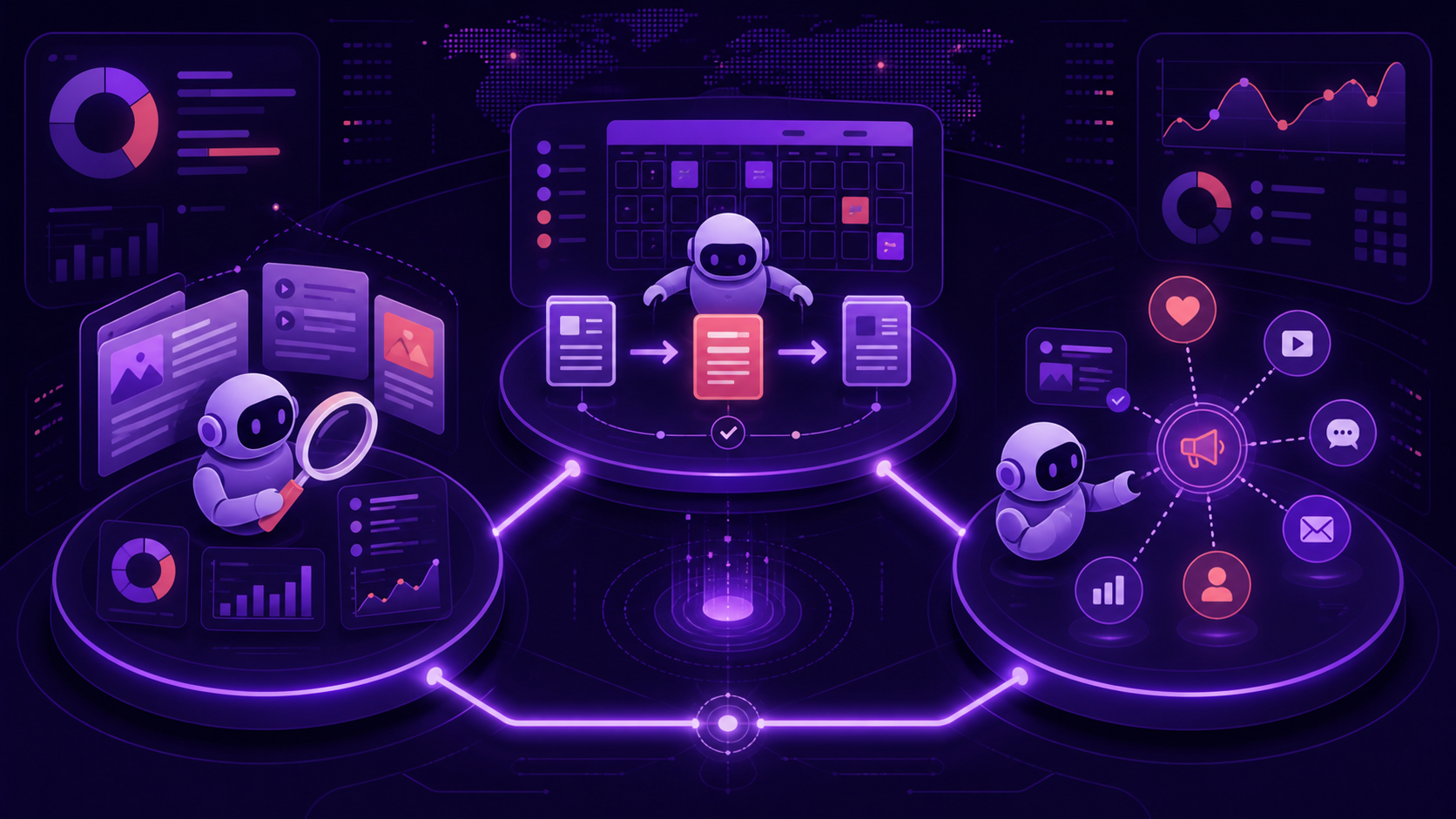
The Distribution & Repurposing Agent
Creating content is half the battle. Getting it in front of the right audience, in the right format, on the right platform — that’s the other half, and most teams treat it as an afterthought. The Distribution & Repurposing Agent changes the math.
This agent takes a single piece of content and reformats it for every distribution channel: a blog post becomes a LinkedIn carousel, a Twitter thread, an email newsletter segment, a short-form video script. It schedules publishing at channel-optimal times and tracks performance per channel, feeding data back into the Intelligence Agent for continuous optimization.
Teams using AI agents report 42% faster time-to-publish, according to HubSpot. The Distribution Agent is where that acceleration compounds most visibly — because it eliminates the manual reformatting bottleneck that creates a 3-7 day lag between “content ready” and “content published across channels.”
-
7Cross-Platform Format OptimizationTrain the agent to take a single long-form piece and generate platform-native versions automatically. A 2,000-word article becomes a 1,200-character LinkedIn post with carousel structure, a 7-tweet thread, a 400-word newsletter segment, and a 90-second video script with visual cues. Each output respects the platform’s format constraints, character limits, and content norms. This skill alone eliminates 4-8 hours of manual repurposing per piece of content.
-
8Channel-Specific Scheduling & PublishingConnect the agent to your publishing tools (WordPress, LinkedIn API, Buffer/Hootsuite, email platform) and configure channel-optimal timing rules. The agent schedules each format variant based on when your audience is most active on each platform. It handles the logistics of publishing cadence — ensuring three LinkedIn posts don’t go live simultaneously, spacing newsletter sends from social posts, and maintaining consistent weekly output without human calendar management.
-
9Performance Measurement Per ChannelThe agent tracks engagement, click-through, and conversion metrics for each piece of content across every distribution channel. It generates a weekly performance digest that answers the question most content teams can’t: which topics perform best on which channels, and what format generates the highest conversion rate? This data feeds back into the Intelligence Agent, creating a closed loop: intelligence informs creation, creation feeds distribution, distribution generates performance data, data refines intelligence.
The DEAL Framework for AI-Native Content Operations
Building the agents is the technical work. Deploying them strategically is the leadership work. Here’s how Tim Ferriss’ DEAL framework maps to content operations in the AI era:
Delegate. The Intelligence Agent handles competitive research and gap analysis. The Editorial Agent handles scheduling and routing. The Distribution Agent handles reformatting and publishing. These are delegation decisions, not abdication decisions — you’re not outsourcing creativity, you’re offloading the operational scaffolding that surrounds it.
Eliminate. Some things your team does shouldn’t exist at all. Manual competitive monitoring that produces reports nobody reads. Calendar wrangling in spreadsheets that go stale within 48 hours. Reformatting content across five platforms by hand. Before you automate a process, ask: should this process exist? The Intelligence Agent eliminates the need for weekly competitor Google searches. The Editorial Agent eliminates calendar meetings that could be automated decisions. The Distribution Agent eliminates the “reformat and repost” grind.
Automate. This is where the agents run. Once you’ve delegated what should be delegated and eliminated what shouldn’t exist, automate the cycles: weekly competitive intelligence briefs, draft routing with review windows, cross-platform format generation, performance digest delivery. The goal is a content operation where your team shows up to make strategic and creative decisions — not to move data between tools.
Liberate. This is the payoff. When your best content strategist isn’t spending 8 hours a week in competitor research, they’re developing category-defining angles. When your editor isn’t chasing drafts and hunting style violations, they’re elevating the quality ceiling. When your social media manager isn’t manually resizing images for five platforms, they’re building community and engaging with your audience. AI agents don’t replace content marketers. They liberate content marketers to be content marketers.
The teams that build these agents in 2026 will enter 2027 with a structural advantage that compounds: faster intelligence, cleaner workflows, broader distribution, and a team focused entirely on the work that machines can’t do. The teams that don’t will still be writing blog posts with ChatGPT and calling it an AI strategy.
The gap between those two futures isn’t a matter of budget. It’s a matter of decision. As I’ve argued before, AI-generated content is table stakes — AI-orchestrated strategy is the moat. If you’re building this out, the new AI content ops playbook for revenue operators shows where agent deployment fits in the full operating model, and why the generalist AI trap is the bottleneck your team will hit next. And if you’re ready to start building, here’s the practitioner’s guide to building AI-native content operations with Claude Code skills.