
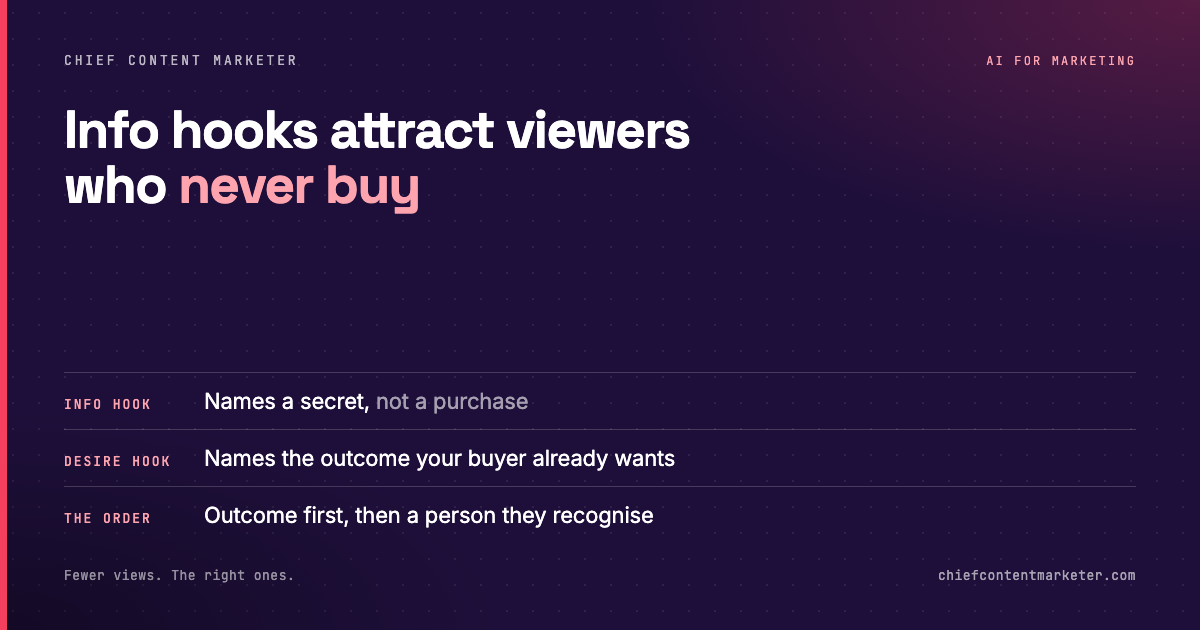




Most hook advice is about pattern interrupts. Start with a number. Start with a mistake. Start with a bold claim. None of that is wrong, and all of it is incomplete, because none of it asks the only question that decides whether a hook produces revenue: what does the viewer want before they know they want it?
There are two kinds of hooks and they attract different audiences. One fills your views with people who will never convert. The other fills it slower with people who will. Almost everyone writes the first kind by default.
Here is the distinction and the method for writing the second kind.
Info hooks sell secrets. Desire hooks sell destinations
An information hook withholds something. “Here are the three best algorithm hacks for Instagram.” “The one setting nobody tells you about.” “Stop doing this in your captions.”
These work. They will get views. They also pull in an audience that is shopping for free tricks, which is the least valuable audience you can build. They arrive for the secret, take it, and leave. Nothing about that hook implies you have something worth paying for.
A desire hook names the outcome instead of hiding it. “Here is how to go from 200 to 20,000 followers in the next six weeks.” Nothing is withheld. The destination is stated plainly, and the value is the path, not the secret.
The reason this converts better is uncomfortable but simple: people do not buy information. They buy a version of themselves. The info hook offers a trick, which they can take and forget. The desire hook offers a transformation, which requires them to stay involved to get it.
Lead with the desired outcome, in numbers
The outcome has to be specific enough that a viewer can picture themselves on the other side of it and check whether it is the thing they actually want. Vague outcomes do nothing because they describe everyone and therefore no one.
“Grow your audience” is not an outcome. “Go from 200 to 20,000 followers in six weeks” is. The second one has a starting point, an ending point, and a clock. All three are doing work.
The starting point is the part most people skip, and it is the most important one. A viewer who is at 200 needs to see 200 in your first line or they assume the advice is for someone else. The moment you name their current position, you have told them this was written for them specifically.

If you do not know your audience’s starting number, you have a research problem before you have a copywriting problem. Go read the comments on ten posts in your niche and count how many people describe the same plateau.
Attach the outcome to a person they can see
An outcome floating in space is a claim. An outcome attached to a character is a story, and stories are believed at a rate claims never reach.
The character can be you (“here is how I went from”), the viewer (“here is how you go from”), or a third party (“here is how someone else went from”). The third option is often the strongest for cold audiences, because it removes the suspicion of self-promotion and replaces it with evidence.
What matters is that the character is specific and adjacent to the audience. Not a Fortune 500 case study. Not an influencer with a team of twenty. Someone who was where the viewer is now, close enough in time that the transformation still seems possible.
The strongest version combines both steps into one sentence: name a person, name their before, name their after, name the timeframe, and imply a system without explaining it yet.
Use the number your buyer is actually at, not the number you wish they were at. This is the line that proves the post is for them.
Specific and measurable. A result someone could argue about, not a feeling nobody can verify.
Six weeks, thirty days, one quarter. A timeframe converts a wish into a plan and creates the urgency you would otherwise have to fake.
You, them, or a named third party. Specific enough that the viewer feels adjacent to the person who did it.
Use desire hooks on cold traffic, paid creative, and any post where you need buyers rather than reach. Do not use them when your goal is genuinely top-of-funnel awareness at scale. A desire hook is narrower by design: it repels people who do not want the outcome, which is the point, and it will lose to an info hook on raw view count every time. If your business model rewards impressions alone, this is the wrong tool. If it rewards qualified attention, it is the only tool.
Fewer views, better viewers
Every info hook is a small bet that reach will eventually convert. Every desire hook is a bet that specificity converts sooner. Both are bets. But only one of them compounds, because the audience a desire hook builds is the audience that buys the next thing you make.
The uncomfortable part is that this looks like a step backward on the dashboard for a month. Fewer views. Lower reach. Then the people who stayed start buying, and the numbers that matter move while the numbers everyone brags about do not.
Write your next hook twice. Once as an info hook, once as a desire hook. Post both. Watch which one brings you a customer instead of a comment.