




The complaint we hear about cold email lands on the channel, and the channel is rarely the problem. The email is. It reads like it went to five hundred people because it did, and readers spot that within the first four words.
Cold email didn’t break because people stopped reading. It broke because the cost of sending a bad email fell to zero, and the market filled every inbox to prove it. The scarce thing is the ability to say something only that one business would care about. That takes research, which is the exact step a volume tool skips.
What is Harvey?
Harvey is an open-source sales agent that runs on your own machine and on the Claude or ChatGPT plan you already pay for. You give it two things, what you sell and who you sell to. It searches for matching companies and reads their websites for buying signals. Then it verifies the decision maker’s email, writes each one a personal cold email, sends it, and handles the replies. That’s the entire loop, and the project is now named Sellbird, with the code in the ethanplusai/sellbird repository on GitHub.
The rename matters if you’ve been searching for it. Everything published under the Harvey name still applies. The repository moved, the documentation moved, and an existing setup carries over. The method is identical, so this guide still treats the two names as one.
Two inputs and one habit
You tell it what you sell, and you tell it who your ideal customer is. That’s the whole configuration. Then it works: it finds leads, reads their websites, and keeps the best fits for what you offer. Research is the first thing the agent does, so nothing gets written until the context exists.
Both inputs reward precision. One clear offer beats a menu of everything you do, because the agent matches leads against the offer, and a fuzzy offer produces fuzzy matches. The customer definition works the same way. The narrower the target, the better the fit of what comes back. A research tool is only as good as the question it’s researching against.
This is where we see most cold email systems quietly fail. They optimize the send, the subject line, and the follow-up cadence, then leave the research to a spreadsheet column. Harvey inverts that order, and the order is the whole trick.
Sources: Instantly, 2026 Cold Email Benchmark Report · lemlist, Cold Email Benchmarks 2026.
Read those numbers together and the case for research writes itself. The average sender earns three replies per hundred emails, and the top decile earns ten or more with the same sending tools. The gap is fit and context, the two things a researched email has and a template doesn’t.
Email that could only have been sent to them
Harvey doesn’t blast the same email to everyone. It writes each one around something specific to that business, the kind of detail only that company would notice. That specificity is what separates a cold email someone answers from a cold email someone archives.

Specificity is a signal that a person read the site before writing, and readers reward it because being read is rare. The generic opener, the compliment about your recent post, the flattery about your growth, all read the same from the fifth email onward. A single detail pulled from their own page reads like it came from someone who looked.
How Harvey works, step by step
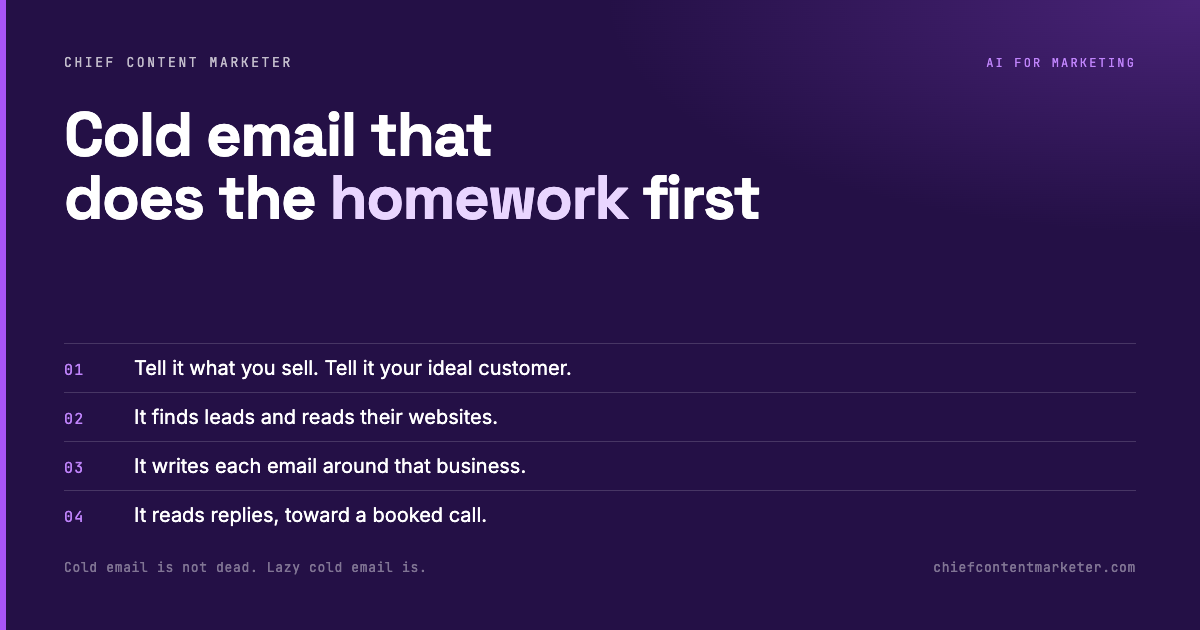
That’s the whole loop we run. You configure two inputs, approve the sends, and the agent repeats the research habit on every lead it touches.
Harvey vs. a sending tool vs. an agency
| What you get | Harvey (Sellbird) | Cold email tool | Agency |
|---|---|---|---|
| Research before writing | Built in, runs first | Manual or add-on | Included |
| Cost | Your AI plan, which you already have | Per-seat subscription | Monthly retainer |
| Runs where | Your own machine, open source | Their cloud | Their team |
| Who owns the research | You keep the method | You rent the volume | They keep the playbook |
| Best for | Founders and small B2B teams who will configure a tool | Teams that need volume now | Teams that want the outcome owned for them |
The honest trade is simple. An agency sells you leads and copy, while Harvey sells you the research habit, encoded, for the price of a plan you already pay for. You lose the hand-holding and keep the homework. For a founder comfortable configuring a tool, that’s a good deal. For a team that wants someone else to own the outcome, it isn’t a replacement.
It keeps going after the first reply
Most tools stop at the send. Harvey doesn’t. It reads the replies and pushes those people toward a booked call. Every thread heads somewhere, the way it would with a sales rep who never skips the research, even on email number five hundred. That continuity, from research to reply to call, is what makes it an agent rather than a spam cannon with better copy.
Where the lead list comes from
Harvey can find companies on its own, and it can also read from a list you feed it. If you want a wider pool to match against, Apollo is one of the databases we see teams pair with a research agent. It carries firmographic and contact data in the same place. The agent still does the reading and the writing, and it doesn’t stop at the list. The database only widens who it gets to look at.
Whatever the source, keep the offer and the customer definition sharp. A bigger list of the wrong companies is just more research pointed at people who were never going to buy.
What to watch before you scale a send
Three honest limits. Research raises quality and volume, and volume still needs a human read of the fit before you scale a send. Reply handling is the fragile step; automated handling of real prospects deserves supervision, not autopilot. And because it runs on your own Claude plan, the agent is only as good as the offer and customer definition you’ve given it. Tighten those before you judge the results.
There’s a subtler limit around volume itself. A researched email is better, not unlimited. Send ten thousand researched emails into a market of two thousand buyers and you run out of good fits before you run out of list. The tool rewards a narrow definition, which is the opposite of how most cold email advice is sold.
Supervision is the other half. The agent drafts and routes, and you still own the judgment about who is worth a reply and when to stop. We treat the approval gate as part of the design, not a training wheel to remove. The same discipline shows up in building quality checks into a content pipeline, where the point is the check, not the speed.
How to get the research you actually want
Two dials decide the quality of what comes back. The first is the offer: describe the outcome you sell, not the list of things you do. “We cut onboarding time for B2B SaaS” gives the agent something to match against; “we do marketing” gives it nothing. The second is the fit definition. The more specific you are, the more the emails read as though a person wrote them for that one company.
Expect to spend a little time up front. This is closer to briefing a new rep than pointing a tool at a list. Feed it a sharp offer and a narrow customer, and it does the homework. Feed it a vague one, and you get researched emails aimed at the wrong people, which is worse than no research at all.
The asymmetry is the reason to bother. The cost of the agent is your setup time, on a plan you already pay for. The cost of doing it by hand or hiring it out is either your hours or a retainer. If your team already runs Claude Code for other work, a lead-research agent is a natural next skill to add. A reusable skill library compounds the moment the second one exists.
Harvey and Cold Email: Common Questions
Is Harvey free?
Yes. Harvey is open source and free to run, and it uses the Claude or ChatGPT plan you already pay for. There’s no separate per-seat subscription for the agent itself.
What happened to Harvey?
It was renamed Sellbird. Same project, same history, new name. The code moved to the ethanplusai/sellbird repository on GitHub, and an existing Harvey setup carries over.
Does Harvey send emails automatically?
Not by default. It runs on your own machine and nothing goes out until you approve it. You can loosen that once you trust the fit of what it writes, and the approval gate is worth keeping longer than you think.
How is this different from a cold email tool?
A sending tool optimizes volume and deliverability. Harvey does the research first and writes each email around a detail specific to that business. It’s a research agent that also sends, not a sender that also personalizes.
What happens after someone replies?
Harvey reads the reply and works the thread toward a booked call, so the conversation keeps moving instead of ending at the send. You still own the decision about which replies deserve your time.
Do I need technical skills to set it up?
Comfort with a developer tool helps, and you don’t need to be an engineer. The setup is two inputs and an approval gate, so it rewards patience more than engineering. If your team already uses Claude Code, the pattern is familiar, and you can pair it with other lead-research automations you already run.
Used properly, it does the part agencies charge for and humans skip: the homework. Keep the fee, do the research.