




Most people treat learning a skill and using a tool as two separate jobs, and both of them land on us. I did that for years. Forty minutes of a tutorial, three notes I never reopened, and no change to how I worked. There is a third option: make the tool do the learning.
Claude cannot watch a YouTube video out of the box. That is a gap we close once, and closing it changes what a video is worth to us. A tutorial stops being thirty minutes you owe your attention, and becomes an input you feed into a system that never forgets what it read.
A transcript is text, and Claude is good with text. So the real work is not teaching a model to see. It is giving it a repeatable way to reach the transcript, extract the method, and file the result somewhere it can find again.
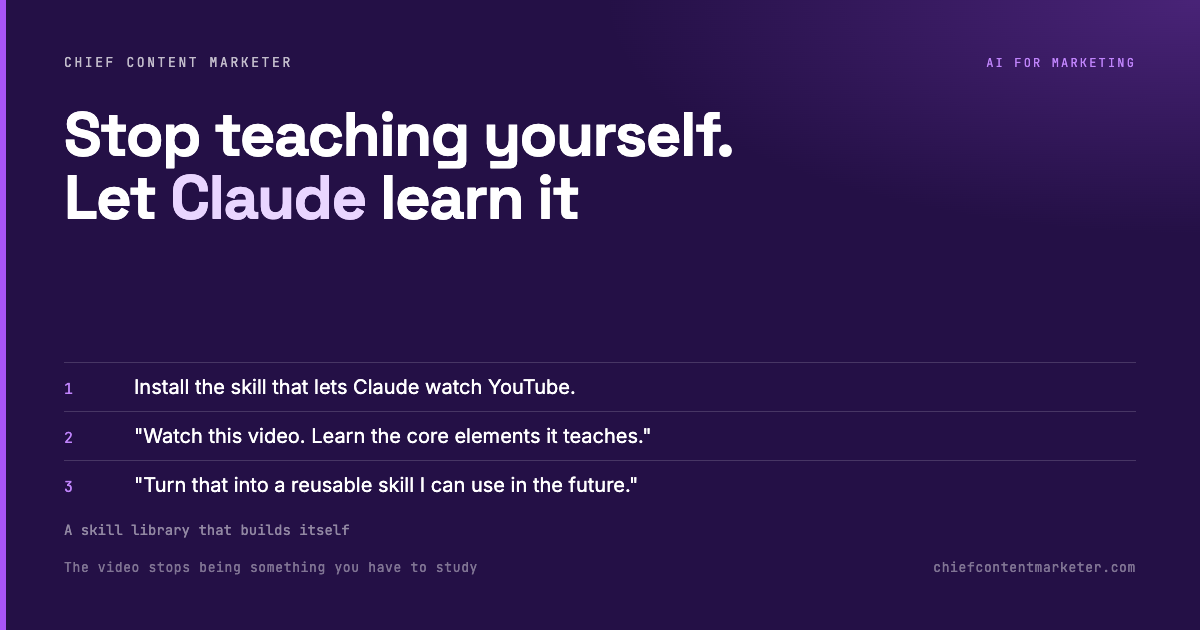
Teach Claude to watch, once
The capability arrives as a skill, and installing it is one instruction. Point Claude at the skill source and ask it to install the skill that reads video transcripts. That is the whole setup. It takes seconds, and we install it once per machine.
In Claude Code, a skill is a folder holding a SKILL.md file. The front matter holds a name and a short description. That description is what Claude reads when it decides whether the skill matters. Write it like a trigger, not a feature list. The Agent Skills documentation covers the file layout, and Anthropic’s own write-up on equipping agents with skills explains why the format is small on purpose. Only the description loads up front. The body loads when the skill is actually used.
youtube-transcript. Vague names are the reason our capable systems keep doing the work by hand.Every step after this is the same four-line request applied to a different video. That consistency is the point. We have turned an open-ended task, watching and taking notes, into a repeatable one with a fixed input.
Then any video becomes a lesson
With the capability in place, the request is fixed and the video is the only variable. Video editing, sales outreach, travel planning, spreadsheet modelling. The topic does not change the instruction, which is why we write the instruction down once.
Read the transcript of this video: <URL>

1. Extract the core elements of what it teaches.
2. Turn those elements into a skill I can reuse.
3. Name the skill and write one line on when to use it.
4. List the three situations this skill applies to.

Save it as a skill, not a summary.
Line four is the cheap verification step, and it is the one people skip. If Claude cannot name three situations where the skill applies, it has summarised the video instead of learning it. A summary describes what happened. A skill tells us what to do next time, which is a different artifact.
Ask for the name and the trigger together. A skill called “video notes” has no trigger, and I have watched a dozen of those go unused. A skill called “rewrite a cold email opener in three lines” still needs its condition. Add it: “only when the reply rate is under 2%.” That is the line that tells Claude when to reach for it.
What separates a skill from a summary
A skill survives contact with a real task. A summary does not. Four parts decide which one we built, and we can check all four in about a minute.

| Part | What it answers | Weak version |
|---|---|---|
| Trigger | When should Claude use this, in plain language? | “For videos” tells it nothing about timing |
| Procedure | What are the ordered steps, with the decision points named? | A paragraph of description with no sequence |
| Constraints | What must it never do, and what does good look like? | Missing entirely, so output drifts toward generic |
| Verification | How do you know the output is right before you use it? | No check, so errors compound quietly |
The constraints row is where most skills fail. A tutorial rarely states its own boundaries, so the video says what to do and never says what to avoid. We ask for it explicitly. “List three things this method should never be used for.” That answer is often the most useful line in the skill.
None of those numbers are benchmarks. They are the shape of our method: one setup, one prompt, four parts. The value comes from repeating it, not from doing it well once.
A skill library that builds itself
One skill is useful. A library changes what our week looks like, because the second skill costs less than the first, and the tenth costs almost nothing at all. Once Claude knows how I like a task handled, the next skill in that area inherits the vocabulary, the tone, and the boundaries.
We also stop re-explaining the fundamentals. Today I describe my format rules to Claude in every new thread. After the first few skills exist, those rules live in files Claude can read, and the prompt shrinks to the part that is actually new. That compounding is why we bother with naming and structure at all.
The library becomes a working reference assembled from people who already solved the problem. Three videos from someone who edits for a living beat one course we never finish. The same pattern works for code, for design, and for video. It is the same reason the steps in editing video with Claude Code matter more than the tool.
Keep a review habit or the library rots. A library nobody audits becomes a folder of half-remembered techniques that all sound plausible, and none of them get used. Once a month I list the skills and delete the ones we never invoked. A skill nobody has reached for in a month is usually a curiosity we mistook for a capability. Each one makes the useful ones harder to find.
What to watch for before you trust it
Three honest limits. First, a transcript can be wrong. Auto-generated captions mangle product names, numbers, and jargon, so a skill built from a bad transcript carries the error forward with confidence. When the topic matters, feed Claude a second source and ask it to reconcile the two.
Second, a skill is only as good as its trigger. If the description does not name the situation, Claude will not reach for it. We then do the work by hand while assuming the library is helping. Rewrite the trigger the first time you catch yourself working around it.
Third, verification is not optional. A skill learned from a video is unverified code in prose form. Give it a check you can run, which is the same discipline as building quality gates into a content pipeline. If we cannot test the output, we are trusting a tutorial more than our own process.
And be ruthless about what earns a place. A technique worth storing is one we will plausibly need again. Turning a one-off curiosity into a skill just adds clutter to a library we then have to search.
Claude, Video, and Skills: Common Questions
Can Claude watch YouTube videos directly?
Not natively. Claude does not stream video, so it cannot reason about what appears on screen. Give it a skill that retrieves the transcript and it can read every word that was spoken. For most tutorials, that covers the method, the order, and the reasoning.
How do I turn a YouTube video into a reusable skill?
Fetch the transcript, then ask Claude to extract the core elements. Next, have it save those elements as a named skill with a trigger and a short description. Confirm the result by asking for three situations where the skill applies. If it cannot answer, it summarised rather than learned.
What is the difference between a summary and a skill?
A summary describes what the video said. A skill tells Claude what to do the next time a related task appears, including the steps, the constraints, and the check. Skills get reused without the video. Summaries get read once and forgotten.
How many skills should one library hold?
Fewer than you think. A working library is usually a handful of skills you invoke monthly, not a hundred you never open. Prune on a fixed schedule, keep the triggers specific, and add a new skill only when you expect to need it again.
Does this replace learning the skill myself?
Partly, and deliberately. We still need judgment about whether the output is good. What we no longer need is the transcription step, the note-taking, and the remembering. Claude holds the procedure. We hold the standard it has to meet.
If you do one thing after reading this, do the smallest version. Install the transcript skill, drop in one video you have been meaning to watch, and turn it into a single named skill. The mechanism is unremarkable. The compounding isn’t, and we only see it after the first one exists.