




You Are Spending Your LinkedIn Time Backward
Ask most B2B marketers how they use LinkedIn and you will hear the same answer: “I post content.” If you push further — “And what about comments?” — you get a shrug. Maybe they drop a “Great post!” on a colleague’s update. Maybe they do not comment at all.
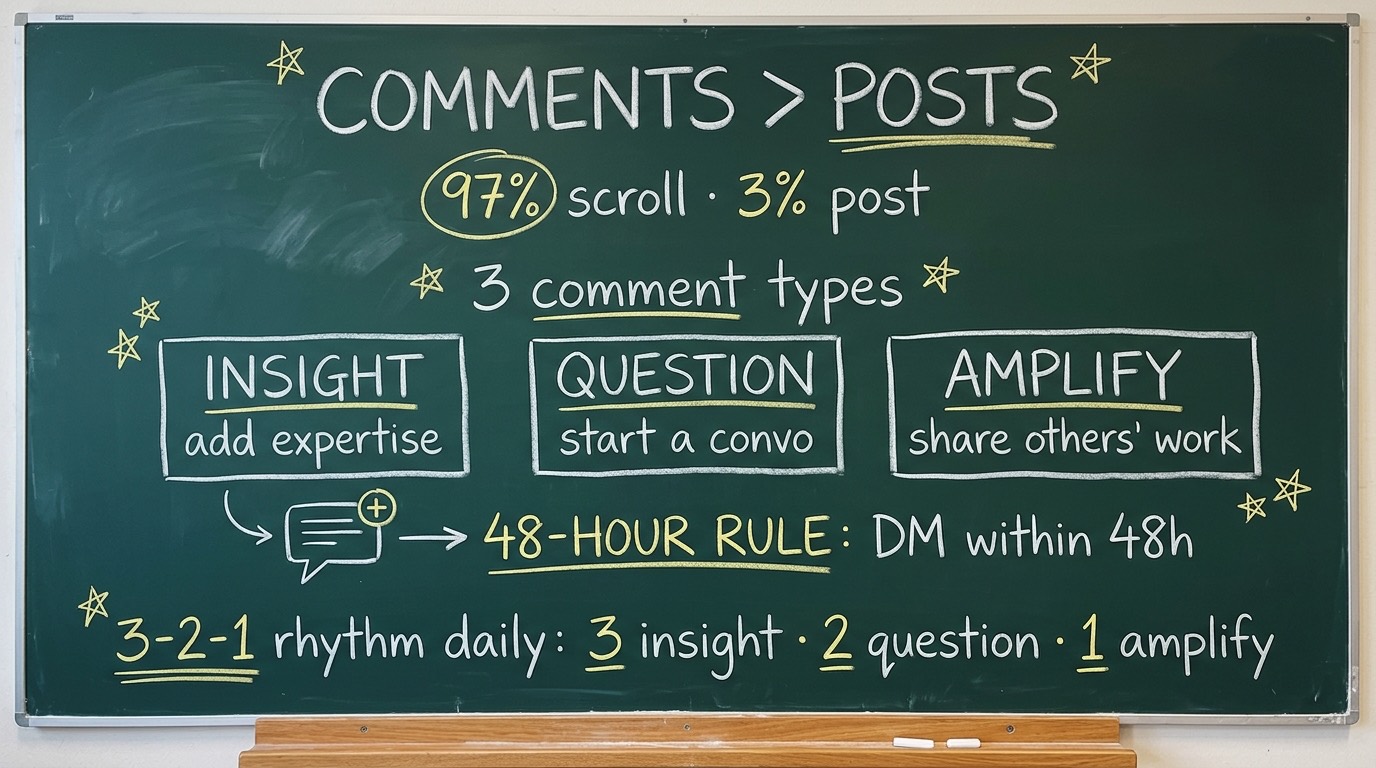
Here’s the math nobody talks about: roughly 3% of LinkedIn’s 1 billion members post weekly. The other 97% are scrolling, reading, and engaging. Your ideal buyers are in that 97%. They are not creating content. They are consuming it. And the comments they leave — on posts from industry voices, peers, and competitors — are the closest thing LinkedIn has to live buying signals.
Strategic commenting is not about being polite. It is about showing up where your buyers already are, adding real value, and making it easy for them to find you when they are ready. This article lays out the exact framework for turning comments into your most reliable inbound lead source.
Why Comments Outperform Posts for Pipeline
If you track time invested versus pipeline generated, commenting beats posting by a wide margin. To understand how commenting fits into your broader strategy, see our pipeline-generating profile guide for the foundation, then layer active commenting as your daily growth engine.
Visibility without the content treadmill. A thoughtful comment on a popular post sits directly in front of that post’s entire audience. If a VP of Sales with 15,000 followers posts about their pipeline challenges and you leave a genuinely useful comment, 15,000 people see your name, headline, and thinking. That is earned distribution with zero content creation overhead.
Context is pre-built. When you comment on a post about demand generation challenges, everyone reading already knows the context. You do not need to establish the problem — it is already established. Your comment can go directly to the solution, which is what buyers actually want.
The algorithm rewards conversation starters. LinkedIn’s feed algorithm weights meaningful comments more heavily than likes or reactions. A post with 30 thoughtful comments gets surfaced to more people than a post with 200 reactions and 3 comments. When your comment sparks further discussion, the algorithm amplifies the entire thread — and your contribution sits at the center of it.
For a complementary view on measuring pipeline impact, see our post on why traditional attribution models lie.
The Three-Comment Framework
Not all comments are created equal. “Great post!” does nothing for your pipeline. “Interesting perspective” is barely better. Strategic commenting requires intention, and there are exactly three types of comments worth leaving.
The Insight Comment does the heavy lifting for your personal brand. It demonstrates competence without self-promotion. The key: add something the original post did not cover. Do not just agree — extend. A marketer who reads your insight comment and thinks “this person knows their stuff” is a marketer who clicks your profile.

The Question Comment is the conversation starter. It signals that you are curious, collaborative, and not just broadcasting. The best question comments are specific enough to show you actually read the post, but open-ended enough that the author wants to reply. When they do, you have a public conversation with an influencer — and their entire audience is watching.
The Amplify Comment builds reciprocity faster than anything else on LinkedIn. When you genuinely amplify someone’s work — not with a repost, but with a specific, personal comment about why it mattered — they remember you. Next time you reach out, you are not a stranger.
How to Find the Right Conversations
You cannot comment strategically if you cannot find strategic conversations. This is not about which content formats work on LinkedIn — it is about which comment threads do. Most people scroll their feed hoping to stumble onto something worth engaging with. That is passive. Here’s the active approach.
-
1Build Your ICP Creator ListIdentify 15-20 LinkedIn creators whose content your ideal buyers read. These are not necessarily your competitors — they are the thought leaders, practitioners, and industry voices your ICP follows. Turn on post notifications for these accounts. This is your commenting feed.
-
2Monitor 3-5 ICP HashtagsHashtags like #demandgeneration, #b2bmarketing, and #salesstrategy surface posts from people you do not yet follow. Spend 5 minutes a day scanning the top posts in your ICP’s hashtags. The engagement on these posts tells you what your buyers care about right now.
-
3Follow the Commenters, Not Just the CreatorsWhen you see a valuable comment on a post in your space, click through to that person’s profile. They are highly likely to be in your ICP — they are actively discussing the exact topics your product or service addresses. Follow them. Their future posts and comments become more surfaces for your strategic engagement.
-
4Create a Saved Posts List for Deeper EngagementNot every post deserves an instant comment. When you spot a post with high engagement and a discussion thread that aligns with your expertise, save it. Come back during your dedicated commenting block and leave a thoughtful comment that stands out in an already-active conversation.
From Comment to Conversation
Here’s where most people get it wrong. They leave a great comment, someone engages with it, and then… nothing. The comment sits there. The opportunity evaporates. A comment without a follow-up is like a handshake without a name — polite, forgettable, and generating exactly zero pipeline.
The transition from public comment to private conversation is the most important skill in this framework. It is also the one most people fumble because they jump from “great post” to “here is my calendar link” in a single move. That kills trust instantly.
The 48-hour rule. If someone engages with your comment — replies to it, likes it, or especially if they view your profile afterward — you have a 48-hour window to initiate a connection request or DM. After that, the context fades. The person barely remembers who you are.
The value-first DM. When you send a connection request or message, reference the specific conversation. Do not pitch. Your message should sound like this:
Hey [Name] — really appreciated your take on [topic] in [Creator's] post. The point about [specific detail] made me rethink how we approach [related challenge] on our team. Would love to connect and follow your work.Notice what this does: it references the exact conversation, shows you paid attention, and asks for nothing. The goal of your first DM is not a meeting. It is a connection. Pipeline comes from relationships, and relationships start with low-pressure, context-rich outreach.
When to pitch (and when to shut up). Wait for a signal. If they reply to your DM with a question about your work, that is your opening. If they mention a challenge you solve, you can offer to share how you have handled it. If they keep replies short and polite, do not push. Some of your best leads will come from people who watched you for six months before ever reaching out.
Scaling Without Becoming a Bot
The goal is consistency, not volume. Fifteen minutes a day of genuine, strategic commenting will outperform three hours of scrolling and throwing likes at everything. Here’s how to make it a habit without turning into a comment-spamming robot.
Build a swipe file, not a script. Keep a running document of your best comments — the ones that got replies, sparked conversations, or led to connection requests. These are not copy-paste templates. They are starting points. Before you type, look at your swipe file for the type and tone that worked. Then write fresh for the specific post in front of you. The structure repeats. The words do not.
Time-block it. The biggest killer of a commenting habit is “I will do it when I have time.” You will not. Block 15 minutes on your calendar — same time every day. Morning works best because that is when most creators in your space publish and conversations are fresh. Open your ICP Creator List, scan for new posts, and leave 3-5 comments. Done.
Track what works. The only metric that matters is: did this comment lead to a profile view, a connection, a DM, or a conversation? You do not need a CRM for this. A simple spreadsheet with columns for date, post, comment type, and outcome is enough. After 30 days, you will see patterns: which creators’ audiences respond to you, which comment types drive the most profile views, and what topics trigger the best conversations.
Start Tomorrow Morning
You do not need new tools. You do not need a content calendar. You do not need to convince your boss to approve a LinkedIn strategy budget. You need 15 minutes, a list of 15 creators in your space, and a commitment to leaving comments that actually say something.
The 3% who post are fighting for attention in an increasingly crowded feed. The 97% who only scroll and engage are where your next five customers are currently reading a post and wondering if anyone else deals with the same problem. Show up in their comments with a useful insight, a sharp question, or a genuine amplification of someone else’s good work. Do it every day for 30 days. Then check your inbound leads.
You will be surprised.
LinkedIn Comments vs. Posting vs. Cold DMs
- Surface live buying signals in public
- Create warm profile visits faster than posting alone
- Give you context before the first DM
- Work especially well when paired with executive thought leadership
- Your core authority narrative on the feed
- A broader employee advocacy layer
- A clear offer page for conversion
- A pillar strategy tying the whole system together
FAQ: turning comments into pipeline
How many LinkedIn comments should I leave per day?
For most B2B teams, 3-5 strong comments on ICP-relevant posts is enough. The win comes from quality and context, not volume.
Should comments replace posting?
No. Comments are the fastest signal-capture layer, but they work best inside a broader LinkedIn demand engine that also includes publishing, executive visibility, and distribution.
What should I do after someone engages with my comment?
Move while context is fresh. View their profile, send a connection request tied to the thread, and route the conversation toward the specific problem you solve.