




The Thread Already Did the Hard Part
Watch what happens to a good post. It lands, the comments come in, the notifications stack up for a day or two. Somebody makes a sharp point, you reply, they reply again. For about forty-eight hours you are in a real conversation with a person who has told you, in public, what they care about.
Then it stops. The post falls down the feed, the notification badge clears, and nothing happens. No message. No call. Nothing added to a pipeline. Two weeks later you cannot remember the person’s name, and if you go looking you will find the thread buried under three newer posts.
That is one of the most expensive habits in founder-led marketing, and it is not a content problem. The content worked. The distribution worked. The conversation happened. What failed is the twenty minutes after the conversation, and almost nobody has a routine for it.
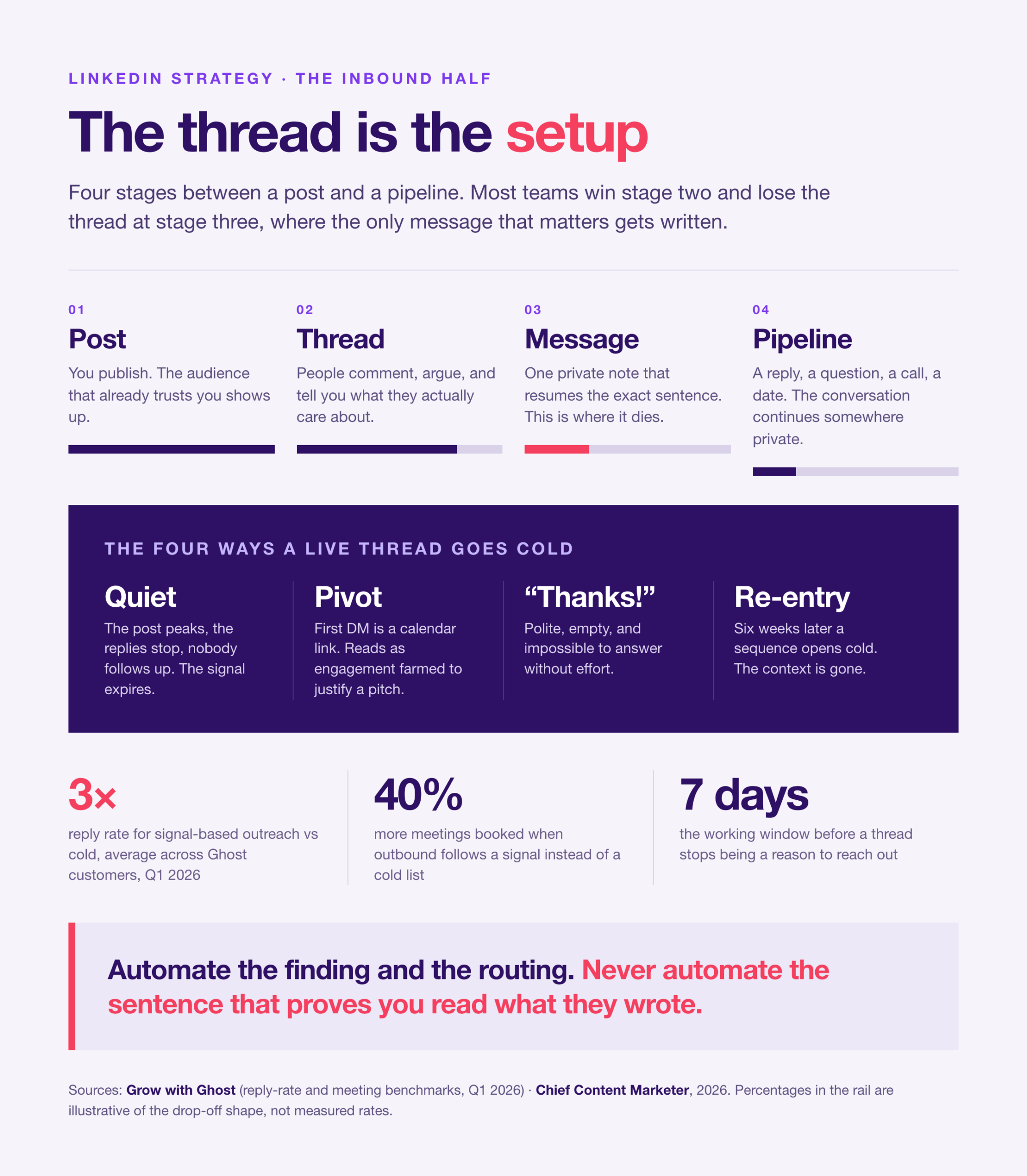
Baz runs Grow with Ghost, an AI outreach and CRM product built around LinkedIn signals, so he sees the pattern from the inbox side. His framing is the whole article: treat the thread as the setup and the message that follows as the decision point. That second message is where the deal either starts or dies.
Those numbers come from a vendor with a product to sell, so treat them as directional, not gospel. The direction is still worth noting: warm beats cold by a margin big enough that the argument is settled. The open question is whether you use the warmth you already generated.
Three Reasons the Thread Beats Any List You Can Buy
A purchased list gives you a title, a company, and an email address. A comment thread gives you something different. All three advantages disappear the moment you copy the contact into a sequence and forget where they came from.
Permission is already granted
The person chose to engage with your work. Not a look, not an impression: a typed sentence or a named reaction on a post that carries your name. That’s a small but real act of consent, and it changes the temperature of the next message. You’re not interrupting a stranger. You’re continuing something they started.
The context is specific
They told you which part of the post mattered to them. Someone who comments that the hard part is getting sales to act on the signals has told you which problem to solve first. A cold contact requires you to guess at that. A commenter hands it over.
The recency is real
LinkedIn engagement is perishable. A like from March is a fact about March, not a reason to reach out in November. A thread stays live in someone’s memory for days, not months. That’s why the routine runs weekly, not quarterly. This is the same decay problem covered in our dark social tracking guide. Attention that is not captured when it happens is mostly attention you lose.
The Four Ways Founders Waste a Good Thread
Almost every wasted thread fails in one of four ways. All four are easy to spot in your own sent folder from the last quarter.

| Failure | What it looks like | Why it loses |
|---|---|---|
| Going quiet | The thread peaks, you reply twice, then drop it | The other person has no reason to continue, and the signal expires |
| The hard pivot | First DM is a calendar link and a service description | It reads as bait: engagement farmed to justify a pitch |
| The thank-you | “Thanks for the comment, appreciate you!” | Polite, empty, and impossible to answer without effort |
| The cold re-entry | Six weeks later, a sequence opens with “Noticed you’re a leader in…” | All the specific context is gone, so you are cold again |
The pattern behind all four is the same: treating engagement as a scoreboard instead of an opening. The thread is a conversation you were lucky enough to have in public. The only thing left is to have it somewhere private, while it still means something.
The Four-Step Routine: Capture, Read, Resume, Route
This takes twenty minutes a week and doesn’t require a new tool. Run it on a fixed day, on the posts from the past seven days, and stop when the list is empty.
Open each post from the week and list every person who commented. Names, headlines, companies. The like count is not data you can act on; the name is. If the post has thirty comments, that’s thirty names, which is a week of conversations in one sitting.
Sort into three buckets: people who added their own experience, people who disagreed or pushed back, and people who asked a question. Those three groups need three different next messages. A generic reply to a person who argued with you is worse than saying nothing.
Write one message that references the specific thing they said and adds one thing they didn’t have. The addition is the point: a number, a worked example, or a template they can steal. If they mention the handoff from marketing to sales, send the two-line fix, or the link to what you wrote about it.
Every resumed conversation gets a record and a next date. Not a mental note, not a starred message. If the person replies, the next action is a call or a question. If they don’t, the next action is in seven days. If that goes quiet, the thread goes to nurture rather than back into the void.
What a Resume-the-Thread Message Looks Like
The difference between a message that gets a reply and one that gets ignored is usually one specific detail. Three before-and-after examples, one per bucket from step two.
| Instead of this | Send this |
|---|---|
| “Thanks for engaging with my post! I help B2B teams build pipeline with LinkedIn. Worth a quick call?” | “You said the hard part is getting sales to act on the signals, not collecting them. That matches what we found: the alert matters less than who owns it. I wrote the two-step version here, curious whether your team has the same gap.” |
| “Appreciate the comment, great perspective.” | “You pushed back on the comment-volume argument, and I think you are half right. Volume without a list of threads to watch is noise. What changed it for us was capping it at six comments a day on a fixed list. How are you handling the selection side?” |
| “Noticed you’re a leader in B2B SaaS, would love to connect.” | “You asked how this works when the buyer never comments, only reads. Honest answer: the reads are invisible, so the comments are the only reliable surface, which is why we work the threads first. Happy to share the checklist we use if it is useful.” |
None of those messages pitch. All three make the next step obvious without asking for it. That’s what “the sales conversation tends to start itself” looks like in practice. The other person replies with their situation, and the call becomes the natural next line rather than a request.
Where This Sits in Your Content Engineering Loop
It’s tempting to file this under sales tactics. In a content engineering model it belongs somewhere more structural: the measurement layer, feeding back into the source layer.
Every content system has the same six layers, covered in full in our content engineering feedback loop: source, knowledge, generation, evaluation, distribution, measurement. Most teams build the first five and treat the sixth as a dashboard. The comment thread is the one place where measurement stops being a report and becomes an input. The people who engage are the most precise audience research you will get, and what they say tells you what to publish next.
That’s the difference between a content calendar and a content system. The calendar publishes and hopes. The system reads the thread, learns what the audience is arguing about, and writes the next post into that argument. The DM is the same loop running at the level of one person instead of one audience.
If you only take one thing from this, take the ordering. The thread is research first and pipeline second, and it only becomes pipeline if somebody sends the second message.
What Software Should and Should Not Do Here
Once the routine is real, tools make sense. Products in this category all work the same way. They score a contact by their LinkedIn activity, then put the highest-scoring people in front of you or into a sequence. Grow with Ghost does this with a 0–100 lead score built from ICP fit and buying signals. Its built-in pipeline keeps every reply attached to the conversation that started it, which is the part most stacks get wrong.
The failure mode is common. A tool that scores signals and then sends a template has automated the wrong half. It found the warm contact and then made the message cold again. The score tells you who to write to. It doesn’t tell you what to say, and the specific sentence from the thread is the only thing that reliably gets a reply.
The other discipline that matters is restraint. Not every commenter is a buyer, and a peer who argues with you every week is not a lead, they are a relationship. Working the thread is a filter as much as a funnel. The people worth a message make themselves obvious, and the rest stay in the audience where they belong. Our guide to commenting for inbound leads covers the outbound half of this system, the threads you join rather than the ones you start.
Three Numbers That Tell You If It Is Working
Impressions and follower growth won’t tell you whether any of this works. Track three things instead, all of which you can count by hand for the first month.
- Thread-to-message rate. How many of the people who engaged got a message from you within seven days. If this is under half, the routine isn’t running, no matter what the dashboard says.
- Message-to-reply rate. Of the messages you sent, how many got a real reply. A resumed conversation should beat a cold sequence comfortably. If it doesn’t, the messages are generic.
- Reply-to-conversation rate. Of the replies, how many became a call, a proposal, or an actual next step with a date. This is the only one that becomes pipeline.
Run the routine for four weeks and you’ll have a number for each. Most founders discover the same thing: the threads were never the problem, and the volume was never the problem. The gap was the twenty minutes nobody had scheduled.
Sources: Grow with Ghost (600M-contact database; reply-rate and meeting benchmarks, Q1 2026), DemandSage LinkedIn Statistics 2026. Quoted with permission from Baz Furby, Founder, Grow with Ghost.