




Your Best Content Is Being Shared in Places You Cannot See
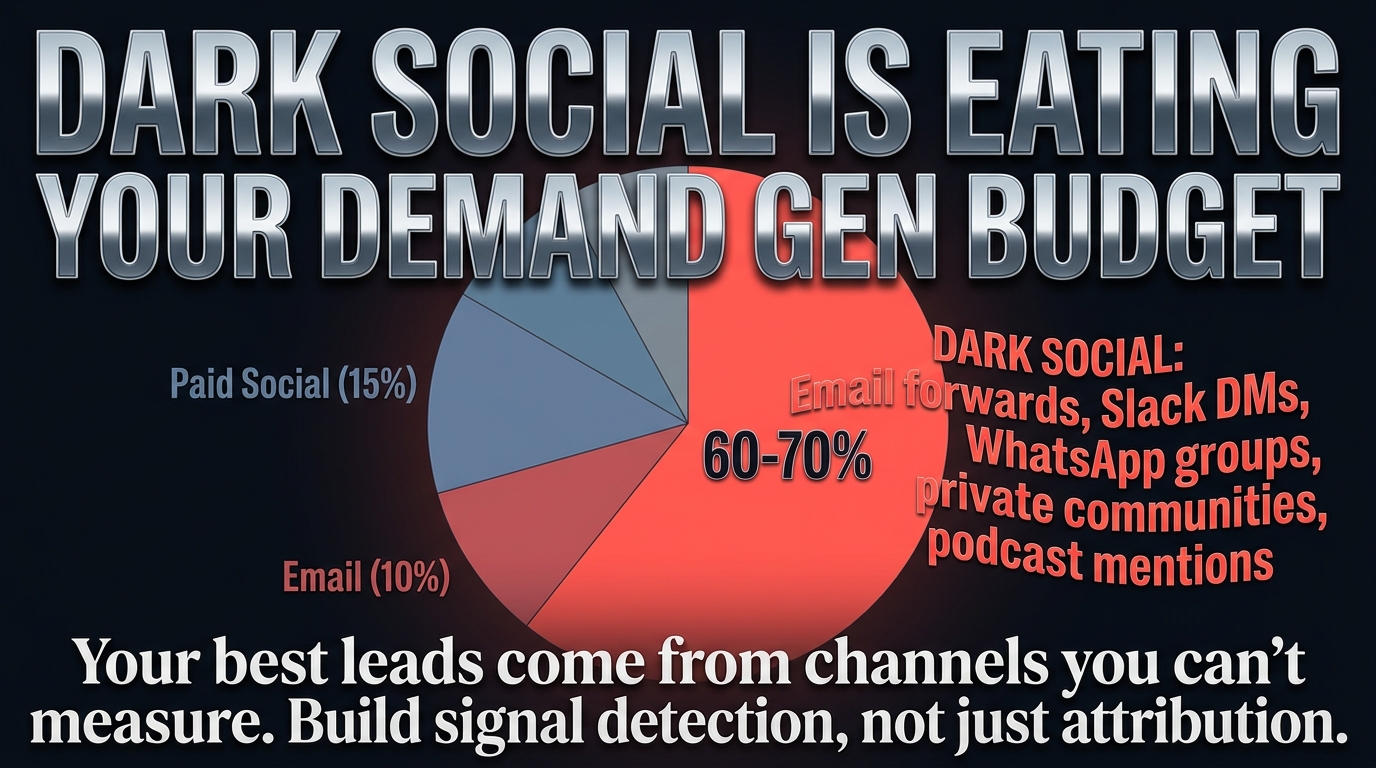
This is not a hypothetical. Dark social — content shared through private channels like messaging apps, email, and direct messages — accounts for an estimated 70% to 84% of all content sharing, according to multiple studies from RadiumOne and later SparkToro research. Yet demand gen teams spend millions optimizing the 16% of sharing they can track. It is like training for a marathon by studying how you walk to the mailbox.
The problem is not that dark social exists. The problem is that demand gen strategy has become indistinguishable from demand gen measurement. We optimize for what we can track because tracking justifies budget. But the buyer does not care about your UTM parameters. They care about whether their colleague said “this is worth reading” in a Slack DM.
The More You Track, the Less You Actually Know
Here’s the uncomfortable truth: the channels that are easiest to measure are getting worse at driving demand. Paid social engagement rates continue declining. Email open rates have been flat for years. Display ad clickthrough rates hover below 0.1%. Meanwhile, the channels where buying influence actually happens — peer recommendations, community discussions, private Slack groups, text messages — are invisible to your analytics stack.
The Content Marketing Institute found that 55% of B2B marketers say creating content that prompts a desired action is their biggest challenge. I would argue the challenge is not creating action-driving content. It is measuring where the action actually starts. When a buyer trusts a recommendation from a peer more than any piece of content you publish, the content is not the conversion trigger — the relationship is. And relationships do not fire GA4 events.
Demand gen teams respond to dark social the same way my parents responded to text messaging in 2005 — by pretending it is not a real thing and hoping it goes away. It is not going away. It is getting bigger. Slack now has over 200,000 paid customers. WhatsApp has 2 billion users. Discord has 150 million monthly active users, and increasingly, those servers include industry communities where buyers ask “has anyone used X vendor?” before ever visiting your website.
Optimize for Shareability, Not Clickability
If you cannot track where your content goes, you can at least design content that is more likely to go somewhere. The difference between shareable content and clickable content is the difference between a billboard and a referral. A billboard is seen. A referral is trusted.
Content that survives dark social has three characteristics.
First, it is extractable. Someone can copy a single insight, a framework name, or a data point and forward it with zero context. “Check out slide 4” only works if slide 4 stands alone. Your content should be a collection of shareable atoms, not one monolithic blob that requires reading the full piece to extract value.
Second, it provokes a reaction strong enough to forward. Nobody forwards generic advice. People forward content that makes them look smart, that challenges something they have been thinking, or that validates a point they have been arguing internally. The most shared content in B2B is not the most comprehensive — it is the most provocative.
Third, it closes the loop. Every piece of dark-social-ready content should include a clear “if this was forwarded to you” landing point. Not a generic CTA — a specific next step for someone who received the content secondhand. “Forwarded this article? Here’s the framework template your colleague was talking about.”

What Dark Social Demand Gen Actually Looks Like
Embracing dark social does not mean abandoning measurement. It means changing what you measure and how you enable distribution.
Measure “forwardability.” For every major content asset, ask: could a reader describe the core insight to a colleague in 30 seconds without pulling up the original? If no, rewrite it until the answer is yes. Shareability is a content design quality, not a distribution tactic.
Build content for the middleman. The person who forwards your content is not the buyer. They are the recommender. Write content that makes the recommender look good. Give them a stat they can quote. Give them a framework they can reference in a meeting. Give them language they can use to describe a problem their team has been struggling to articulate. When you serve the recommender, the buyer finds you through trust, not through a paid ad.
Create “secondhand landing pages.” When someone receives your content via dark social, they arrive cold — no email nurture, no retargeting pixel, no context. Your content page should recognize this. Include a quick “was this forwarded to you?” module. Offer a related asset that extends the insight. Make it trivially easy for a dark social visitor to self-identify and get on the radar.
For more on building content that actually drives pipeline, read our article on why your content attribution dashboard is lying to you and our guide to building a content engine from customer conversations.