
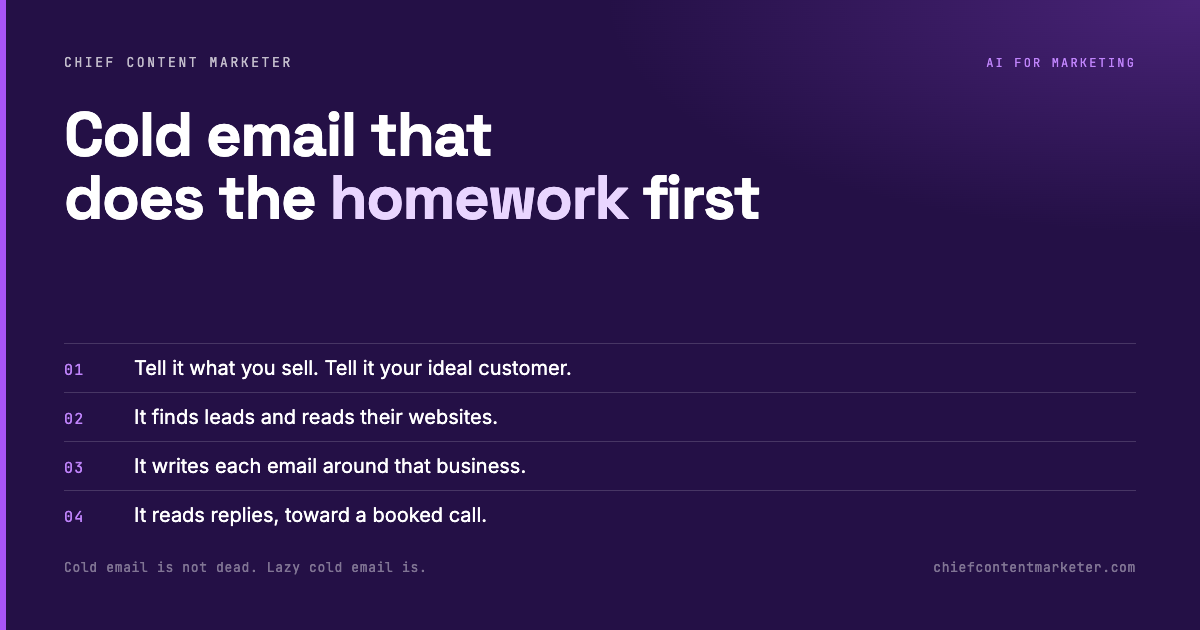




The complaint about cold email is almost never about the channel. It is about the email, which reads like it was sent to five hundred people because it was. Harvey is an attempt to fix the part that actually fails: it does the homework before it writes a word, and it is free and open source on GitHub right now.
The reason this matters is that cold email did not break because people stopped reading it. It broke because the cost of sending a bad email dropped to zero, and the market responded by filling inboxes with them. The scarce thing now is not the ability to send. It is the ability to say something only that one business would care about, and that requires research, which is exactly the step that a volume tool skips.
Two inputs
You tell it what you sell, and you tell it who your ideal customer is. That is the whole configuration. Then it works: it finds leads, reads their websites, and picks the best fits for what you offer. The research is not a step you schedule; it is the first thing the agent does, so nothing gets written until the context exists.
Both inputs reward precision. One clear offer beats a menu of everything you do, because the agent matches leads against the offer, and a fuzzy offer produces fuzzy matches. The same is true of the customer definition: the narrower you draw it, the better the fit of what comes back. A tool that does research is only as good as the question it is researching against.
Email that could only have been sent to them
This is the difference that matters. Harvey does not blast the same email to everyone. It writes each one around something specific to that business, the kind of detail only that company would notice. That specificity is what separates a cold email someone answers from a cold email someone archives.
It keeps going after the first reply
Most tools stop at the send. Harvey reads the replies and pushes those people toward a booked call. Every thread heads somewhere, the way it would with a sales rep who never skips the research, even on email number five hundred. That continuity, from research to reply to call, is what makes it an agent rather than a spam cannon with better copy. The work does not stop at the moment of contact; it continues through the part where most outreach quietly dies.
What to watch
Three honest limits. Research raises quality and volume, and volume still needs a human read of the fit before you scale a send. Reply-reading is the fragile step; automated handling of real prospects deserves supervision, not autopilot. And running on your own Claude plan means the agent is only as good as the offer and the customer definition you gave it, so tighten those before you judge the results.
There is a subtler point about what you are actually buying here. An agency sells you leads and copy. This sells you the research habit, encoded, for the price of a plan you already have. The trade is real, but it is a trade: you lose the hand-holding and keep the homework. For a founder who is comfortable configuring a tool, that is a good deal. For a team that wants someone else to own the outcome, it is not a replacement.
Used properly, it does the part agencies charge for and humans skip: the homework. Keep the fee, do the research.
How to get the research you actually want
Two dials decide the quality of what comes back. The first is the offer: describe the outcome you sell, not the list of things you do. “We cut onboarding time for B2B SaaS” gives the agent something to match against; “we do marketing” gives it nothing. The second is the fit definition, and the more specific you are, the more the emails read as though a person wrote them for that one company.

Expect to spend a little time on the front end. This is not a tool you point at a list and forget; it is closer to briefing a new rep, and the quality of the brief shows up directly in the quality of the first hundred emails. Feed it a sharp offer and a narrow customer, and it does the homework. Feed it a vague one, and you get researched emails aimed at the wrong people, which is worse than no research at all.
The reason to bother is the asymmetry. The cost of the agent is your setup time, on a plan you already pay for. The cost of the alternative, doing it by hand or hiring it out, is either your hours or a retainer. For a founder who will invest an afternoon in configuration, the trade is clearly worth it.