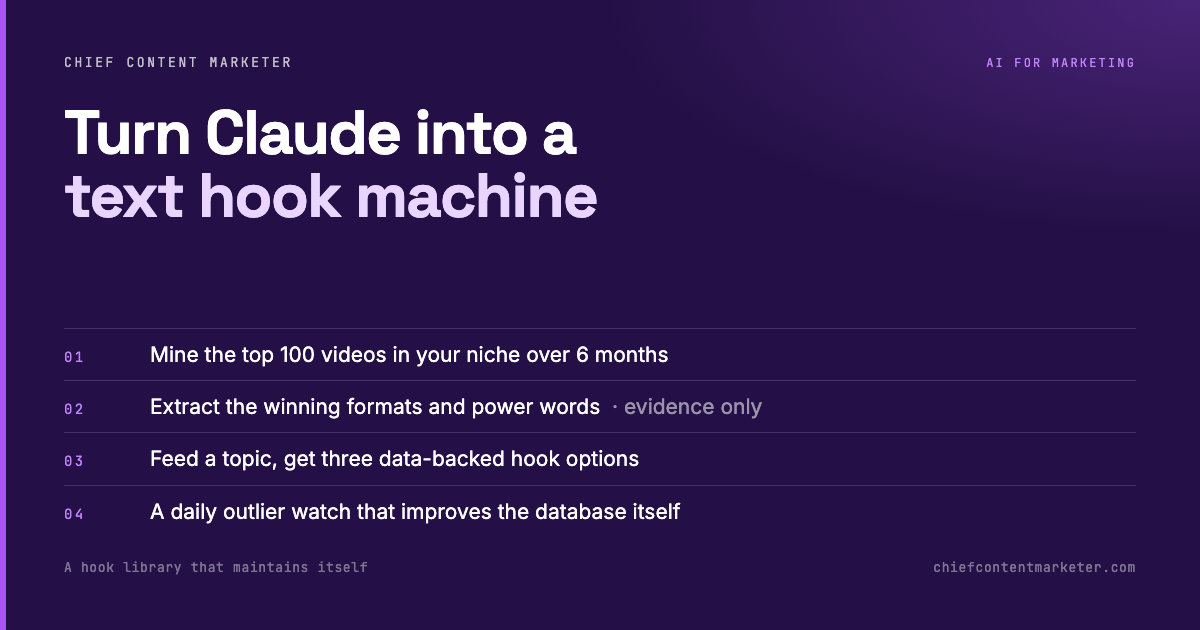
The on-screen text is the most underrated part of a social hook, and most people write it by feel. You can point Claude at the top-performing videos in your niche, have it extract the actual text formats and power words from what already worked, and generate three data-backed title options for any new topic. Set up a daily outlier watch and the hook database improves itself while you sleep.
Watch · 66 seconds
The 3 prompts to copy
Once the plugin and skill are loaded, these are the only lines you type.
1
“Build my text hook database from the top 100 videos in my niche over the last 6 months.”
This is the setup run. It extracts the formats and power words.
2
“New topic: [your topic]. Write 3 text hook options using my database, with why each one works.”
The daily driver. Three options, each explained from the data.
3
“Every morning, find new outlier videos in my niche and add their text hooks to my database.”
Ask ten creators how they write the text on their thumbnails and nine will tell you they just know what feels right. It is the one part of the hook most people never test, even though it is the line a viewer reads before deciding to stop scrolling. The fix is not more intuition. It is taking the videos that already worked in your niche, pulling the text off them, and letting the pattern show itself.
The Shift
Stop Guessing, Start Extracting
Most hook advice hands you a formula someone invented and asks you to trust it. What actually converts in your niche is already published. It is sitting in the top-performing videos of the last six months, and every one of them carries a text hook you can read off the screen.
If you point Claude at that corpus and have it isolate the text, the guesswork disappears. You are no longer writing hooks from taste. You are writing them from a ranked, evidence-backed list of what your specific audience already rewarded. Nothing is brainstormed. Every phrase in the database earned its place by being the text on a video that outperformed its neighbours.
The Build
Turning Claude Into a Hook Machine
The workflow has two moving parts, and the order matters. First comes the bridge that gets your social data into Claude. Then comes the skill that reads it. Neither one alone gets you there.
1
Connect the data source
Install the Sandcastles.ai plugin inside Claude. It is the bridge: without it, Claude has no view of your social performance, and a hook generator with no data is just another prompt. This step is what makes everything downstream evidence-based.
2
Load the skill
Drop in the text-hook skill file and run it. The skill is the method: it knows to pull the top 100 videos in your niche over six months, then mine them rather than invent anything.
3
Let it extract formats and power words
It breaks every winning text hook into two things: the format it uses and the words doing the work. Formats are structural, like an A vs B comparison label or a numbered lesson. Power words are the adjectives and phrases that show up across the biggest outliers, ranked by how far they beat the median.
4
Feed it a topic
Give it anything you plan to post about. It returns three text hook options built from your own database, each with a plain-language explanation of why it should work. You keep the writing; it supplies the pattern.
5
Schedule the outlier watch
Turn on a recurring task that scans every morning for new breakout videos in your niche. When it finds one, it reads the text hook and folds the new format and power words back into the database.
6
Let it compound
Every morning the library grows by whatever the niche rewarded overnight. The output gets sharper without you touching it, which is the part that turns a weekend project into an asset.
The best hook for your audience has already been written. Your job is to find it, not to invent it.
Source: Chief Content Marketer
Why It Works
Formats Live in the Text, Not the Algorithm
The reason this beats a generic hook formula is that it reads the pattern off real outliers instead of importing someone else’s taste. An A vs B label and a numbered lesson are not virality tricks. They are structures that make a viewer understand the stakes in a single glance, and the data proves which structures your audience rewards.
The power words are the second layer. When the same qualifier keeps appearing on videos that beat the median, that is signal. Highlighted chips in the database come only from videos above a 10x outlier threshold, so the phrases carrying your topic are earned, not guessed. Extracting them means you stop reaching for whatever adjective comes to mind and start using the ones already doing the work.
100
videos mined per niche to seed the database, then topped up daily by the outlier watch. The library keeps growing; you do not.
Where it breaks down
This is only as good as your data source. If the connected account does not see the niche you actually want to win, the database learns the wrong patterns. Keep the watchlist tight, and treat the output as three strong starting points, not final copy. The judgment call, which hook fits your angle today, is still yours.
Bottom Line
A Hook Library That Maintains Itself
Most creators treat the title text as an afterthought and rewrite it in thirty seconds. This flips that: the text becomes the most studied line in the post, backed by a database of what already worked in your niche and refreshed every morning. The setup is a plugin and a skill file. The payoff is that the one line that decides whether anyone reads the rest stops being a guess.
Start by building the database for your own niche, then post three options against each other and let the results tell you which format your audience actually reads. The machine gets better as it eats. All you have to do is feed it a topic and pick the winner.
Get Smarter With AI, Every Week
Practical AI workflows for content marketers, one short email at a time. No fluff, no vendor spam.