
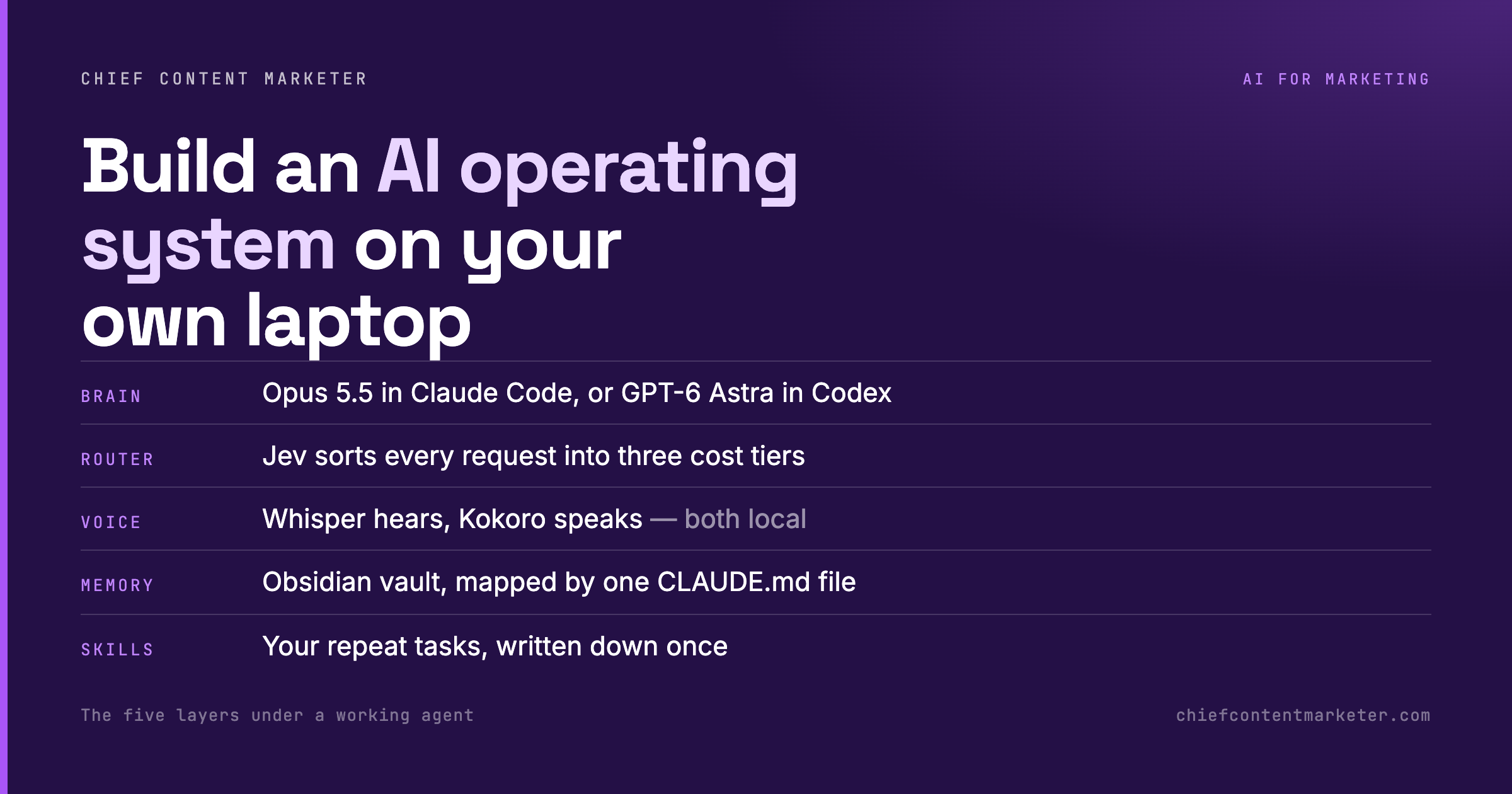




The default experience of AI is stateless. You open a window, ask, read, close it, and tomorrow nothing carries over. That is fine for a one-off question and terrible for work you repeat every day. An agentic setup inverts it: instead of you re-explaining context forever, the system holds your memory, your standards and your repeat tasks, so every request starts where the last one ended.
A Chatbot Forgets. An Operating System Remembers.
The difference is not the model. It is everything around the model. A chat window has no memory, no routing, no notion of what you do on a Tuesday morning. An operating system has all three, plus a way to speak and a way to act.
Think of it as five layers stacked on top of each other. The brain is whichever frontier model you point at. The router decides which requests even reach the brain. The voice is how you talk to it hands-free. The memory is where everything lands. The skills are the repeat work, written down once so the system runs it without you.
The Five Layers, In Build Order
Each layer is only worth building once the one above it works. Do not start at the bottom.
Cheap Requests Should Stay Cheap
Most of what you ask a personal assistant does not need a frontier model. “What are my priorities?” is a lookup against data you already have. “Summarize today’s news” is a small-model job. Meanwhile the actual work, research, drafting, running a script, is the only part that deserves the expensive model.
Without a router, every request pays frontier prices and frontier latency, and the system feels slow enough that you stop reaching for it. Three tiers is not an engineering luxury. It is the difference between a tool you use all day and one you avoid.
The Maintenance Bill Nobody Budgets For
Every layer has a failure mode, and none of them announce themselves. The system degrades quietly, and the first symptom is that you stop trusting it, then stop opening it.
Memory rot. A vault that only grows becomes useless. After three months you have hundreds of captures and no way to tell a decision from a stray thought, so the model retrieves noise and answers confidently from it. Fix it with one rule: raw captures land in one folder, anything that matters gets promoted into a named note that week, and everything else is allowed to expire. Retrieval quality is a housekeeping problem, not a model problem.
Router drag. The cheapest tier is the one people skip. Every request that goes straight to the frontier model costs latency as well as money, and a system that takes twenty seconds to answer a question you could have looked up stops being used. Rules first, small model second, real work last. If a request has a deterministic answer, no model should see it.
Skill sprawl. The temptation is to write a skill for everything in week one. Twenty half-working skills is worse than three that run on schedule, because you stop knowing what fires when. Keep a short list, put a real trigger on each one, and delete anything you have not invoked in a month. A skill with no trigger is a note.

Voice as novelty. Talking to a local speech stack is impressive for a week and then becomes the thing you forget you have. It earns its place in two contexts only: away from a keyboard, and while your hands are busy. If neither applies, a text box is faster, and pretending otherwise just adds a layer that fails.
Two habits keep the whole stack alive: a weekly ten-minute pass where you delete more than you add, and one place where the model records what it did, so you can see the system working instead of guessing. Build the memory layer first, wire it to a source of truth like a content knowledge layer, and only then automate. If you want the ingestion half solved properly, a reference library is the cheapest quality upgrade you can hand the same system.
The Gain Is In the Plumbing
Everyone is chasing the next model. The people getting real work out of AI are the ones who built the plumbing: a place for memory, a way to sort requests, a voice that works without a screen, and a handful of skills that fire on schedule.
None of it is exotic. Obsidian is free, Whisper and Kokoro are open source, Claude Code and Codex are a subscription you probably already have. The work is in wiring them together, and the order you do it in.