
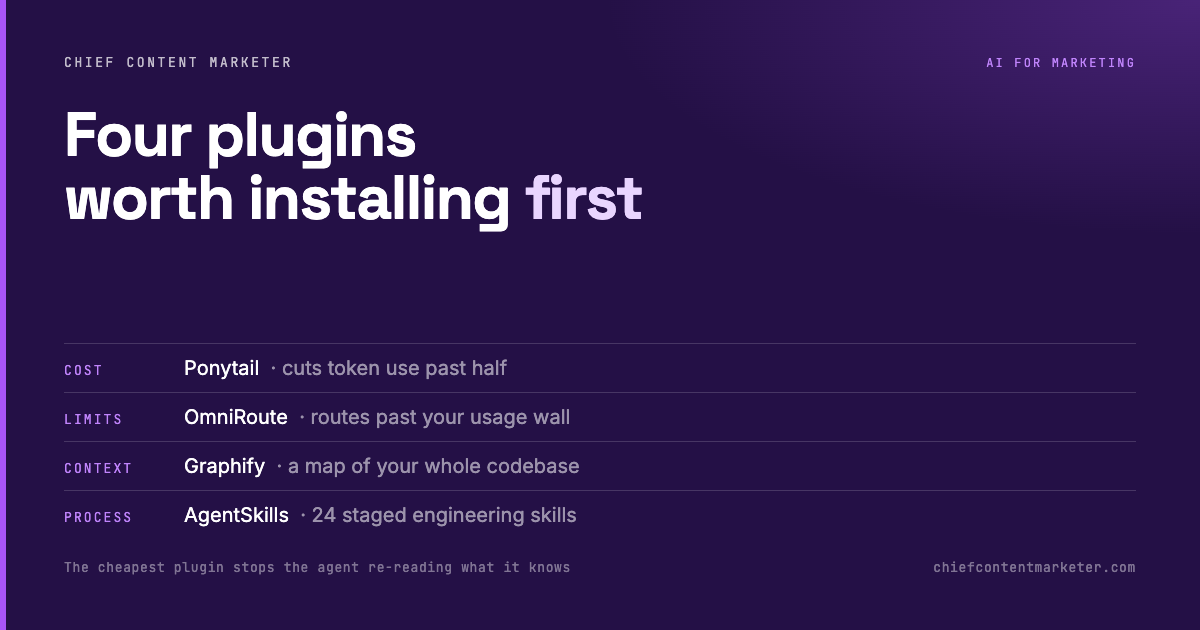




Two things go wrong when you start vibe coding seriously. The bill climbs because every agent turn re-reads context it has already seen, and the output stays mediocre because the agent has no process. Both have plugins. Neither is glamorous, and that is rather the point: the tools that matter in an agentic workflow are rarely the ones that write the clever code. They are the ones that stop the agent wasting money and making the same mistake twice.
Think of them in two pairs. Two attack cost and limits, which is what kills a project quietly once you scale past a demo. Two attack context and process, which is what quietly keeps the output generic no matter how good the model gets. Most people install none of them and then wonder why an agent that aces a toy problem flails on a real repository.
Cut the tokens without cutting the quality
Ponytail optimises Claude Code output and claims to cut token use by more than half with no loss of accuracy. In a workflow where the same files are read on every turn, this is the plugin that pays for itself first. The reason is structural: an agent conversation is largely a re-reading machine, and anything that trims the redundant reads compounds with every turn, which is why the savings scale with how long you keep the session open.
Stop hitting the usage wall
OmniRoute connects Claude Code to more than three hundred other providers, so when your limit runs out it switches you to the next best model instead of stopping work. It claims up to 1.6 billion free tokens a month across those routes. Treat that number as a ceiling rather than a promise, but the fallback behaviour alone is worth having: the difference between an agent that stalls at the cap and one that keeps working is the difference between finishing today and finishing next week.
Give the agent a map of your codebase
Graphify turns your whole codebase into a knowledge graph. The practical effect is that your agent stops burning tokens re-reading files just to work out where things live. On a repository past a few hundred files this is the difference between an agent that navigates and one that explores, and exploring is expensive: every wrong turn is a file read you paid for and a token spent that did not move the work forward.
Borrow a senior engineer’s habits
AgentSkills is a pack of twenty-four skills covering planning, coding, testing and publishing, built by a former AI engineering director at Google. It activates the right skill at the right stage on its own, which is the part that matters: a structured engineer does not jump from idea to code, and neither should an agent. The skills encode the order of operations that separates someone who ships from someone who produces impressive fragments.
What to install first
Start with the cost plugin and the codebase graph, because they compound with project size and cost nothing in process change. Add the skills pack when you want the agent to behave like a team rather than a very fast intern. Treat provider routing as the last one in, once you have decided what you are comfortable sending off your machine.
If you only take one thing from this list, take the framing: the highest-leverage plugin is almost never the one that makes the agent smarter. It is the one that removes the waste that was quietly capping everything else.
Install one, measure for a week
The temptation is to install all four at once and feel productive. Resist it. The value of these plugins is that each removes a specific, measurable tax, and if you bolt them on together you will never know which one earned its place. Add the cost plugin first, keep a rough eye on your usage for a week, and you will see the drop in a way you can attribute. Then add the codebase graph and watch how much less the agent wanders.
This matters because an agentic workflow compounds in both directions. A little waste, left in place, multiplies with every turn until a project that should take an afternoon takes three days. A little discipline, applied early, does the reverse. The plugins are not features so much as a set of small structural fixes, and structural fixes are the ones that keep paying after you have forgotten you made them.

Treat the list as a checklist you work through over weeks, not a shopping spree. One in, one measured, one kept. That is how a vibe-coding setup stops being a demo and starts being something you can trust on real work.