
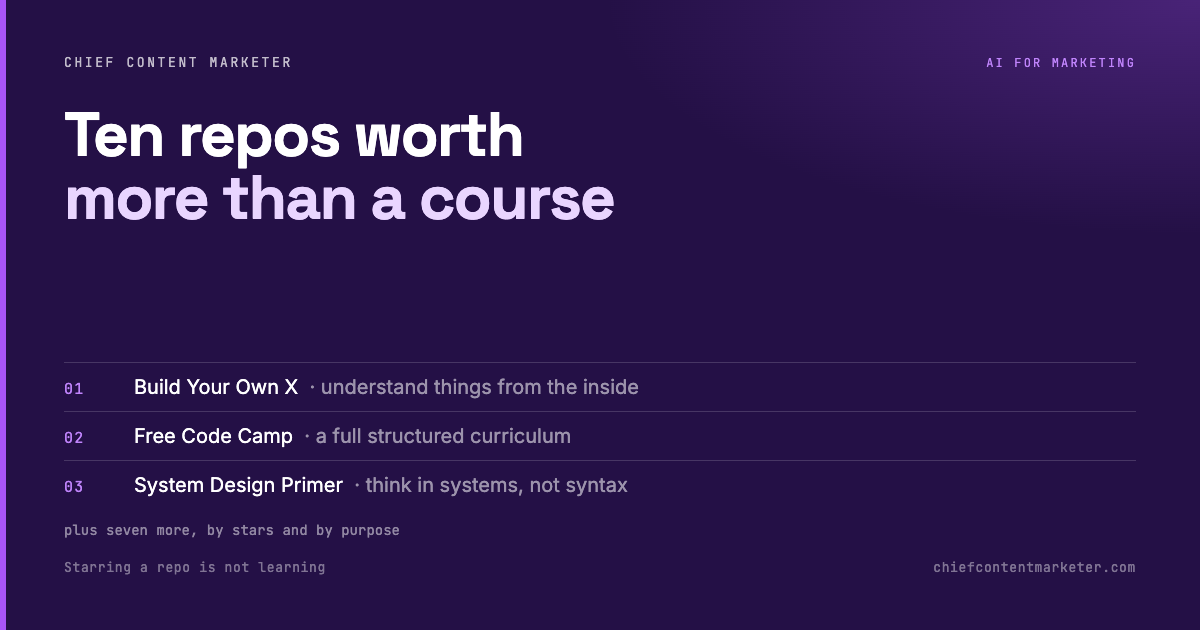




GitHub is the largest free learning resource in software and most developers use it as a filing cabinet. These ten repositories are the ones that turn it into a curriculum. Every one has at least 280,000 stars, which is a decent proxy for still worth reading years later, because a repository only accumulates that many stars by being genuinely useful to people who had no incentive to be generous.
The reason to trust this over a paid course is not that free is better. It is that these repositories are maintained in the open, by the people who use them, and updated when they go stale. A course is a snapshot. A well-starred repository is a living document, and the difference shows up a year in, when the course is teaching you a stack that has moved on.
Learn how things actually work
Build Your Own X sits near 500,000 stars and teaches from the inside out: step-by-step tutorials for building databases, operating systems, web servers, programming languages and more. When you want to understand a technology rather than use it, this is where you start. Using a database teaches you its syntax. Building one teaches you why it behaves the way it does, and that knowledge transfers to every database you touch afterward.
Discovery, curated
Awesome, around 510,000 stars, is a directory of curated lists covering Python, JavaScript, machine learning, DevOps, security, databases and nearly anything else. Public APIs, around 480,000, is a categorised collection that is genuinely useful the moment you need an API for a prototype or a portfolio project. Between the two you have a map of where things are and a source of parts to build with, which is most of what you need when you start something new.
Free, and more rigorous than most paid tracks
Free Code Camp has more than 450,000 stars and is a full open-source learning platform: web development, JavaScript, Python, databases, machine learning, with structured paths and practical projects. Free Programming Books, near 400,000, covers languages, computer science, web and data science in one place. The pair covers the two modes you need, doing and reading, without the completion ceremony that makes paid platforms feel like progress when they are just scheduling.
Think in systems, not syntax
The System Design Primer, over 370,000 stars, teaches scalability, caching, databases, load balancing, queues and distributed systems. It is the repository people return to before a system design interview, and the one that changes how you read any architecture diagram afterward. Syntax gets you hired. Systems thinking is what lets you stay, because the hard problems at scale are never about knowing the language.
Know what to learn, then prove it
Developer Roadmap, over 360,000 stars, gives visual learning paths for front-end, back-end, DevOps, machine learning and data science, in order. Coding Interview University, also over 360,000, is a complete computer science study plan aimed squarely at technical interviews. Awesome Python, past 300,000, collects frameworks, libraries and tutorials. Project-Based Learning, around 280,000, is the one that stops you watching and starts you building.
The toolkit, not the trophy shelf
These ten turn GitHub from storage into a complete learning and development toolkit. The failure mode is collecting them: a starred list on your profile that you never open, which feels like preparation without any of the cost. The fix is picking the one that matches the gap you have this month and finishing something small with it before you move on.
Ten repositories will not teach you to program. One repository, used this month, will teach you more than a course you buy and never finish. The difference is entirely in which one you open first.
How to work a repository properly
A repository is not a book you read cover to cover. It is a workspace, and it rewards a specific kind of attention. Start by cloning it and reading only the README and the first project on the list, not the whole index. The index is a menu; opening the menu is not eating. Pick the single item that matches a problem you already have, and finish it badly before you polish anything. A rough finished project teaches you ten times what a carefully planned unfinished one does.

The second habit is to keep the repository open while you build. These are reference material, and reference material is worthless if you close it the moment you start. When you get stuck, search inside it before you search the web, because the answer is usually already there and already tailored to the thing you are building. That is the entire difference between using a repository and starring it.
Finally, when you finish something, write down the one thing that surprised you. That note is the seed of the next project, and it is the thing a course would have handed you pre-digested. The repositories give you the material. The method is what turns it into skill.