




Your AI Is Not a Bad Writer. Your Brief Is a Bad Manager.
The Content Marketing Institute reports that 62% of marketers use AI for brainstorming and 44% use it for writing drafts. But here is the stat that actually matters: 10% of those marketers say the output requires no editing. The other 90% are spending more time rewriting AI slop than they would spent writing from scratch. The bottleneck is not the model. The bottleneck is the instructions you give the model.
AI models are pattern-matching engines. They predict the most statistically likely next word based on their training data. If you give them a generic brief, they give you the statistical average of everything ever written on that topic. Which is exactly what your audience ignores every day. The solution is not a better model. The solution is a better brief. Here is how to build one.
Define the Insight Before the Topic
Most content briefs start with a keyword: “content marketing strategy,” “demand generation best practices,” “AI for marketing.” This is backwards. A keyword tells AI what to write about. An insight tells AI what to say. The difference is everything.
An insight is a specific, arguable, non-obvious claim that your article proves. “Content marketing strategy” is a keyword. “Most content marketing strategies fail because they optimize for search engines instead of buying committees” is an insight. The keyword tells you the territory. The insight tells you the argument.
How to build it: Before opening any AI tool, write one sentence that completes this prompt: “After reading this article, the reader will believe that ________.” If your answer sounds like something you have read on three other blogs, dig deeper. If your answer could appear on a competitor’s site without anyone noticing, you do not have an insight yet. Keep digging until the answer is specific enough that it could only come from your brand’s perspective.
Build the “Not This” Section
AI models are trained to be agreeable. They default to safe, consensus views because that is what the training data reinforces. If you do not explicitly tell AI what to avoid, it will give you the statistical average of industry opinion — which is indistinguishable from every other AI-generated article in your space.
The “Not This” section is the most important part of any AI content brief and the one almost nobody includes. It explicitly tells the model what conventional takes to avoid, what angles are overdone, and what competitors are already saying.
NOT THIS — What to avoid:
- Do not lead with the "fast-paced digital landscape" throat-clearing opener
- Do not cite the same HubSpot/CMI stats everyone else uses as your primary hook
- Do not conclude with "content is king" or any variation thereof
- Avoid these angles (already covered by competitors): [list 2-3]
- Avoid this framework (overused): [name it]
- Do not use these examples (every AI defaults to them): Netflix, Nike, Apple

THIS — What to target:
- Lead with the counterintuitive insight: [your insight]
- Use data from these specific sources: [your research]
- Frame the problem around: [your audience's specific pain point]
- Conclude with: [specific action, not vague summary]
The “Not This” section works because it constrains the model’s pattern-matching tendencies. Without it, AI reaches for the most common patterns. With it, you have blocked those patterns and forced the model to find less common, more specific alternatives — which is where differentiated content lives.
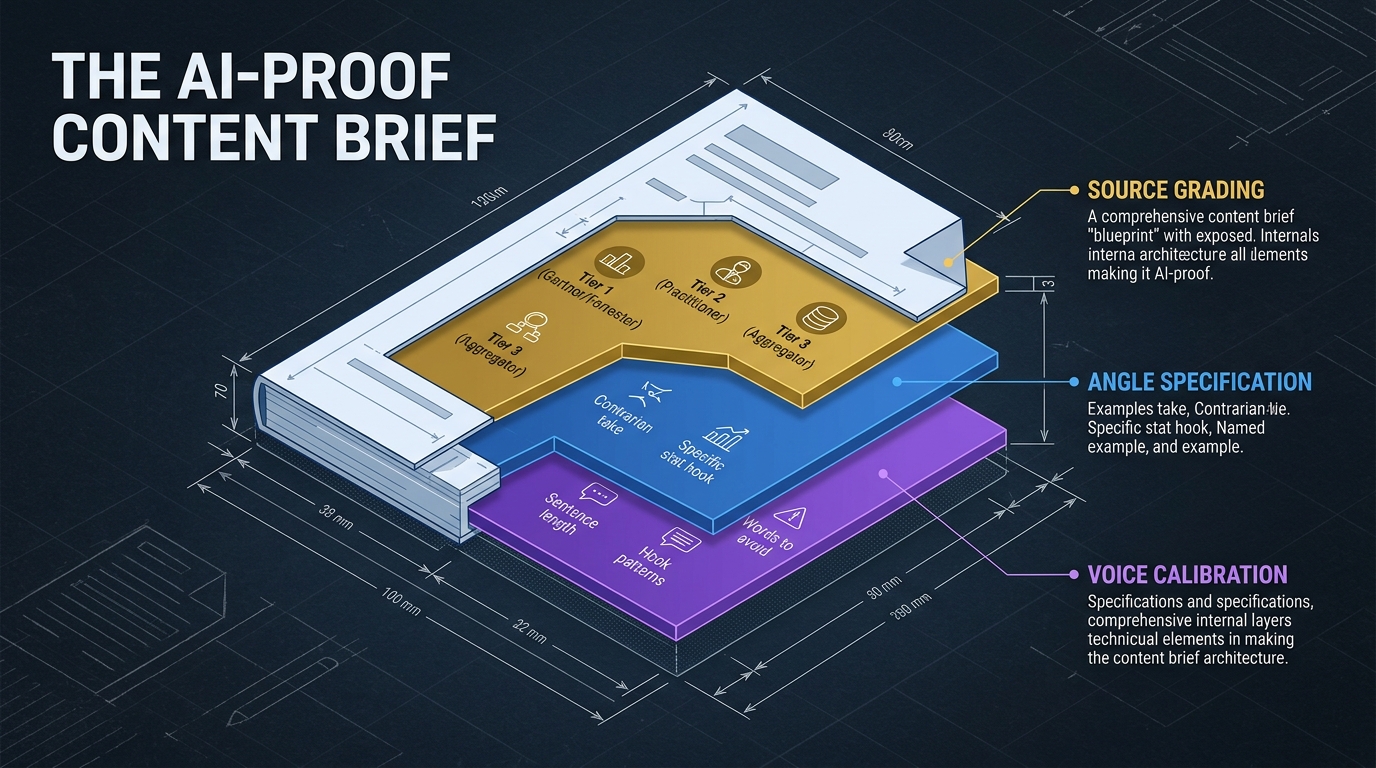
Supply the Source Material
AI models produce generic content because they are working from generic training data. The fix is simple: give them specific data to work from. A content brief should include at least three pieces of source material the model would not otherwise have access to.
Source material types:

1. Internal data. Survey results, customer interview transcripts, sales call recordings, product usage data, win/loss analysis. Anything proprietary that only your company has. AI cannot hallucinate your customer data — but it can synthesize it into compelling content if you provide it.
2. Subject matter expert quotes. Three to five verbatim quotes from internal experts or external sources. AI writes better when it is organizing and contextualizing real human insight rather than inventing fake authority.
3. Competitor gap analysis. Links to 3-4 existing articles on the topic with a one-sentence note on what each one misses. “This article covers the what but not the how.” “Good framework but no data to back it up.” “All theory, no implementation.” This tells the AI exactly where the gap is that your content fills.
Write the Audience Objection Paragraph
Every reader arrives at your content with skepticism. They have been burned by generic advice before. They are scanning for proof that this article is different before committing to reading it. If your AI-generated draft does not preemptively address their objections, they will bounce before paragraph three.
The “audience objection paragraph” is a section in your brief that tells the AI what the reader is thinking but not saying:
“We do not have time to build elaborate briefs for every piece of content.”
“This sounds like it works for enterprise teams with dedicated strategists, not for a team of two.”
“If this is so effective, why is not everyone doing it?”
Your brief should instruct the AI to address each objection directly in the draft. This is not about being defensive — it is about meeting the reader where they actually are. Most AI-generated content sounds like it was written for nobody because it addresses nobody’s specific objections. It just recites information into the void.
Define the Voice as a Constraint, Not a Description
“Professional but conversational” is not a voice description. It is what everyone says when asked to describe their brand voice, and it gives AI exactly zero useful constraints. Voice instructions need to be specific enough that the model can self-correct during generation.
Voice constraint examples that actually work:
The best voice constraints include negative examples — things the AI should NOT do. AI models are better at following “do not” instructions than “do” instructions because “do not” eliminates options, and fewer options means less generic output.
Include the “But Actually” Test
Here is the most effective quality filter I have found for AI-generated content. After the AI produces a draft, run every claim through the “But Actually” test:
-
1Identify every declarative statementGo through the draft and highlight every sentence that makes a claim: “Content marketing builds trust.” “AI is transforming marketing.” “Personalization drives conversions.”
-
2Ask: “But actually…”For each highlighted claim, finish the sentence “But actually…” If the follow-up is more interesting than the original claim — for example, “But actually, most content marketing builds familiarity, not trust, and trust requires risk” — replace the generic claim with the specific follow-up.
-
3Delete anything that fails the testIf a claim does not have an interesting “but actually” behind it, the claim itself is generic. Cut it. The remaining content will be shorter but dramatically more valuable.
Build this test into your brief. Tell the AI: “After you write the draft, run the ‘But Actually’ test on your own output and revise accordingly.” AI models are surprisingly good at self-critique when given a clear framework. It will not catch everything — you still need a human review — but it eliminates the most obvious generic filler before it ever reaches an editor.
Putting It All Together: The 6-Part AI Content Brief
Here is the complete brief template. Fill it out before asking any AI tool to generate content. The 15 minutes you spend on this brief will save you 45 minutes of rewriting generic slop on the back end.
The Content Marketing Institute found that 76% of marketers believe they need specialized skills to remain relevant in the AI era. Building better briefs is one of those skills. It is not flashy. It does not require a new tool or a bigger budget. It requires discipline — the willingness to spend 15 minutes thinking before you spend 15 seconds prompting. That ratio is the entire game.
If you want to go deeper on building AI-native content operations, read our guide to the specialized AI agents every content team needs and our warning about why content volume without quality will destroy your brand.