




Here is the uncomfortable version of the next two years: the content team does not get bigger. It gets smaller, and it stands on a system.
Every content leader I talk to is asking the same question in a different accent. Do we hire another writer, another strategist, or another editor? The better question is a systems question. What produces the work, and who owns the machine that produces it? That question has a new answer, and it is showing up in job postings under a few different names.
The clearest one is content engineer. An AI content engineer designs the system that produces content. A traditional content person produces the content. That is the whole shift, and it splits content marketing into two camps: people who make things, and people who build the machine that makes the things.
I run this system myself, every day, across a live content operation. So this is not a prediction built from conference slides. It is a description of work that is already happening, plus the hiring data that proves the market is catching on.
The Title Is Messy. The Job Is Not.
Companies are inventing the name in real time: content engineer, AI content engineer, marketing AI engineer, AI marketing solutions engineer, GTM engineer, AI search specialist. Ahrefs makes the same point in its 2026 analysis of AI marketing trends: the naming is unsettled, but the direction is not. Marketers are moving from the production level to the system level.
The catch is that three genuinely different jobs are sharing one name. If you post a requisition without knowing which one you need, you will hire the wrong person and blame the role.
| Marketing Content Engineer | AI-Native Technical Content Engineer | AI Product & Model Content Engineer | |
|---|---|---|---|
| Lives in | Marketing | Engineering | Product and AI research |
| Hiring today | Delinea, Tenex, Assured | LlamaIndex | Meta Superintelligence Labs |
| Builds | AI workflows, prompt libraries, agents, evaluators, SEO and GEO systems, CMS automation | Benchmarks, experiments, production code, and the technical write-ups that come from them | Evaluation frameworks, golden datasets, rubrics, quality benchmarks, LLM-as-judge systems |
| Screening signal | “Marketing plus hands-on AI workflow building” | “Production Python, ML, benchmarks” | “Editorial judgment plus evaluation science” |
Most content teams need the first column. It reports into marketing, it does not require a software engineer, and it fixes the problem you have. The other two are different animals, and you should know that before you write the job description.
Production Versus Systems Is the Real Divide
Strip away the titles and the split is clean. One side makes assets. The other side builds the capability that makes the assets. Compare them row by row, and notice where the ground moves: the last row.
That is why the economics changed. A marketer who spends a week on one campaign made one campaign. A marketer who spends that week building an automated research, content, and distribution workflow made an asset that saves hundreds of hours over the next year. Businesses reward compounding capacity, every time.
Engineer the Science, and the Art Comes Back
Here is where I part company with most of the AI-and-content conversation. The dominant fear is that AI strips the art out of content. I think the opposite happens, and I have watched it happen in my own operation.

Content has always had two halves. There is a science: format, structure, voice, knowledge architecture, evaluation, distribution. There is an art: the argument, the insight, the story, the judgment about what is worth saying at all. For most of the last decade the science ate all the time. Writers fought the CMS, reformatted the same layouts, chased approvals, and hand-built derivative assets. The art got whatever energy was left, which was usually none.
Engineer the science and you stop paying that tax. Structure is encoded. Voice is documented and enforced by an evaluator. Knowledge lives in a layer every asset draws from. Distribution runs itself. What is left for the human is the part that matters: deciding what should exist and whether the argument holds.
And here is the part people miss. The system does not replace the art with volume. It gives the art more raw material. When the machine handles formatting, research, and the derivative work, you finally have room to add detail, nuance, real examples, and a point of view. The art gets easier because you have the time and the inputs to do it well.
What a Content Engineer Builds
The deliverable is a loop, not a list of tools. Six layers, each feeding the next, with measurement feeding the top of the stack again.
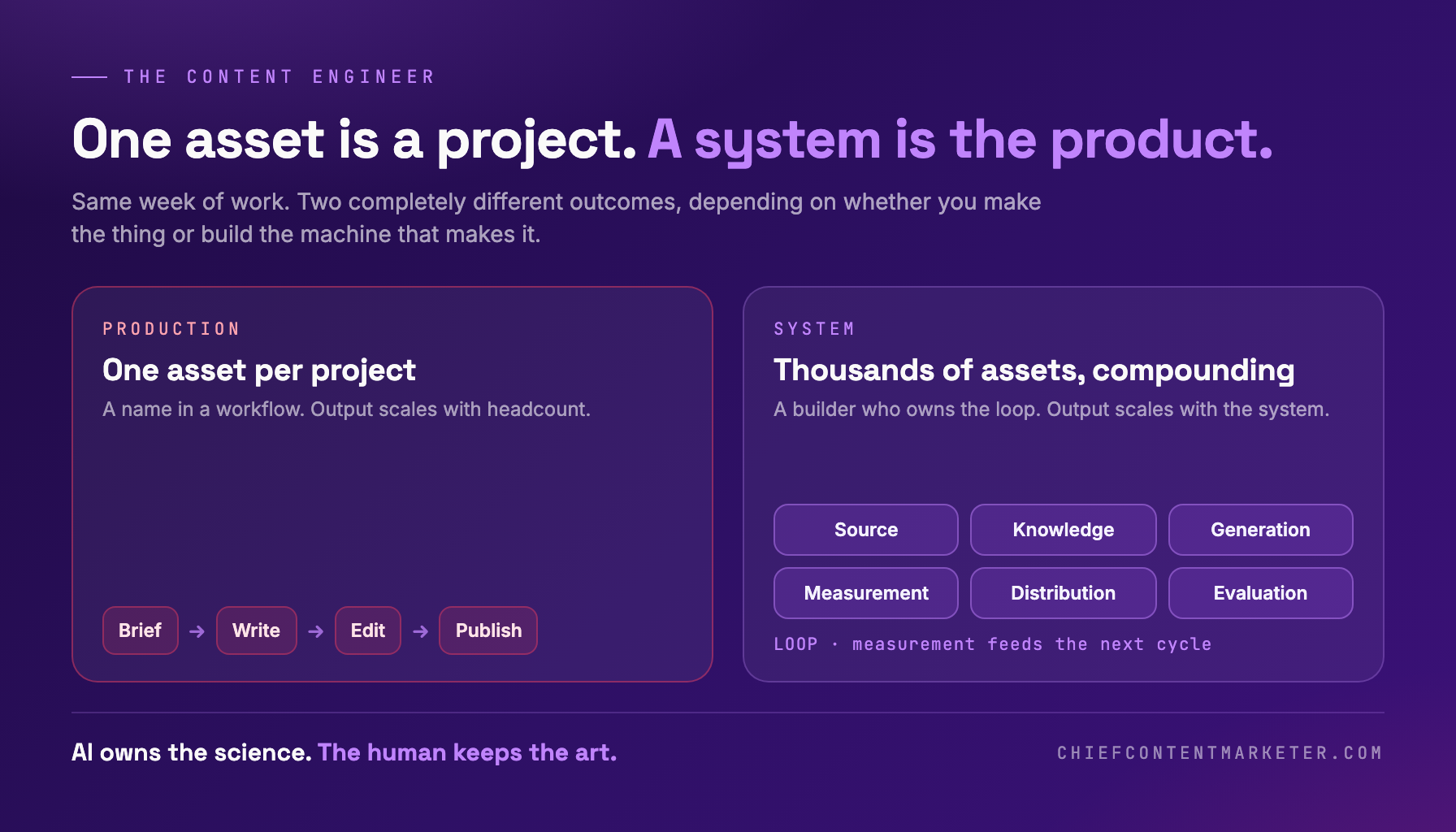
The source layer collects raw truth from customer interviews, sales calls, product documentation, CRM data, and competitive intelligence. The knowledge layer turns that raw material into atoms: claims, proof points, objections, personas, product facts. The generation layer assembles the atoms into every format you publish. The evaluation layer scores each output against accuracy, voice, buyer relevance, and citation potential, and it is the layer most teams skip. The distribution layer pushes to the CMS, social, email, and the AI surfaces that now read your site. The measurement layer grades the whole system and decides what to create, refresh, or retire.
Yext now defines content engineering in almost exactly these terms: content is becoming structured, machine-readable information that has to work across both traditional search and AI systems. That is not a formatting preference. It is distribution.
This Is Not a Thought Experiment. It Is a Job Post.
The reason I am confident about the direction is that companies are already staffing it. Same underlying job, different titles, all live listings.
- Delinea, AI Marketing Solutions Engineer: build AI workflows, agents, prompt libraries, automation, governance, and measurement across marketing. View the role.
- Tenex, Content Engineer: run AI production pipelines, build prompt libraries and agent stacks, develop evaluators, and improve the workflow over time. The posting is explicit that you do not need to be a software engineer, but you do need to build and evaluate the system. View the role.
- Sendbird, Content Engineer: pairs traditional SEO with generative engine optimization and treats AI visibility as part of the content architecture, not an optimization step bolted on at the end. See careers.
- LlamaIndex, AI Content Engineer: the genuinely technical version, housed in engineering, where the person builds benchmarks, runs experiments, and writes the findings that drive adoption. See careers.
- Meta Superintelligence Labs, Content Engineer: focused on how models behave, with evaluation frameworks, golden datasets, rubrics, and LLM-as-judge systems. See careers.
When unrelated companies post descriptions this specific, it is not a trend piece. It is a category forming. I have written before about how specialized AI agents reshape a content team, and this role is the human who owns that stack.
What to Do Monday Morning
You do not need permission or a reorg to start. Four moves, in order.
- 1Audit the unit of workFor one week, log whether your team is producing assets or building capability. If every hour went into a deliverable, you have a production team and no system, and that is the constraint to name out loud.
- 2Stand up the knowledge layer firstBefore you automate generation, build the structured layer underneath it: your claims, proof points, objections, and personas in one place every asset can draw from. Teams that skip this get fast garbage.
- 3Build one evaluator before ten generatorsDefine what good looks like as a rubric, with golden examples. The evaluation layer is what separates a system from a slot machine. It is also the skill that separates a content engineer from a fast writer.
- 4Change the interviewStop asking candidates to show a portfolio. Ask them to walk you through how one piece traveled from idea to measured result, and what they would change about that path. The good answer is a loop with gates. The weak answer is a list of tools.
The Skill Stack Changed, and So Did the Bar
A senior content marketer still needs writing, editorial judgment, strategy, SEO, research, and distribution. The content engineer needs all of it, plus LLMs and structured prompting, agent workflows, APIs and structured data, evaluation frameworks, content schemas, and enough scripting to inspect JSON, call an API, and debug a workflow when it breaks.
That is technical fluency, not software engineering. Tenex says it plainly: you do not need to be an engineer, but you do need to build prompts, agents, and evaluators, and to work comfortably alongside engineers. Delinea expects the same, listing automation platforms, AI tools, and marketing systems as the working stack.
If you want to go deeper on the operating layer underneath all of this, I have written about treating AI content platforms as a marketing operating system and about where your moat sits when everyone has the same tools. The short version: the tools converge. The system you build around them is what differentiates.